When you start learning SEO, one of the first things you’ll come across is Local SEO and Organic SEO. At first, they might sound similar, but they serve different marketing goals and require different ways to measure success. Local SEO helps businesses reach high-intent customers in a specific area who are ready to visit, call, or make a purchase. In fact, 76% of people who search for something nearby on their smartphone visit a related business within a day, while 28% of local searches result in a purchase. Organic SEO, on the other hand, focuses on building long-term visibility by ranking a website for broader search queries and attracting traffic from a wider audience. The top organic Google result also receives an average CTR of 39.8%, showing the value of strong organic rankings.
In this article, I’ll explain how Local SEO and Organic SEO work, how they differ, and which strategy is the right fit for your business goals.
What Is Local SEO?
Local SEO is an SEO strategy that helps businesses appear in location-based search results, making it easier for nearby customers to find their products or services. When users search for terms like "restaurant near me," "electrician in Chennai," or "dentist in Hyderabad," Google often displays the Google Map Pack, where businesses can receive calls, direction requests, and website visits directly from search results.
Unlike Organic SEO, which builds long-term visibility for broader keywords, Local SEO targets geographically specific searches with high purchase intent, often generating faster enquiries and conversions. In fact, 84% of consumers search for local businesses daily, businesses in the Google Map Pack receive 126% more traffic and 93% more customer actions, and 78% of local mobile searches result in an offline purchase.
For example: A user searching for "AC repair near me" is usually looking to book a nearby service immediately, making Local SEO highly effective for businesses that rely on local customers.
How Local SEO Works
Google ranks local businesses by evaluating three key factors:
- Relevance,
- Distance, and
- Prominence
It checks how well your business matches the user's search, how close your location is to the searcher, and how trustworthy your business appears based on reviews, citations, backlinks, and a well-optimized Google Business Profile. These signals help Google decide which businesses appear in the Google Map Pack. For example, between two nearby cafés, the one with complete business information, better reviews, and a stronger online presence is more likely to rank higher.
Local SEO Best Practices
Perfecting your Local SEO strategy requires following a few essential best practices. Here are some of the most effective techniques to improve your local search visibility.
- Keep your Google Business Profile updated: Claim and optimize your Google Business Profile by adding accurate business information, including your name, address, phone number, website, business category, and operating hours. Keeping this information up to date helps Google display your business in relevant local searches.
- Maintain consistent business information: Ensure your business name, address, and phone number (NAP) remain consistent across your website, online directories, and social media profiles. Consistent information builds trust with search engines and improves your local search rankings.
- Encourage and respond to customer reviews: Ask satisfied customers to leave genuine reviews and respond professionally to both positive and negative feedback. Strong customer reviews improve your online reputation while helping your business rank higher in local search results.
- Create location-specific content: If your business serves multiple areas, create dedicated location pages with unique content for each city or region. Pair these pages with relevant local keywords to increase visibility for location-based searches.
- Optimize your website for local users: Ensure your website is fast, mobile-friendly, and provides valuable local content. A well-optimized website delivers a better user experience and supports long-term Local SEO success.
What Is Organic SEO?
Organic SEO is the process of improving a website's visibility in unpaid search results for keywords that are not tied to a specific location. Unlike Local SEO, which helps businesses reach nearby customers, Organic SEO focuses on attracting visitors from regional, national, or global markets. It is ideal for businesses that want to increase website traffic, build brand authority, and generate long-term online growth.
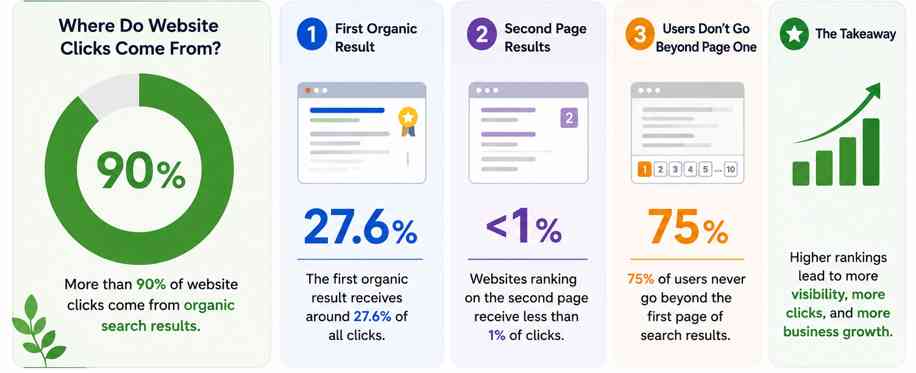
The importance of Organic SEO is reflected in search behaviour. More than 90% of website clicks come from organic search results, while the first organic result receives around 27.6% of all clicks. In comparison, websites ranking on the second page receive less than 1% of clicks, and 75% of users never go beyond the first page. These numbers highlight why achieving higher organic rankings is essential for long-term online visibility.
How Organic SEO Works
Organic SEO works by helping search engines understand that your website provides the most relevant and valuable answer to a user's search query. Unlike Local SEO, which also considers location and proximity, Organic SEO primarily evaluates content quality, search intent, website authority, backlinks, technical SEO, page speed, mobile usability, and user experience.
For example: If two websites publish an article on "How to Choose CRM Software," Google is more likely to rank the page that offers detailed, updated information, loads quickly, earns quality backlinks, and provides a better user experience. Consistently creating valuable content and maintaining a technically sound website improves your chances of ranking for competitive keywords.
Organic SEO Best Practices
Perfecting your Organic SEO strategy requires following a few essential best practices. Here are some of the most effective techniques to improve your website's visibility in search engine results.
- Conduct thorough keyword research: Identify the keywords your target audience uses when searching for products, services, or information related to your business. Focus on relevant keywords with a good balance of search volume and ranking difficulty.
- Create high-quality, keyword-focused content: Publish valuable, original content that naturally includes your target keywords. Well-optimized content helps search engines understand your pages while providing useful information to your audience.
- Use internal linking strategically: Connect related pages across your website using descriptive anchor text. Internal links help search engines crawl your site more effectively while guiding visitors to relevant content and keeping them engaged.
- Improve page speed and website performance: Optimize your website to load quickly on both desktop and mobile devices. Faster websites provide a better user experience, reduce bounce rates, and contribute to stronger organic search rankings.
- Optimize on-page SEO elements: Write compelling title tags, meta descriptions, headings, and image alt text for every page. Proper on-page optimization helps search engines understand your content and increases the chances of ranking for relevant searches.
Local SEO vs Organic SEO: What's the Difference?
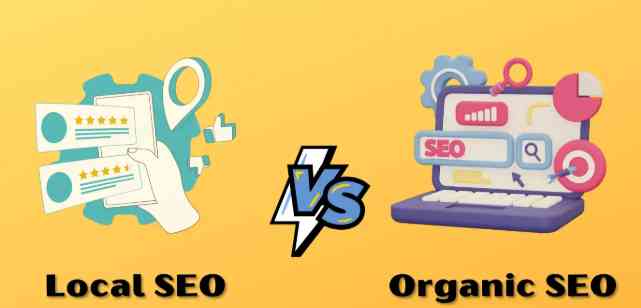
Although both strategies improve search visibility, they target different audiences and business goals. Local SEO focuses on geographically targeted searches to increase store visits, phone calls, and local enquiries, often by appearing in Google's Map Pack. Organic SEO, on the other hand, focuses on ranking for broader keywords to increase website traffic and build long-term brand authority across larger markets.
The difference becomes clear when looking at search intent. A person searching for "emergency plumber near me" usually needs immediate help from a nearby business, making Local SEO more relevant. In contrast, someone searching for "how to fix a leaking tap" is looking for information, making Organic SEO the better fit.
Core Differences at a Glance
|
Feature |
Local SEO |
Organic SEO |
|
Primary Goal |
Increase store visits, phone calls, bookings, and local enquiries |
Increase website traffic, brand visibility, and long-term growth |
|
Target Audience |
Customers within a specific location |
Regional, national, or global audience |
|
Search Intent |
Location-based and "near me" searches |
Informational, commercial, and transactional searches |
|
Key Ranking Factors |
Google Business Profile, proximity, reviews, and local citations |
High-quality content, backlinks, technical SEO, and topical authority |
|
Competition |
Usually lower, making it easier for local businesses to compete |
Usually higher due to national and international competitors |
|
Results |
Often delivers faster results |
Requires consistent long-term effort |
|
Best For |
Restaurants, clinics, salons, retail stores, and local service providers |
SaaS companies, blogs, publishers, and eCommerce businesses |
Key Difference
The biggest difference between Local SEO and Organic SEO lies in the audience they target and the results they deliver. Local SEO connects businesses with nearby customers who are ready to take immediate action, making it highly effective for generating calls, bookings, and store visits. Organic SEO focuses on building long-term visibility for broader search queries, helping businesses attract a larger audience and achieve sustainable website traffic. Rather than choosing one over the other, many businesses benefit from combining both strategies to maximize their online presence.
Similarities Between Local SEO and Organic SEO
Although Local SEO and Organic SEO focus on different audiences, they share the same objective: improving your visibility in search engines and attracting qualified visitors. Both strategies require high-quality content, a technically optimized website, fast loading speeds, mobile responsiveness, and a positive user experience. Google rewards websites that provide reliable information and make it easy for users to find what they need.
Keyword research also plays an important role in both approaches. The difference is that Local SEO targets location-specific searches such as "roofing contractor in Delhi," while Organic SEO focuses on broader keywords that attract users regardless of their location. In both cases, publishing valuable content and maintaining a trustworthy website remain essential for achieving long-term SEO success.
Benefits of Local SEO
Local SEO helps businesses attract nearby customers who are actively searching for their products or services. By improving local visibility, especially in Google Search and the Map Pack, businesses can increase website traffic, customer actions, enquiries, and sales.
- Increases local visibility: Helps businesses appear in local search results and Google's Map Pack.
- Attracts high-intent customers: Reaches people who are actively looking for nearby products or services.
- Generates more customer actions: Customers can quickly view reviews, opening hours, contact details, and directions.
- Builds trust and credibility: Positive reviews, accurate business information, and an optimized Google Business Profile improve customer confidence.
- Supports small businesses: Local businesses can compete more effectively within their specific area instead of competing directly with large national brands.
- Improves conversions: Local search traffic is often more likely to result in enquiries, visits, bookings, or purchases.
Benefits of Organic SEO
Organic SEO helps businesses build long-term visibility by ranking their website for relevant keywords searched by people across different locations. Unlike paid advertising, well-optimized content can continue attracting qualified traffic over time while strengthening brand authority and customer trust.
- Builds long-term visibility: Helps websites rank for relevant keywords and attract traffic over an extended period.
- Reaches a wider audience: Businesses can target customers across a country or even globally, not just in a specific location.
- Generates sustainable traffic: Well-optimized pages can continue bringing visitors for months or years.
- Reduces reliance on paid advertising: Organic rankings can generate traffic without paying for every click.
- Builds brand authority: Consistently publishing helpful content can position a business as a trusted source.
- Supports future conversions: Increased visibility and trust can encourage users to become customers over time.
Local SEO vs Organic SEO: Which One Should You Choose?
The right strategy depends entirely on your business model, target audience, and marketing objectives. Neither approach is universally better, as each solves a different business challenge.
Choose Local SEO If:
- Your business serves customers in a specific city, region, or service area.
- You want to increase phone calls, appointment bookings, store visits, or walk-in customers.
- Your customers usually search for nearby products or services.
- You operate a restaurant, clinic, salon, gym, law firm, repair service, or another location-based business.
Choose Organic SEO If:
- You want to reach customers across multiple locations or nationwide.
- Your business sells products or services online.
- You want to build long-term website traffic and brand authority.
- You operate an ecommerce store, SaaS company, educational website, publishing platform, or other online business.
Should You Use Both?
In many cases, the strongest strategy is combining Local SEO and Organic SEO.
Consider a dental clinic with multiple branches. Local SEO helps each clinic appear when someone searches for "dentist near me," while Organic SEO allows the business to publish educational articles on oral health, attracting visitors who may later become patients.
Similarly, a law firm can rank locally for legal services while building authority through informative guides that answer common legal questions. Combining both strategies expands visibility throughout the customer journey, from initial research to final purchase.
Common Local SEO and Organic SEO Mistakes to Avoid
Both Local SEO and Organic SEO require consistent optimization and attention to important best practices. Avoiding common mistakes can help businesses improve rankings, attract the right audience, and achieve more sustainable results.
- Ignoring search intent: Targeting keywords without providing the information users are actually looking for can lead to high bounce rates and poor engagement. Content should match the user's needs and the reason behind their search.
- Having a slow website: Poor loading speed can negatively affect user experience and search performance. A slow website may cause visitors to leave before the page fully loads.
- Neglecting mobile optimization: A website that does not work well on mobile devices may lose visitors and rankings. Since many users search on mobile, pages should be easy to navigate on smaller screens.
- Ignoring technical SEO: Issues such as broken links, indexing problems, and poor site structure can affect visibility. Regular technical audits can help identify and fix these problems.
- Neglecting the Google Business Profile: An incomplete or outdated profile can reduce local visibility. Businesses should keep their information, services, photos, and other details updated.
- Using inconsistent business information: Different names, addresses, or phone numbers across directories can create confusion. Consistent information helps search engines and customers identify the correct business.
- Publishing low-quality content: Creating large amounts of thin or unhelpful content instead of valuable, detailed resources can weaken a website's overall quality. Businesses should focus on content that genuinely answers user questions.
- Expecting immediate results: SEO is a long-term strategy that requires regular updates, monitoring, and continuous optimization. Rankings and traffic often take time to improve, so consistent effort is essential.
Conclusion
Understanding the difference between Local SEO vs Organic SEO helps you choose an SEO strategy that aligns with your business goals and target audience. Local SEO is ideal for attracting nearby customers, while Organic SEO builds long-term visibility and drives consistent website traffic. Rather than choosing one over the other, many businesses achieve the best results by combining both strategies. This balanced approach improves online visibility, attracts qualified customers, and supports sustainable business growth.
Frequently Asked Questions
1. Can Local SEO improve online sales?
Yes. Although Local SEO is often associated with physical stores, it can also increase online sales by helping nearby customers find your business through location-based searches. Businesses offering online ordering, bookings, or local delivery often see higher conversions because users searching locally usually have strong purchase intent.
2. Does Organic SEO help local businesses?
Yes. Organic SEO helps local businesses attract visitors searching for information related to their products or services. Publishing useful content, answering common customer questions, and improving website authority can generate additional traffic beyond local search results while supporting overall brand credibility.
3. How much does Local SEO cost compared to Organic SEO?
The cost depends on your industry, competition, and business goals. Local SEO is often more affordable for small businesses because it targets a limited geographic area. Organic SEO usually requires a broader content strategy, technical optimization, and ongoing link building, making it a longer-term investment.
4. Can I do Local SEO and Organic SEO without hiring an SEO agency?
Yes. Many businesses manage basic SEO tasks themselves, including optimizing their website, creating helpful content, maintaining a Google Business Profile, and collecting customer reviews. However, highly competitive industries often benefit from professional SEO expertise to achieve stronger results.
5. What tools are best for Local SEO and Organic SEO?
Several tools can support both strategies. Google Search Console and Google Analytics help monitor website performance, while Google Business Profile is essential for Local SEO. Keyword research platforms such as Ahrefs, Semrush, and Moz can assist with keyword analysis, competitor research, backlink monitoring, and overall SEO performance.
People are also reading