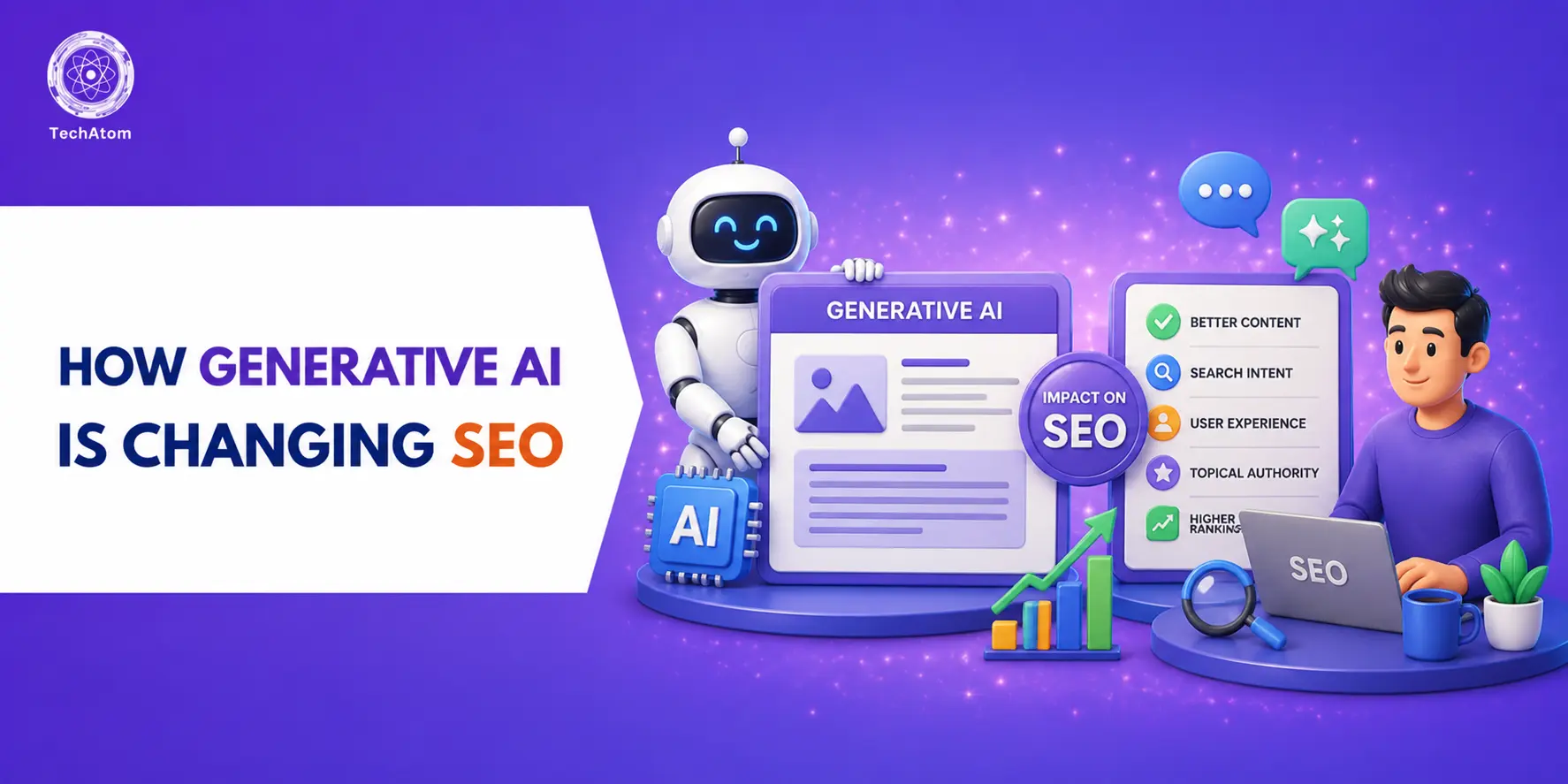
Search is undergoing one of its biggest transformations since the launch of modern search engines. The rise of generative AI is changing how users discover information, shifting search behavior from traditional keyword-based queries to more conversational interactions. Gartner predicts that traditional search engine volume could decline by 25% by 2026 as users increasingly turn to AI-powered assistants and generative search experiences. At the same time, technologies such as Google's AI Overviews are reshaping how information is presented, creating new challenges and opportunities for SEO professionals.
For businesses and marketers, this shift is redefining how search visibility is earned. Traditional ranking factors like keywords and backlinks remain important, but they are no longer enough on their own. Search visibility increasingly depends on how well content can be understood, trusted, and referenced by AI systems when generating responses.
What Is Generative AI in Search?
Generative AI in search refers to AI systems that do not just show a list of links but directly generate answers for users. Instead of making users click multiple websites, AI tools like search assistants and AI Overviews collect information from different sources and summarize it into a single response.
This changes how information is consumed because users get faster and more direct answers. As a result, websites now need to focus not only on ranking in search results but also on being included in AI-generated responses.
How AI Understands Content Through Entities
Modern AI search systems do not depend only on keywords. They understand content through entities such as topics, brands, people, and concepts, along with the relationships between them.For example, SEO, Google, search intent, and rankings are connected in meaning rather than treated as separate words.
This approach allows AI systems to interpret the real context of content. When an article clearly defines concepts and maintains consistency in terminology, it becomes easier for AI systems to understand and use it in generated answers. In 2026, entity clarity plays a more important role than keyword repetition.
Traditional SEO vs Generative AI SEO
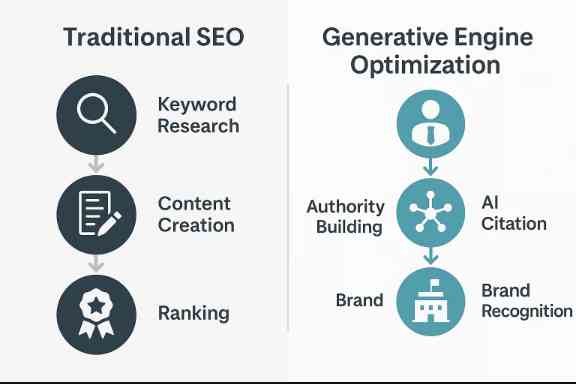
Traditional SEO mainly focuses on ranking web pages higher in search engine results using keywords, backlinks, and on-page optimization. The main goal was to attract clicks from users visiting websites.
Generative AI SEO is different. The focus is shifting from just ranking to being cited or referenced in AI-generated answers. Instead of only targeting keywords, content must be structured, trustworthy, and easy for AI systems to understand.
|
Feature |
Traditional SEO |
Generative AI SEO (GEO/AEO) |
|
Primary Goal |
Rank higher in search results and earn clicks |
Become a trusted source cited in AI-generated answers |
|
Visibility Metric |
Rankings, impressions, and organic traffic |
AI citations, brand mentions, and answer visibility |
|
Content Focus |
Keywords and search intent |
Context, authority, and comprehensive answers |
|
Content Structure |
Optimized for crawlers and SERPs |
Optimized for AI understanding and entity recognition |
|
Key Success Factors |
Backlinks, keywords, technical SEO |
Authority, trust, structured data, and topical depth |
|
User Interaction |
Users click through to websites |
Users often get answers directly from AI systems |
|
Main Objective |
Drive website traffic |
Increase visibility within AI-generated responses |
Semantic SEO and Topic Based Structure
Search engines and AI systems now focus on overall topic understanding instead of individual pages. This has increased the importance of structured content that demonstrates complete subject coverage. A strong topic based structure usually includes a central core article supported by related content that covers subtopics in detail. Internal linking between these pages helps AI systems understand how the information is connected.
This structure improves clarity, strengthens authority, and helps search systems identify expertise on a subject.
Why Generative AI Is Reshaping Search Engines
Generative AI is changing the way search engines deliver information to users. Traditionally, search engines displayed a list of web pages and users had to visit multiple sites to find answers. Today, AI-powered search experiences can analyze information from different sources and generate direct responses within the search results page.
This shift is reducing the importance of traditional click-based search behavior. Users can often find answers without leaving the search engine, which contributes to the rise of zero-click searches. According to recent studies, zero-click searches have reached 68%, showing how user behavior is evolving.
For businesses, this means visibility is no longer limited to ranking on the first page. Content must also be optimized to become a trusted source that AI systems can reference when generating answers.
The Shift From Traditional SEO to Answer Engine Optimization
For years, SEO focused on improving rankings for keywords and driving users to websites. In 2026, visibility within AI-generated responses is becoming just as important as traditional rankings.
This shift has led to the rise of Answer Engine Optimization (AEO), which focuses on helping content appear in AI-generated answers. Instead of optimizing only for search engines, businesses now need to create content that AI systems can easily understand, trust, and cite.
The goal is no longer just earning a click. It is becoming a reliable source of information that appears within AI-powered search results.
The Impact of Generative AI on Organic Traffic
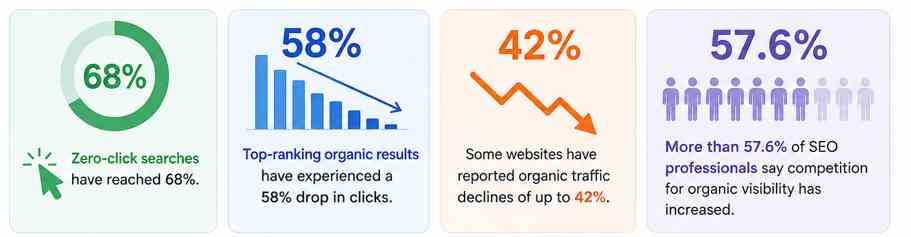
Generative AI has significantly changed traffic patterns across the web. Search engines now provide detailed answers directly on search result pages, reducing the need for users to click through to websites.
Recent studies highlight the scale of this change:
- Zero-click searches have reached 68%.
- Top-ranking organic results have experienced a 58% drop in clicks.
- Some websites have reported organic traffic declines of up to 42%.
- More than 57.6% of SEO professionals say competition for organic visibility has increased.
These numbers show that ranking on the first page is no longer enough to guarantee traffic.
How AI Breaks Down and Uses Content
AI systems do not always read web pages in a linear way. Instead, they break content into smaller meaningful sections such as definitions, explanations, and key points. Because of this behavior, content that is clearly structured has better visibility. Short paragraphs, direct explanations, and well defined sections improve how easily AI can process and present information. Content designed in a structured format is more likely to appear in AI generated answers because it is easier to extract and summarize.
How User Behavior Is Changing
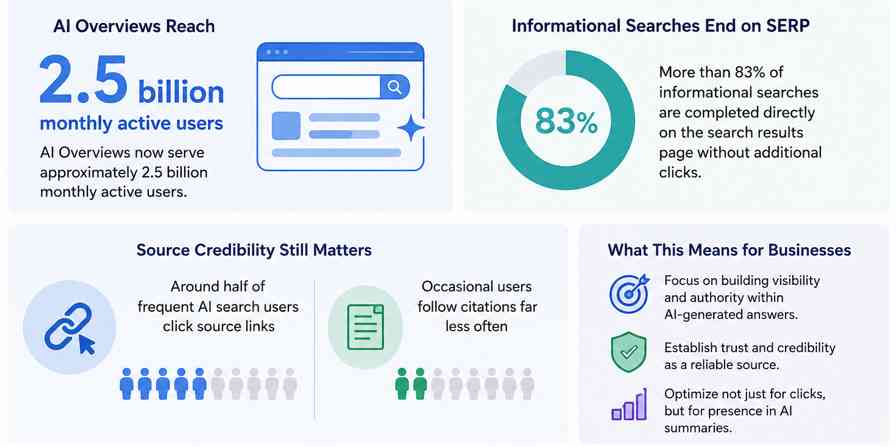
User behavior is evolving alongside AI-powered search. Instead of browsing multiple websites, users increasingly rely on instant summaries generated by AI systems. AI Overviews now serve approximately 2.5 billion monthly active users. Research also shows that more than 83% of informational searches are completed directly on the search results page without additional clicks.
However, source credibility still matters. Around half of frequent AI search users click source links when they want deeper information, while occasional users follow citations far less often. This change means businesses must focus not only on attracting clicks but also on building visibility and authority within AI-generated answers.
Key SEO Strategies for 2026
Businesses that want to remain competitive must adapt to the changing search landscape.
- Focus on Source Citations: AI systems often pull information from trusted sources. Creating clear, accurate, and well-structured content increases the likelihood of being cited in AI-generated responses.
- Publish Original Research and Data: As more content is produced online, unique information becomes increasingly valuable. Original studies, surveys, and industry insights help establish authority and improve citation opportunities.
- Strengthen Topical Authority: Rather than targeting individual keywords, businesses should build comprehensive content around key topics. This helps search engines and AI systems recognize expertise.
- Improve Content Structure: Clear headings, concise answers, schema markup, and organized content make information easier for search engines and AI systems to process.
- Prioritize E-E-A-T: Experience, Expertise, Authoritativeness, and Trustworthiness remain essential ranking factors. Content supported by expert knowledge and credible sources is more likely to earn visibility.
The Marketing Measurement Challenge
Traditional SEO metrics such as rankings and organic traffic no longer provide a complete picture of performance. Despite the rapid growth of AI-powered search, only 14% of marketers actively track AI visibility. Many organizations still focus solely on traffic while ignoring how often their content appears in AI-generated answers. As search continues to evolve, businesses must begin measuring:
- AI citations
- Brand mentions
- Answer engine visibility
- Share of voice across AI platforms
These metrics provide a more accurate view of online visibility in 2026.
How Small Businesses Can Adapt to AI Search
Small businesses need to adapt to AI search because over 60% of Google searches now end without a click as users get answers directly on the results page (SparkToro research). AI-powered summaries and tools like Google’s AI Overviews are changing how information is shown, delivering instant answers across a growing share of search queries worldwide. Around 46% of all Google searches have local intent, so updating business listings and using structured data is essential for visibility in AI-driven results.
Businesses should focus on natural language keywords and question-based content since users now search in more conversational and AI-like ways. By combining SEO, high-quality content, and strong local optimization, small businesses can improve their chances of appearing in AI search results and attracting more customers.
Common Mistakes in AI SEO
Many websites are struggling in the AI-driven search era because they are still using outdated SEO methods. These mistakes can reduce visibility in both traditional search and AI-generated answers.
- Focusing only on keywords: Many creators still focus on repeating keywords instead of covering topics in depth. However, AI systems understand context, so content must be topic-based, not keyword-stuffed.
- Ignoring content structure: Poorly structured articles with long paragraphs and no clear headings are harder for AI systems to process. Clear headings, bullet points, and logical flow improve readability and AI understanding.
- Not giving direct answers: AI prefers content that answers questions quickly and clearly. If the content is too long-winded or unclear, it is less likely to be used in AI responses.
- Lack of topical authority: Publishing random articles on unrelated topics weakens authority. Websites that focus deeply on one niche are more likely to be trusted and cited.
- Over-relying on traditional rankings: Ranking on Google’s first page is no longer enough. Even top-ranking pages may lose traffic if AI provides direct answers without clicks.
- Weak E-E-A-T signals: Content without expertise, credibility, or trust signals has lower chances of being selected by AI systems. Strong author information, data, and reliable sources are important.
Conclusion
Generative AI is changing SEO by transforming how information is delivered and consumed. Traditional search traffic is declining, zero-click searches are increasing, and AI-generated answers are becoming a major source of visibility. To remain competitive, businesses must move beyond keyword-focused optimization and invest in Answer Engine Optimization, topical authority, original research, and trustworthy content. The brands that adapt to these changes will be better positioned to maintain visibility and attract audiences as search continues to evolve.
Frequently Asked Questions
1. How is generative AI changing SEO in 2026?
Generative AI is changing SEO by shifting search results from traditional link-based listings to AI-generated answers. Instead of users clicking multiple websites, AI systems now summarize information directly in search results, reducing organic traffic and increasing the importance of being cited in AI responses.
2. What is AI SEO or Answer Engine Optimization (AEO)?
AI SEO, also known as Answer Engine Optimization (AEO), is the process of optimizing content so it appears in AI-generated answers. It focuses on structured content, clear explanations, authority, and relevance so that AI systems can easily understand and reference the information.
3. Will SEO become obsolete because of AI search?
No, SEO will not become obsolete, but it is evolving. Traditional ranking signals like keywords and backlinks still matter, but SEO is now expanding to include AI visibility, content authority, and citations in generative search results.
4. How can I rank in AI-generated search results?
To appear in AI-generated results, you need to create high-quality, structured, and trustworthy content. Focus on clear answers, topical authority, E-E-A-T principles (Experience, Expertise, Authoritativeness, Trustworthiness), and well-organized information that AI systems can easily process.
5. What is the difference between traditional SEO and AI SEO?
Traditional SEO focuses on ranking web pages in search engines to get clicks, while AI SEO focuses on getting content included or cited in AI-generated answers. The goal has shifted from just driving traffic to becoming a trusted information source for AI systems.
People are also reading