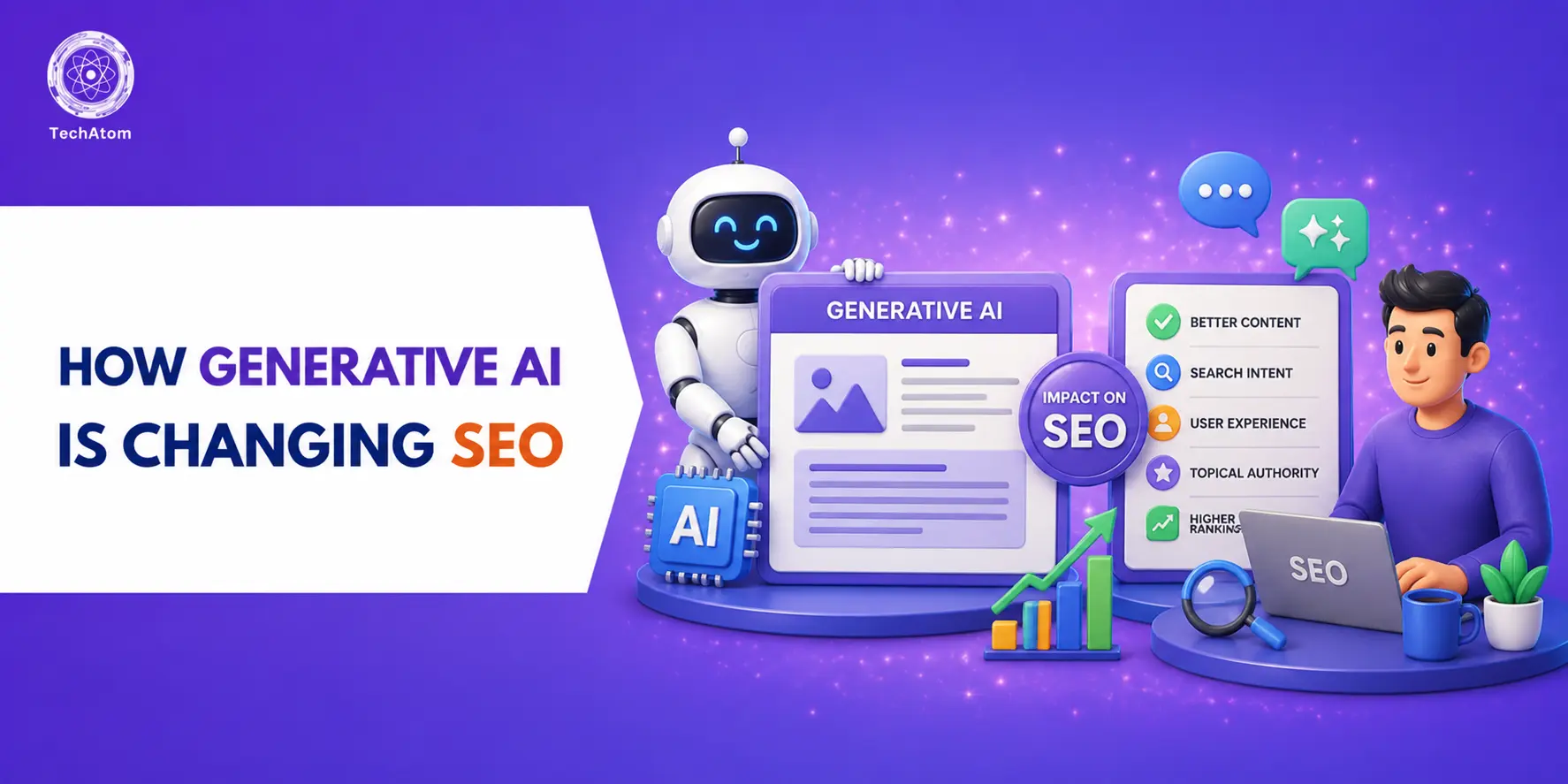

Search is no longer just a list of results. It has become an answer system.From 2000 to 2023, visibility meant ranking on Google’s search results pages. From 2024 onward, visibility expanded beyond rankings to include citations, references, and recommendations inside AI-generated answers.
Today, users increasingly rely on AI-generated answers instead of browsing multiple search results. They ask systems like ChatGPT, Perplexity, Gemini, and Google AI Overviews and receive instant, synthesized answers in seconds. This shift has quietly reshaped the entire foundation of SEO.
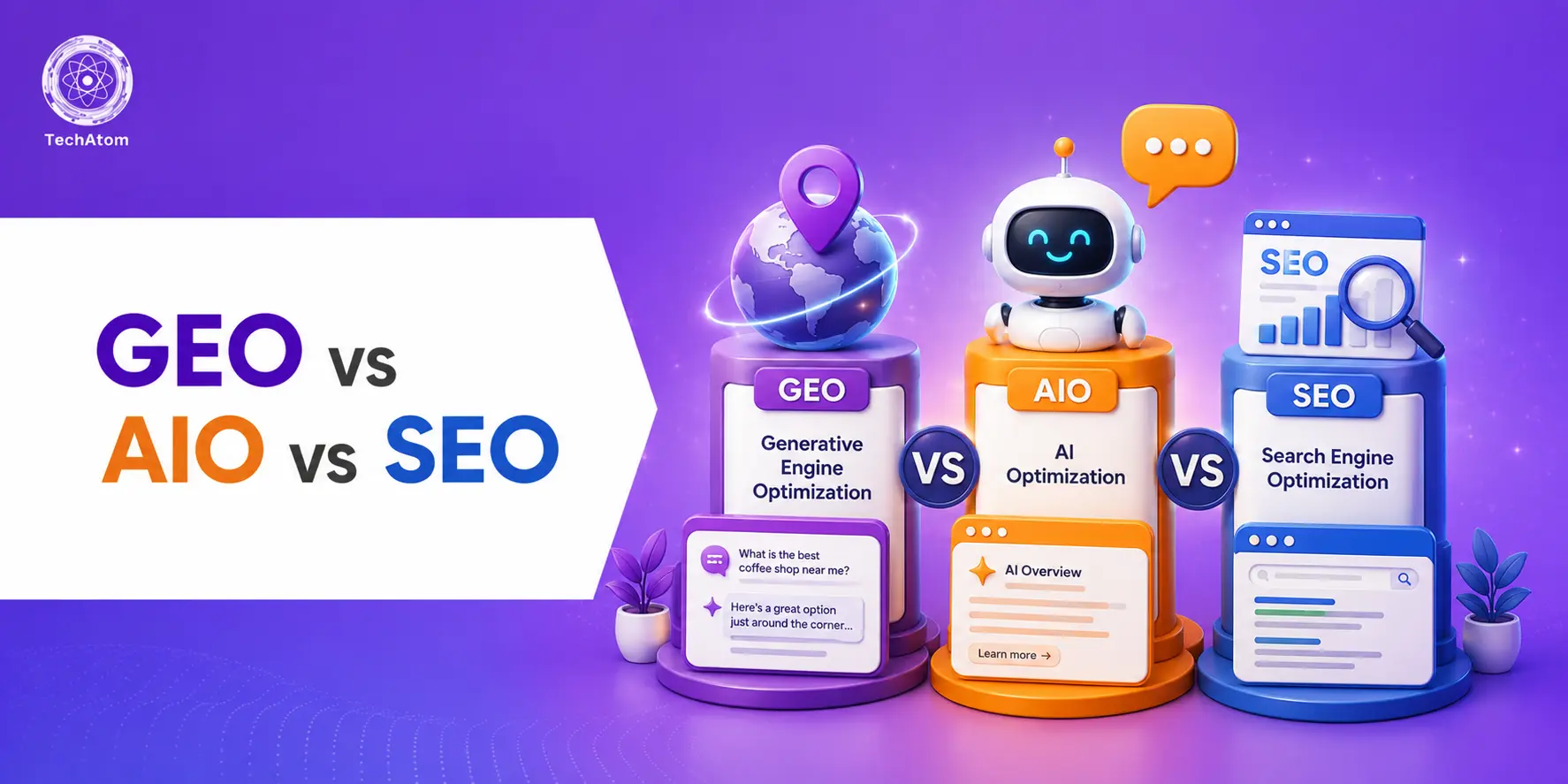
Because search visibility is no longer a single layer. It now exists in three distinct forms:
- SEO: ranking in traditional search results
- GEO: being cited in AI-generated answers
- AIO: optimizing content for AI discovery and recommendations
Most websites are still optimizing for only one of these layers.
And that’s where the biggest visibility gap and opportunity exists today.
What Is SEO?
SEO (Search Engine Optimization) is the process of improving a website’s visibility in traditional search engine results like Google and Bing. It focuses on helping web pages rank higher when users search for relevant keywords.
Main Goals of SEO
- Higher search rankings
- More organic traffic
- Better click-through rates
- Increased conversions
Check Also: Best SEO Practices
Core SEO Components
- Keyword research
- Technical SEO
- On-page SEO
- Link building
- Content optimization
- User experience
Why SEO Still Matters in 2026
Even in the AI era, SEO remains the foundation of visibility because:
- AI systems rely on search indexes (Google + Bing)
- Indexes depend on backlinks and authority signals
- Well-ranked pages are more likely to be retrieved by AI tools
SEO is not replaced it is the base layer of GEO and AIO
What Is GEO (Generative Engine Optimization)?
GEO is the practice of optimizing content so AI systems can find, understand, and cite it inside generated answers.
Instead of ranking on search pages, the goal is to become part of the AI’s response itself.
GEO Objectives
- Get cited in AI-generated answers
- Improve visibility in AI tools
- Increase content inclusion in responses
- Build topical authority
GEO Platforms
- ChatGPT Search
- Perplexity AI
- Gemini
- Claude
- Google AI Overviews
How GEO Works
AI systems evaluate content based on how clear, relevant, and trustworthy it is. Content that is well-structured, fact-based, and easy to interpret is more likely to be cited.
Content must be:
- structured
- easy to extract
- fact-based
- clearly answer-driven
Content Types That AI Systems Prefer to Cite
Not all content has equal chances of being used in AI-generated answers.
AI prefers:
- Step-by-step guides
- Data-driven or research content
- Clear Q&A structured answers
- Comparison articles
- Unique insights or original analysis
- Tools, frameworks, or structured explanations
The more “explainable” your content is, the more likely it is to be cited.
Content That Gets Ignored vs Cited
Not all content has equal chances of being used by AI.
Low chance content:
- shallow blog posts
- keyword-stuffed pages
- generic summaries
High chance content:
- structured explanations
- step-by-step guides
- comparison breakdowns
- original insights or frameworks
The deeper and more structured the content, the more “citation-worthy” it becomes.
What Is AIO (AI Optimization)?
AIO (AI Optimization) focuses on making brands, products, and entities appear in AI-generated recommendations.
Unlike GEO, which targets citations, AIO is about being mentioned or suggested by AI systems.
AIO Goals
- Brand mentions in AI answers
- Product recommendations
- Entity recognition
- Strong semantic authority
Example of AIO
Question: “Best project management software?”
AI response may include: Asana, Monday.com, ClickUp
These brands benefit from AIO because AI systems directly recommend them based on relevance and authority.
Semantic Brand Positioning (Core of AIO)
AI systems don’t just recognize brands they understand what a brand consistently represents.
For AIO success, a brand must appear in:
- Clear problem-solution contexts
- Consistent topic associations
- Repeated semantic environments
Clarity beats complexity. A brand that does “one thing clearly” is more likely to be recommended than a brand that does “many things vaguely.”
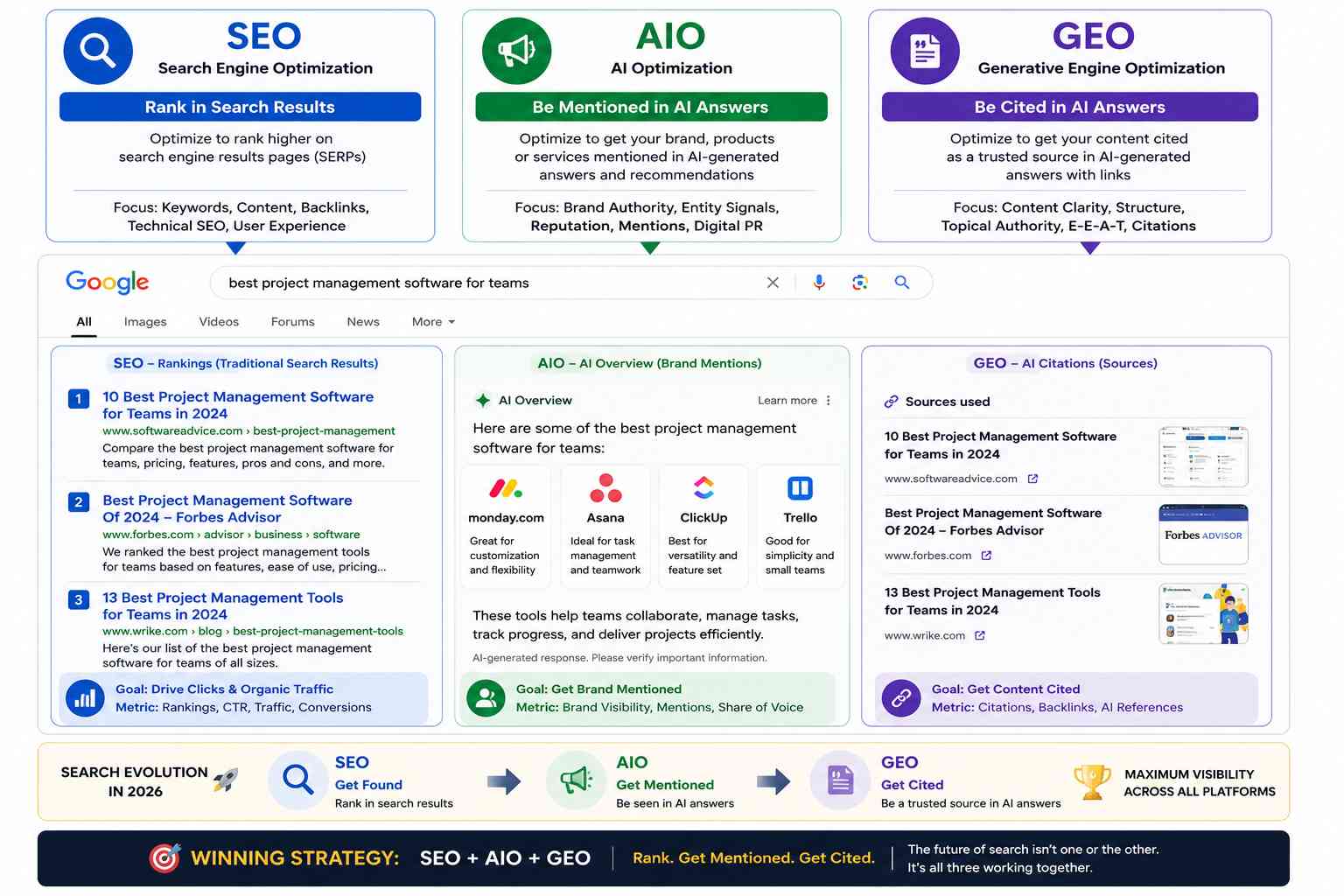
GEO vs AIO vs SEO: Key Differences
|
Feature |
SEO (Search Engine Optimization) |
GEO (Generative Engine Optimization) |
AIO (AI Optimization) |
|
Main Goal |
Rank on search engines |
Get cited in AI-generated answers |
Get mentioned or recommended by AI |
|
Focus |
Websites & SERPs |
AI answer engines |
AI recommendations & entities |
|
Visibility Type |
Search rankings (links) |
Citations in AI responses |
Brand/product mentions |
|
Platforms |
Google, Bing |
ChatGPT, Perplexity, Gemini, AI Overviews |
ChatGPT, Copilot, Gemini, Claude |
|
User Behavior |
Click links to find answers |
Read AI-generated summaries |
Trust AI suggestions |
|
Key Strategy |
Keywords, backlinks, content SEO |
Structured, authoritative content |
Brand authority & entity optimization |
|
Outcome |
Website traffic |
AI citations & visibility |
Brand awareness & recommendations |
How Google AI Overviews Are Changing Search
Google AI Overviews are reshaping how users interact with search results by providing direct, AI-generated answers at the top of the page. Instead of relying only on traditional blue links, users now see summarized responses with selected sources.
Reduced Clicks
More users are getting answers directly on the search page, which reduces the need to click through to websites. This has led to a noticeable drop in organic click-through rates for many informational queries.
Increased Visibility Opportunities
While clicks may decrease, visibility opportunities have expanded. Websites that are referenced in AI-generated summaries can gain exposure even without ranking in the top traditional positions.
Featured Sources
AI Overviews pull information from multiple trusted websites and highlight them as supporting sources. Being included as a cited source has become a new form of search visibility.
Citation Competition
Instead of competing only for rankings, websites now compete for inclusion in AI-generated citations. Content quality, clarity, and authority play a major role in being selected.
Impact on Organic Rankings
Traditional SEO rankings still matter, but they are no longer the only factor. Even high-ranking pages may receive fewer clicks if AI Overviews fully answer the user’s query above the results.
The Rise of Zero-Click Search
AI-powered search is driving the growth of zero-click searches, where users get answers directly on the search results page. According to SparkToro's 2026 data, 68% of Google searches now end without a click, and studies show this can rise to 72% when AI Overviews appear. As a result, being cited in AI-generated answers is becoming just as important as earning website traffic.
Real-World Example: Project Management Software
Let’s take a SaaS company offering project management tools.
SEO Strategy:
- Target keywords like “best project management software”
- Build comparison pages
- Earn backlinks
GEO Strategy:
- Write deep guides on remote team collaboration
- Build authority through detailed content clusters
AIO Strategy:
- Ensure brand appears in AI recommendations
- Build consistent semantic positioning in productivity tools category
How AI Actually Understands Content
Modern AI systems don’t “rank pages” the way Google traditionally does. Instead, they analyze content based on meaning, context, and relationships between concepts.
AI models use:
- Semantic similarity (what ideas are related)
- Context patterns (how topics appear together online)
- Co-occurrence signals (which brands/topics appear together)
- Training + retrieval data (learned + real-time sources)
This means content is not just judged by keywords anymore but by how clearly it fits into a known knowledge pattern.
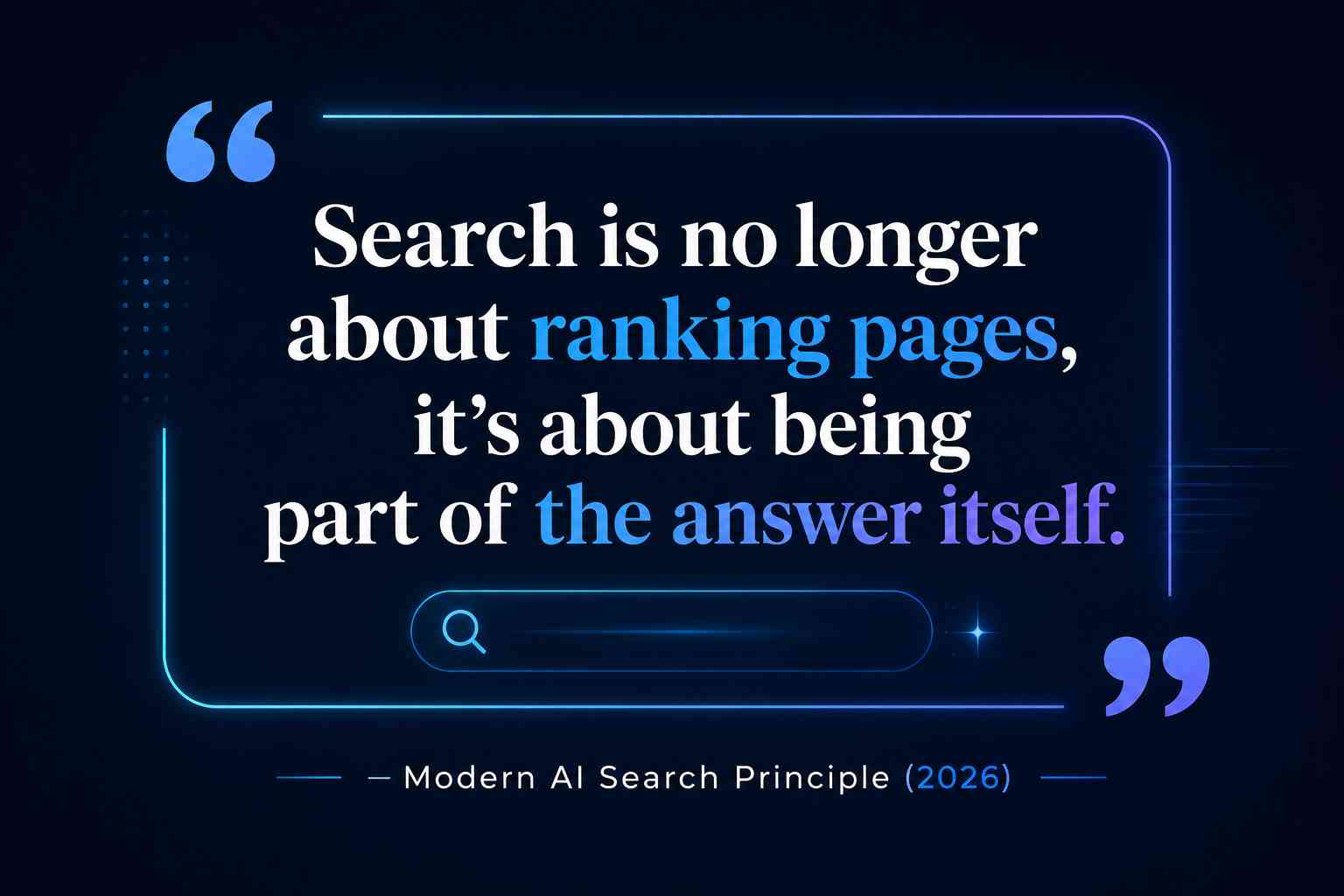
Understanding the Evolution of Search
Traditional Search Engines
Traditional search engines worked in a simple, keyword-based system. Users would type a query, and the engine would return a list of relevant web pages.
The process looked like this:
- User enters keywords into a search bar
- Search engine displays a list of blue links
- Users manually browse and choose the most relevant website
In this model, visibility depended heavily on ranking positions, backlinks, and SEO optimization.
The Data Behind Traditional Search:
- Google processes over 13 billion searches daily, making traditional search a dominant source of online discovery.
- The top organic Google result earns an average CTR of around 29%, driving significant website traffic.
Examples of traditional search engines:
- Google Search
- Bing
- Yahoo
AI-Powered Search Experiences
AI-powered search has changed how users interact with information. Instead of typing keywords, users now ask full questions in natural language and receive direct, synthesized answers.
Key characteristics include:
- Users ask conversational or complex questions
- AI generates instant, structured responses
- Sources or citations may be included
- Significantly fewer clicks to external websites
This shift reduces reliance on browsing multiple pages and increases the importance of being referenced by AI systems.
The Data Behind AI Search:
- AI search adoption is growing rapidly, with platforms like ChatGPT and Perplexity processing billions of prompts and queries each month.
- AI-generated answers are reshaping user behavior, increasing reliance on direct responses rather than traditional link browsing.
- According to recent industry data, 68% of Google searches now end without a click, and zero-click rates can rise to 72% when AI Overviews are displayed.
Examples of AI-powered search platforms:
- ChatGPT Search
- Perplexity AI
- Google AI Overviews
- Gemini
Final Thoughts
The biggest mistake in modern search thinking is assuming SEO is still the final goal. It is not. SEO built the foundation of digital visibility, but AI systems now decide what gets seen, cited, and recommended across search and answer platforms.
Visibility now works in layers. SEO determines presence in traditional search results, GEO determines whether content is cited in AI-generated answers, AIO determines whether a brand is recommended, and AEO determines whether it becomes the direct answer. Search visibility is no longer one-dimensional. It is a layered system where each level shapes how information is discovered and delivered.
In 2026, the winning brands will not just rank higher on Google but will be the ones consistently referenced inside AI answers across tools like ChatGPT, Perplexity, and Google AI Overviews.
Because rankings still bring traffic, but AI now drives perception, and perception is the new authority.
Frequently Asked Questions
1. What is GEO in SEO?
GEO is the practice of optimizing content to increase its chances of being cited by AI-powered search engines and answer platforms.
2. What is the difference between GEO and SEO?
SEO focuses on ranking webpages in search results, while GEO focuses on making content appear in AI-generated answers.
3. What is AIO in digital marketing?
AIO refers to AI Optimization, which improves a brand's visibility and relevance within AI-generated recommendations and responses.
4. Is SEO still relevant in 2026?
Yes. SEO remains essential because it supports content discovery, authority building, and search visibility across both traditional and AI-powered search platforms.
5. Does ChatGPT use SEO?
ChatGPT Search benefits from many SEO principles, including authoritative content, structured information, and trustworthy sources.
6. Which is more important: SEO, GEO, or AIO?
They serve different purposes. SEO drives rankings, GEO increases AI citations, and AIO improves brand visibility in AI-generated answers. The most effective strategy combines all three.
People are also reading