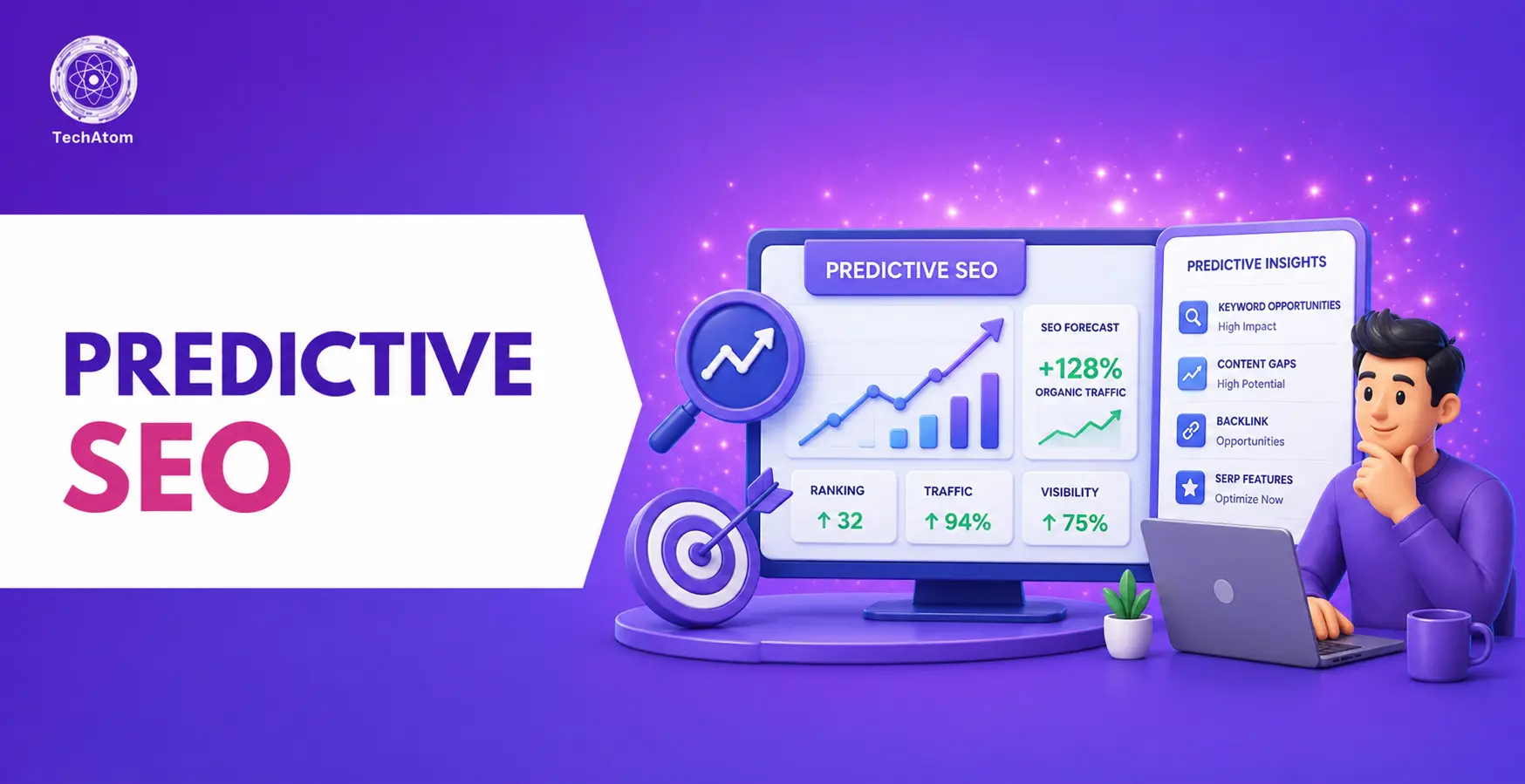
Predictive SEO is changing how websites compete in search because ranking is no longer only about current keyword demand. It focuses on forecasting future search behavior using AI, historical data, and trend analysis so content can be created before competition increases. Unlike traditional SEO, which reacts to existing keywords, predictive SEO targets future demand cycles and helps businesses gain a first mover advantage by preparing content 3 to 6 months in advance. This approach reduces competition pressure and improves long term visibility.
Around 60% of Google searches are now zero click, where users get answers directly from SERP features or AI Overviews without visiting websites. This makes predictive SEO essential for staying visible in modern search results.
What is Predictive SEO?
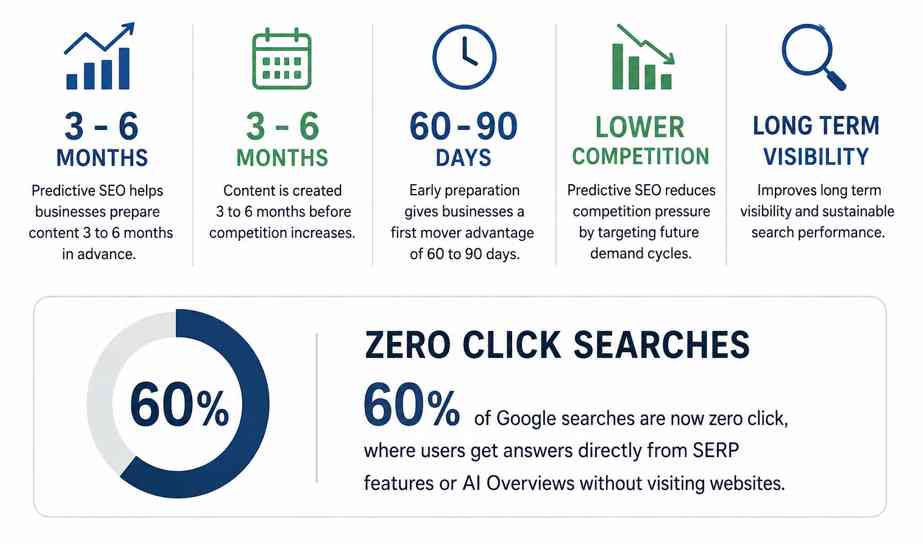
Predictive SEO is a data driven SEO approach that uses artificial intelligence, historical search data, and keyword trend analysis to forecast future search demand. Instead of focusing only on what users are searching today, it identifies what users are likely to 6search in the next 3 to 6 months.
This method uses multiple data layers such as SERP behavior tracking, keyword growth momentum, impression trends, and user intent evolution. Machine learning models detect early signals that indicate rising search demand before it becomes competitive.
Around 60% of Google searches now result in zero click behavior, where users get answers directly from SERP features or AI Overviews without visiting websites. This makes predictive SEO even more important, as it helps websites target demand earlier and secure visibility before competition increases.
Why Traditional Keyword Research is No Longer Enough
Traditional keyword research is no longer enough because search behavior is changing too fast due to AI, social media trends, and real time user intent shifts. It only focuses on past or current keyword data, which often fails to predict future demand. As a result, websites relying only on it miss early ranking opportunities and face higher competition later.
1. Search Trends Change Faster Than Ever
Search behavior is evolving faster than traditional keyword tools can track. Trends are influenced by AI tools, social platforms, news cycles, and viral content, which causes sudden spikes in search demand. Because of this rapid change, traditional keyword research often fails to capture future demand patterns and only reflects past or current data.
2. AI Search Is Reshaping User Journeys
Search engines are no longer only ranking websites; they are now providing direct answers using AI Overviews and featured snippets. Around 4.6 billion organic clicks still happen daily on Google, but a large portion of searches now end without website visits due to instant answers.
3. Competition In Mature Keywords Is Increasing
Most high value keywords are already dominated by strong authority websites. Entering these markets late requires higher investment, stronger backlinks, and longer timeframes. Predictive SEO helps avoid this by identifying opportunities before competition becomes saturated.
4. Importance Of Identifying Trends Before They Peak
Predictive SEO allows brands to identify keyword growth early and publish content before search volume peaks. This creates a strong ranking advantage because early content builds authority, backlinks, and trust before competitors enter the space.
How Predictive SEO Works
Predictive SEO works by using data, trends, and user behavior patterns to forecast what people are likely to search for in the future. Instead of reacting to current keywords, it helps you create content in advance for topics expected to grow in demand.
It analyzes search trends, seasonal patterns, competitor performance, and audience interests to predict which keywords or topics will become popular. Based on these insights, you can optimize your content early and rank before competition increases.
Process of Predictive SEO
- Trend Identification: Machine learning tools analyze historical data, social media conversations, and semantic shifts to spot growing topics before they peak.
- Early Content Creation: You publish in-depth content early, allowing your website to build topical authority and establish E-E-A-T signals while the topic is still low-competition.
- AI-Ready Structuring: Content is formatted using semantic markup, clear headings, and answer-focused blocks to improve visibility in AI-driven search results and conversational search systems.
Benefits Of Predictive SEO
- Lower Competition: Target emerging, low-competition keywords before they become mainstream and overcrowded.
- Earlier Traffic Acquisition: Capture search traffic as soon as trends emerge, building early authority and long-term visits.
- Better ROI: Focus content resources on high-potential topics instead of declining or saturated markets.
- Future-Proofing: Align strategy with upcoming search behaviors to stay resilient against algorithm updates.
- Enhanced Topical Authority: Establish your brand as an industry leader by publishing valuable content before competitors.
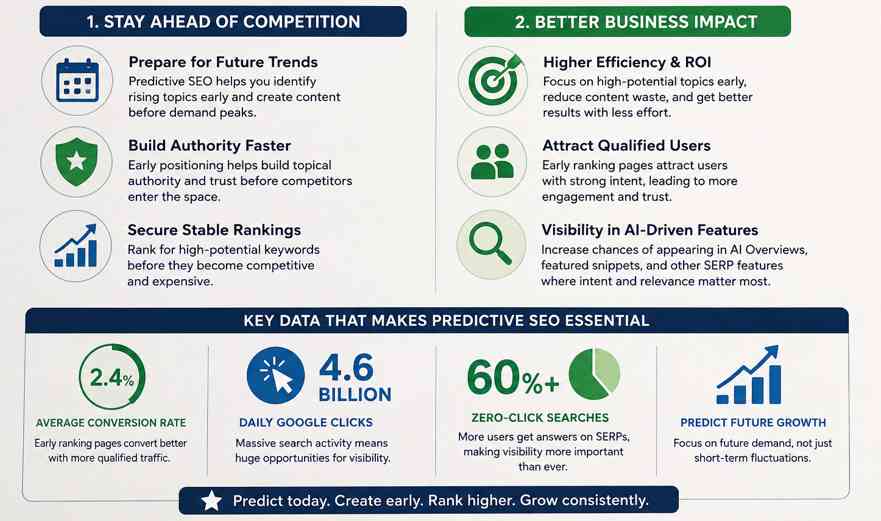
Predictive SEO shifts strategy from reacting to current search demand to preparing for future trends, helping websites publish content earlier than competitors. This builds authority faster and secures stable rankings before keywords become highly competitive.
From a business perspective, it improves efficiency and ROI by targeting high-potential topics early. With an average conversion rate of around 2.4%, early-ranking pages often gain higher-quality traffic and engagement. Top-ranking results also capture over 50% of organic clicks, making early visibility a strong advantage, especially in AI-driven search features like snippets and AI Overviews.
How AI Helps Predict Keyword Trends Early
AI helps predict keyword trends early by analyzing large amounts of search data, user behavior, and content engagement patterns in real time. It detects small changes in search volume, rising queries, and shifting user intent before they become visible in traditional keyword tools. This allows SEO strategies to focus on emerging topics at an early stage and gain a competitive advantage before the trend becomes highly competitive.
1. Search Behavior Analysis
AI studies user behavior signals such as impressions, clicks, dwell time, and query refinements. These signals help detect changes in user intent before keyword tools show actual volume growth, making it possible to identify early demand shifts.
2. Trend Forecasting Models
Machine learning models analyze query velocity, seasonal patterns, industry trends, and social media activity. Query velocity is especially important because it shows how fast interest in a topic is increasing, helping predict future keyword growth.
3. Competitor Opportunity Detection
AI systems scan SERPs to find weak content, missing topics, and low quality pages. This helps identify gaps where content can rank quickly because competition is still low.
Predictive SEO Vs Traditional SEO
|
Factor |
Traditional SEO |
Predictive SEO |
|
Strategy Type |
Reactive optimization |
Proactive forecasting |
|
Keyword Focus |
Current search volume |
Future predicted demand |
|
Competition Level |
High competition |
Lower early stage competition |
|
Content Timing |
After trend rises |
Before trend peaks |
|
Data Usage |
Historical data only |
AI + historical + predictive models |
|
SEO Goal |
Ranking improvement |
Authority building and future dominance |
Key Data Sources Used In Predictive SEO
Predictive SEO uses multiple data sources together to forecast future search demand more accurately than traditional keyword research. Instead of depending on one tool, it combines real time analytics, historical performance data, and trend signals to understand how user search behavior is evolving. This multi source approach improves prediction accuracy and helps identify opportunities before competition increases.
Google Search Console provides key metrics like impressions, clicks, CTR, and keyword positions, which help detect pages gaining visibility but not fully optimized. Google Analytics adds behavioral insights such as engagement rate, session duration, and conversion paths to evaluate content quality. Along with this, tools like Google Trends, Semrush, Ahrefs, and social platforms such as YouTube, Reddit, and X help identify early trends and keyword opportunities before they peak in search volume.
How To Build A Predictive SEO Strategy
Building a predictive SEO strategy involves using data driven insights to identify future search demand and create content ahead of competition. It starts with analyzing historical search data, spotting emerging trends, and forecasting which keywords are likely to grow. After that, content is organized into topic clusters, optimized for semantic search, and continuously monitored to adjust based on performance and changing search behavior.
1. Analyze Historical Search Data
This step involves studying past keyword performance, ranking fluctuations, and traffic behavior. It helps identify seasonal patterns, evergreen topics, and declining keywords to understand long term search behavior.
2. Identify Emerging Search Trends
Tools like Google Trends and Exploding Topics are used to detect early rising topics before they become competitive, helping businesses act before the market peaks.
3. Forecast Future Keyword Opportunities
Keyword demand is estimated for the next 3 to 6 months using growth rate, SERP changes, and user intent signals to predict which keywords will increase in value.
4. Create Topic Clusters Around Future Demand
Topic clusters are built using pillar content, supporting articles, and related subtopics. This strengthens topical authority and improves semantic SEO performance.
5. Optimize For Semantic Search
Semantic SEO focuses on meaning, context, and relationships rather than keyword repetition. This helps content align with AI driven search systems.
6. Monitor Performance And Adjust Forecasts
SEO performance is tracked using rankings, CTR, impressions, and engagement metrics. Forecasts are continuously refined based on real data.
Common Predictive SEO Mistakes To Avoid
One major mistake in predictive SEO is relying only on keyword tools without validating real user behavior data. Many tools provide delayed or incomplete signals, which can lead to incorrect forecasting if not supported by real time data from Google Search Console or trend platforms. This often results in targeting keywords that do not perform as expected in real search conditions.
Another common issue is ignoring search intent shifts and zero click search behavior. Even if a keyword grows, the intent behind it may change, reducing content effectiveness. With nearly 60 percent of searches ending without website clicks, focusing only on rankings is not enough. Predictive models must also be updated regularly every 30 to 90 days to maintain accuracy and relevance.
Future Of Predictive SEO Beyond 2026
Predictive SEO is evolving into a more automated system where AI tools will handle forecasting, trend detection, and content planning in real time. Instead of manual keyword research, machine learning models will continuously analyze search behavior and suggest future content opportunities. This will make SEO more proactive and data driven.
Search engines are also shifting toward semantic and intent based ranking systems where meaning matters more than exact keywords. As zero click searches continue to grow, visibility in AI Overviews, featured snippets, and SERP features will become more important than traditional clicks. Businesses that adopt predictive SEO early will gain a long term advantage in organic search visibility.
Conclusion
Predictive SEO represents a shift from reactive optimization to forward looking strategy, where decisions are based on forecasting rather than current search demand alone. It enables businesses to anticipate how user behavior and search interest will evolve, allowing them to publish content earlier and establish authority before competition intensifies. This approach is supported by growing search data patterns, high daily search activity, and increasing zero click behavior, making early visibility and intent focused content essential for sustained organic growth.
Frequently Asked Questions
1. How is Predictive SEO Different From Traditional SEO?
Predictive SEO focuses on future search demand using AI and trend data, while traditional SEO focuses on current keyword rankings.
2. Why is Predictive SEO Important For Modern Search?
It helps businesses capture traffic early before competition increases and improves visibility in AI driven search systems.
3. What is Keyword Forecasting in SEO?
It is the process of predicting future keyword demand using historical data, trend signals, and machine learning models.
4. Can Predictive SEO Improve AI Search Visibility?
Yes, it improves visibility in AI Overviews, featured snippets, and semantic search results by targeting intent early.
5. Which Tools Are Best For Predictive SEO Analysis?
Google Trends, Google Search Console, Semrush, Exploding Topics, and AnswerThePublic are widely used.
People are also reading