
Search behavior has shifted significantly in recent years. Google still processes over 8.5 billion searches per day, making SEO a key driver of organic traffic. However, AI tools like ChatGPT, Gemini, and Perplexity are increasingly being used to get direct answers instead of browsing multiple websites.
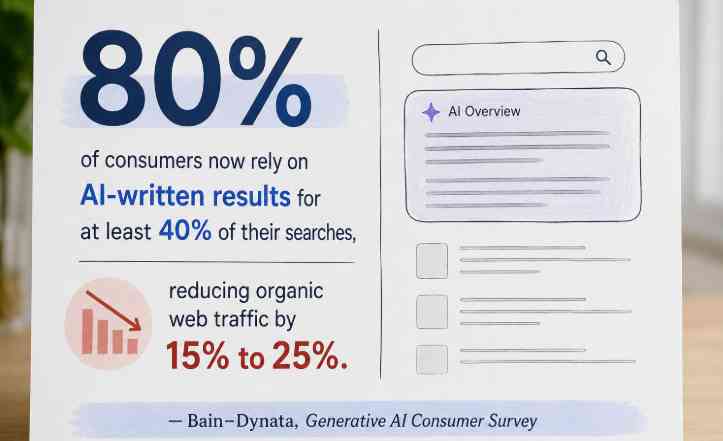
According to the Bain-Dynata Generative AI Consumer Survey, about 80% of consumers now rely on AI-generated results for at least 40% of their searches, which has reduced organic website traffic by 15%-25%.
This change has led to a new approach called Generative Engine Optimization (GEO), which focuses on how brands appear in AI-generated answers, while SEO focuses on ranking websites in search engines. In 2026, businesses need both SEO and GEO to stay visible across Google and AI platforms.
What is SEO?
Search Engine Optimization (SEO) is the process of improving a website's visibility on search engines such as Google and Bing. The goal is to rank higher for relevant search queries and attract users who are actively looking for information, products, or services.
SEO involves several activities, including content optimization, technical improvements, backlink building, and keyword targeting. When implemented correctly, SEO helps search engines understand your website and determine whether it deserves to rank for specific searches.
For example: If someone searches for "best project management software," Google analyzes thousands of pages and displays the most relevant results. Businesses with strong SEO strategies are more likely to appear on the first page and receive organic traffic.

Key Benefits of SEO
SEO remains one of the most effective long-term marketing strategies because it helps businesses:
- Increase organic traffic
- Generate qualified leads
- Improve brand visibility
- Build trust and authority
- Reduce dependence on paid advertising
Although search technology continues to evolve, SEO still provides the foundation for online visibility.
What is GEO?
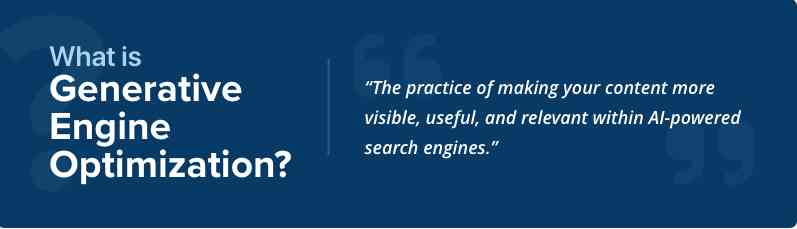
Generative Engine Optimization (GEO) is the practice of optimizing content and brand signals so that AI-powered search platforms can understand, trust, and reference your business in their responses.
Unlike SEO, which focuses on ranking webpages, GEO focuses on increasing a brand's visibility within AI-generated answers. When users ask AI platforms for recommendations, comparisons, or solutions, those systems gather information from multiple sources to generate a response.
Consider the following query:
"Which digital marketing agencies are best for AI visibility?"
Instead of showing ten blue links like a traditional search engine, an AI platform may provide a direct answer mentioning several agencies. GEO helps improve the chances of your brand being included in that answer.
This is becoming increasingly important because users are spending more time interacting with AI assistants and less time browsing through multiple search results.
GEO vs SEO: What's the Difference?
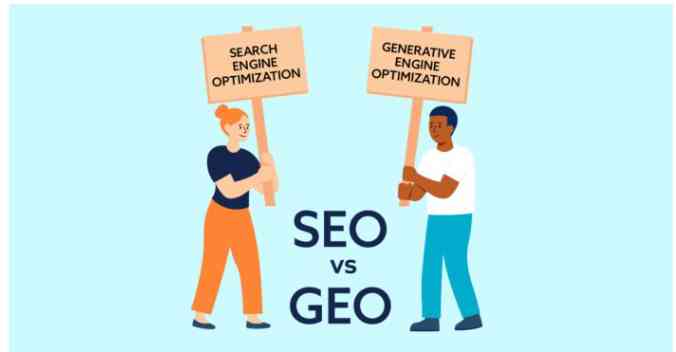
Although GEO and SEO both aim to improve online visibility, they achieve this goal in different ways.
|
Factor |
SEO |
GEO |
|
Primary Goal |
Rank webpages in search engines |
Appear in AI-generated answers |
|
Main Platforms |
Google, Bing, YouTube |
ChatGPT, Gemini, Perplexity, AI Overviews |
|
Focus Area |
Keywords, backlinks, technical SEO |
Authority, citations, entities, trust signals |
|
Visibility Type |
Search engine results |
AI recommendations and summaries |
|
Success Metrics |
Rankings, traffic, CTR, conversions |
AI mentions, citations, share of voice |
|
Main Outcome |
Website visits and leads |
Brand visibility in AI responses |
The biggest distinction is how users consume information. Traditional search engines present a list of results and allow users to choose which website to visit. AI platforms often provide the answer directly, reducing the number of clicks required. Because of this, businesses that only focus on rankings may miss opportunities to appear in AI-generated recommendations.
Why GEO Matters in 2026
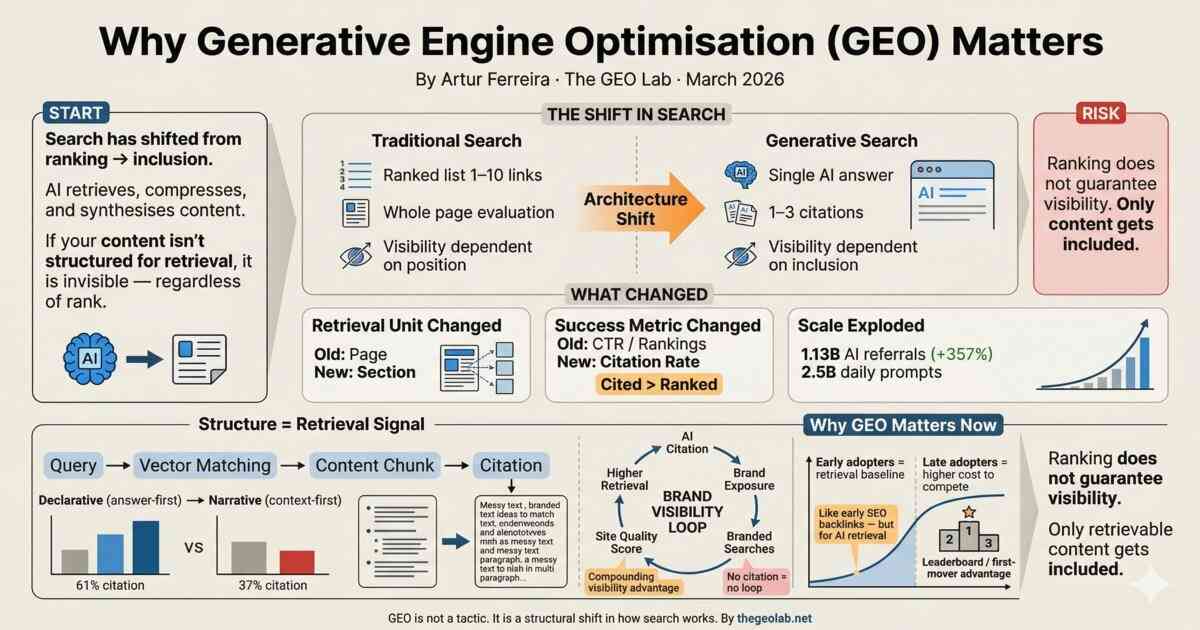
The growing adoption of AI search is changing how customers research products and services. Instead of visiting multiple websites, users can ask detailed questions and receive instant answers tailored to their needs.
For example, a business owner searching for accounting software may ask an AI assistant:
"What is the best accounting software for a small business with fewer than 20 employees?"
The AI system will likely provide recommendations along with reasons for each suggestion. If your brand is included in that response, you gain visibility before the user even visits a website.
Several trends are driving the growth of GEO:
- Increased use of AI assistants for research
- Growth of AI-generated search results
- More conversational search queries
- Faster decision-making through summarized answers
- Greater reliance on trusted sources and authority signals
As AI search continues to expand, businesses that ignore GEO may find themselves losing visibility during critical stages of the customer journey.
Recent Industry Data & Trends
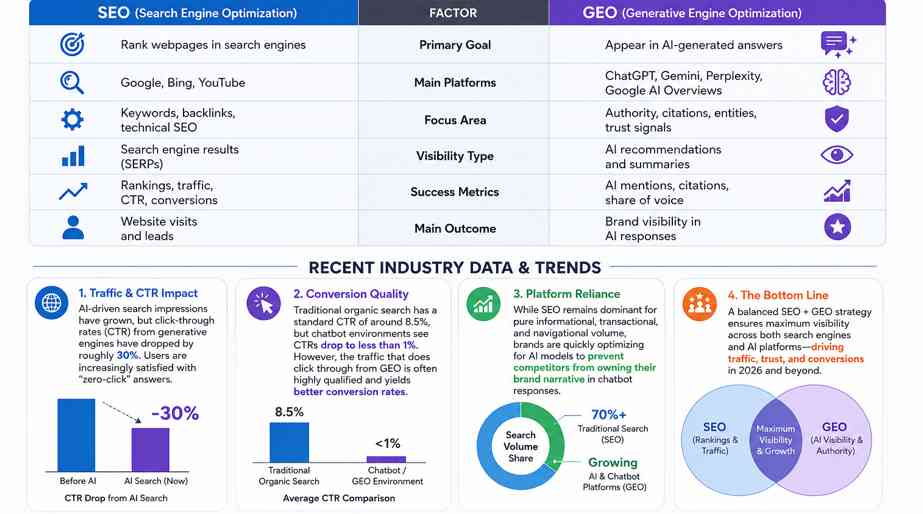
The rise of AI-powered search is changing how users interact with online content. Industry reports show that click-through rates (CTR) from generative search experiences have dropped by nearly 30% as more users rely on AI-generated answers instead of visiting websites. While traditional organic search averages around 8.5% CTR, AI chatbot environments often see CTRs below 1%. However, the traffic that does click through from AI platforms is typically more qualified and more likely to convert. As AI search adoption grows, businesses are investing in both SEO and GEO to maintain visibility across traditional search engines and AI-generated recommendations.
Why Businesses Need Both GEO and SEO in 2026
As search behavior continues to evolve, businesses need visibility across both traditional search engines and AI-powered platforms. The following data highlights why SEO and GEO work best together in 2026.
SEO and GEO Visibility Metrics in 2026
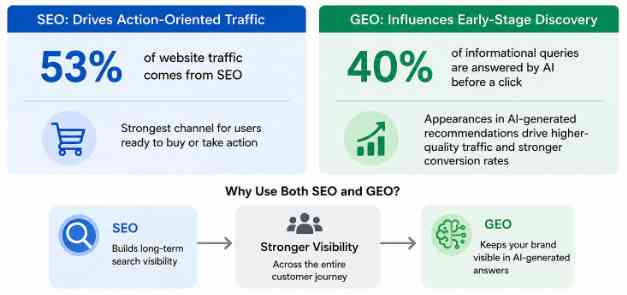
Comparison of major SEO and GEO performance indicators based on recent industry trends.
The data shows that SEO and GEO serve different but equally important roles in modern digital marketing. SEO continues to drive over 53% of website traffic and remains the strongest channel for capturing users who are ready to buy or take action. At the same time, AI-powered search is changing how people discover information, with around 40% of informational queries being answered directly by AI before users click a website. Businesses that appear in AI-generated recommendations often benefit from higher-quality traffic and stronger conversion rates. Rather than choosing between SEO and GEO, companies should use both strategies together. SEO builds long-term search visibility, while GEO helps brands stay visible in AI-generated answers, creating a stronger presence throughout the entire customer journey.
How AI Search Is Changing Customer Discovery
The way customers find information online is changing rapidly. Traditional search engines require users to browse through multiple websites, compare information, and form their own conclusions. AI-powered search platforms simplify this process by delivering direct answers in a conversational format.
For example: Instead of typing a short keyword such as "best project management tool," users now ask more detailed questions such as Which project management software is best for remote teams with fewer than 50 employees?"
AI systems analyze large amounts of information and provide tailored recommendations based on the user's intent. This means businesses need to optimize not only for keywords but also for topics, context, and user questions.
How GEO Works in Real Search Scenarios
Instead of displaying a list of search results, the AI may provide a direct recommendation mentioning platforms such as HubSpot, Salesforce, and Zoho along with a summary of their strengths.
The companies that appear in these recommendations are not necessarily those with the highest search rankings. AI systems often consider factors such as content quality, brand authority, customer reviews, industry mentions, and overall trustworthiness when generating responses.
This illustrates the difference between SEO and GEO. SEO helps a company rank in traditional search results, while GEO increases the likelihood that the brand will be referenced directly in AI-generated answers.
Key Changes in User Behavior
Several trends are shaping modern search behavior:
- Users are asking longer and more conversational questions.
- AI-generated summaries are reducing the number of websites people visit.
- Buying decisions often begin before users reach a company's website.
- Trust and authority are becoming more important than simple keyword optimization.
As a result, businesses that establish themselves as reliable sources of information are more likely to be referenced by AI systems and trusted by potential customers.
GEO Ranking Factors: What Influences AI Visibility?
Unlike Google, AI companies do not publish detailed ranking algorithms. However, industry observations suggest that certain factors consistently influence whether a brand appears in AI-generated answers.
1. Content Quality
Content remains one of the strongest visibility signals. AI systems prefer content that answers questions clearly, provides accurate information, and covers topics comprehensively. Articles that include real-world examples, expert insights, and practical advice are generally more valuable than content written solely to target keywords.
2. Authority and Trust
AI platforms aim to provide reliable information. Because of this, they often favor brands that demonstrate expertise and credibility.
Authority can be strengthened through:
- Industry recognition
- Expert-authored content
- Research reports
- Case studies
- Media mentions
- Thought leadership content
The stronger your authority signals, the greater the likelihood that AI systems will reference your brand.
3. Reviews and Reputation
Customer feedback plays an important role in both SEO and GEO. Positive reviews help establish trust and provide additional signals about the quality of your products or services. Businesses with strong reputations across review platforms often have a better chance of appearing in recommendations.
4. Entity Consistency
AI systems collect information from multiple sources. If your business information varies across websites, directories, and social media profiles, it becomes more difficult for AI tools to understand your brand accurately. Consistency in company name, services, descriptions, and contact information helps strengthen your digital identity.
5. Structured Data
Schema markup helps search engines and AI systems interpret website content more effectively. While schema alone won't guarantee AI visibility, it provides valuable context that supports both GEO and SEO efforts.
Signs Your Brand Has Poor AI Visibility
Many businesses assume they are visible in AI search simply because they rank well on Google. Unfortunately, that is not always the case. A company may have strong rankings yet rarely appear in AI-generated recommendations. This often indicates a gap between SEO performance and AI visibility.
Common Warning Signs
If you notice any of the following issues, your brand may need stronger GEO optimization:
- Competitors appear in AI answers more frequently than your brand.
- AI platforms provide incomplete or inaccurate information about your company.
- Your business is rarely mentioned in industry discussions.
- AI tools cite third-party sources instead of your website.
- Your online reviews and authority signals are limited.
These issues often indicate that AI systems do not have enough trusted information to confidently reference your brand.
How to Optimize GEO
Improving GEO visibility requires more than publishing content. Businesses must build authority, establish trust, and create information that AI systems can easily understand. The first step is creating content that directly answers user questions. Rather than focusing only on keywords, think about the specific problems your audience is trying to solve.
Step 1. Focus on Topic Authority
Instead of publishing isolated articles, create clusters of related content around your core topics. This helps establish expertise and makes it easier for AI systems to understand your area of specialization.
Strengthen Your Brand Presence AI systems often rely on information from multiple sources. Increasing your presence across reputable websites can improve visibility significantly.
Consider investing in:
- Digital PR
- Guest contributions
- Industry interviews
- Expert roundups
- Business directories
Step 2. Encourage Genuine Reviews
Positive customer reviews not only influence purchasing decisions but also strengthen trust signals that AI systems may consider when generating recommendations.
Step 3. Keep Information Consistent
Make sure your company information remains accurate across all platforms, including your website, social profiles, directories, and review websites. Small inconsistencies can weaken your entity signals and reduce AI visibility over time.
By combining these efforts with strong SEO practices, businesses can improve both traditional search performance and AI-driven visibility.
Can GEO Replace SEO?
One of the most common questions marketers are asking today is whether GEO will eventually replace SEO. The short answer is no.
While AI-powered search is growing rapidly, search engines still remain one of the primary ways people find information online. Millions of users continue to use Google every day to research products, compare services, read reviews, and make purchasing decisions. More importantly, AI systems themselves rely on information that already exists across the web. They pull insights from websites, articles, reviews, forums, and other online sources. Without strong SEO foundations, it becomes much harder for AI platforms to find and trust your content.
Think of SEO as the foundation and GEO as the extension built on top of it. SEO helps search engines understand and rank your content, while GEO helps AI systems recognize and reference your brand in generated responses. Businesses that abandon SEO in favor of GEO risk losing organic traffic and long-term visibility. Instead of replacing SEO, GEO expands the way brands appear online.
GEO Strategy Checklist for Businesses
Building AI visibility requires a structured approach. While every business has different goals, there are several core actions that can improve GEO performance.
- Create Answer-Focused Content: AI platforms prefer content that answers questions clearly and directly. Start important sections with a concise answer before providing detailed explanations.
- Build Topical Authority: Rather than publishing random articles, focus on creating content around your main areas of expertise. This helps search engines and AI systems understand what your business specializes in.
- Improve E-E-A-T Signals: Google's E-E-A-T framework continues to play an important role in both SEO and GEO. Focus on demonstrating:
- Experience
- Expertise
- Authoritativeness
- Trustworthiness
- Earn Quality Mentions: Mentions from trusted websites help establish authority. Businesses should actively pursue opportunities to be featured in:
- Industry publications
- News websites
- Professional directories
- Expert interviews
- Research reports
- Use Structured Data: Schema markup helps machines understand your content more effectively. Relevant schema types include:
- Organization Schema
- Article Schema
- FAQ Schema
- Product Schema
- Review Schema
- Local Business Schema
- Monitor Your AI Visibility: Businesses should regularly test prompts related to their products, services, and industry to see how AI platforms describe and recommend their brand.
This helps identify visibility gaps and opportunities for improvement.
GEO vs SEO: Which Should Your Business Prioritize?
The answer depends largely on your business goals, industry, and current digital presence.
Businesses that are just beginning their online marketing journey should focus on building a strong SEO foundation first. Without quality content, technical optimization, and website authority, GEO efforts may have limited impact.
For established businesses that already receive organic traffic, GEO should become an important part of their growth strategy. As AI-generated search results become more common, visibility inside these platforms can influence customer decisions before users ever visit a website.
Prioritize SEO If:
- Your website receives little organic traffic.
- Technical SEO issues still exist.
- You have limited content.
- Your website lacks authority and backlinks.
- Search rankings are your primary growth channel.
Prioritize GEO If:
- Your website already has strong SEO foundations.
- Customers frequently research your industry through AI tools.
- Competitors are appearing in AI-generated answers.
- Brand visibility is a major business objective.
- You want to increase authority and recognition.
The Best Approach
For most businesses in 2026, the smartest strategy is not choosing one over the other. Instead, businesses should combine SEO and GEO into a unified visibility strategy. SEO helps attract visitors through search engines, while GEO helps ensure your brand remains visible as AI-powered search continues to grow.
The Future of Search Beyond 2026
Search technology will continue evolving over the coming years. AI-generated answers are expected to become more accurate, personalized, and integrated into everyday online experiences.
Rather than replacing traditional search completely, AI is likely to work alongside it. Users will continue using search engines for detailed research while relying on AI tools for quick answers and recommendations.
Several trends are expected to shape the future of search:
- More conversational search experiences.
- Increased use of voice-based AI assistants.
- Greater personalization in search results.
- Growth of AI-generated recommendations.
- Stronger emphasis on authority and trust signals.
- Integration of text, image, video, and voice search.
Businesses that adapt early will be better positioned to benefit from these changes.
The brands that consistently publish valuable content, build authority, and maintain strong digital reputations will have the greatest chance of succeeding regardless of how search technology evolves.
How to Measure GEO Success
Unlike SEO, where rankings and traffic are easy to track, GEO success is measured through visibility and brand presence across AI platforms. Monitoring these metrics can help businesses understand whether their GEO efforts are producing results.
Key GEO Metrics to Track
- AI Mentions: How often your brand appears in ChatGPT, Gemini, Perplexity, and other AI-generated responses.
- Citation Frequency: The number of times AI platforms reference your website or content.
- Share of Voice: How often your brand is mentioned compared to competitors.
- Brand Accuracy: Whether AI tools provide correct information about your business.
- Review Growth: The increase in positive reviews and reputation signals across review platforms.
- Authority Mentions: Mentions from trusted websites, publications, and industry sources.
- Referral Traffic: Traffic generated from AI-powered search experiences and citations.
Regularly testing industry-related prompts on AI platforms can help identify visibility gaps and highlight areas for improvement.
Key Takeaways
- SEO still drives 53%+ of website traffic.
- Around 40% of informational searches are now answered by AI before a click.
- AI-referred visitors can have higher conversion potential than traditional organic traffic.
- SEO builds visibility in search engines, while GEO increases visibility in AI-generated answers.
- The strongest strategy in 2026 is combining both SEO and GEO.
Conclusion
GEO and SEO are not competing strategies; they work together to improve online visibility. While SEO helps businesses rank in search engines and drive organic traffic, GEO increases visibility in AI-generated answers and recommendations. As search continues to evolve in 2026, businesses that combine strong SEO foundations with GEO optimization will be better positioned to reach customers across both traditional search engines and AI-powered platforms.
Frequently Asked Questions
1. What is the difference between GEO and SEO?
SEO focuses on improving website rankings in search engines, while GEO focuses on improving visibility within AI-generated answers and recommendations.
2. Does GEO replace SEO?
No. GEO complements SEO rather than replacing it. Strong SEO foundations often improve GEO performance as well.
3. Why is GEO important in 2026?
AI-powered search platforms are becoming a major source of information for users. GEO helps businesses appear in AI-generated responses and recommendations.
4. What are GEO KPIs?
Common GEO metrics include:
- AI mentions
- Citation frequency
- Share of voice
- Brand accuracy
- Competitor visibility
- Sentiment analysis
5. How can small businesses improve GEO?
Small businesses can improve GEO by creating high-quality content, earning reviews, maintaining consistent business information, building authority, and gaining mentions from trusted sources.
6. Should businesses invest in GEO or SEO first?
Businesses should generally establish strong SEO foundations first. Once those foundations are in place, GEO can help expand visibility across AI-powered search platforms.
People are also reading