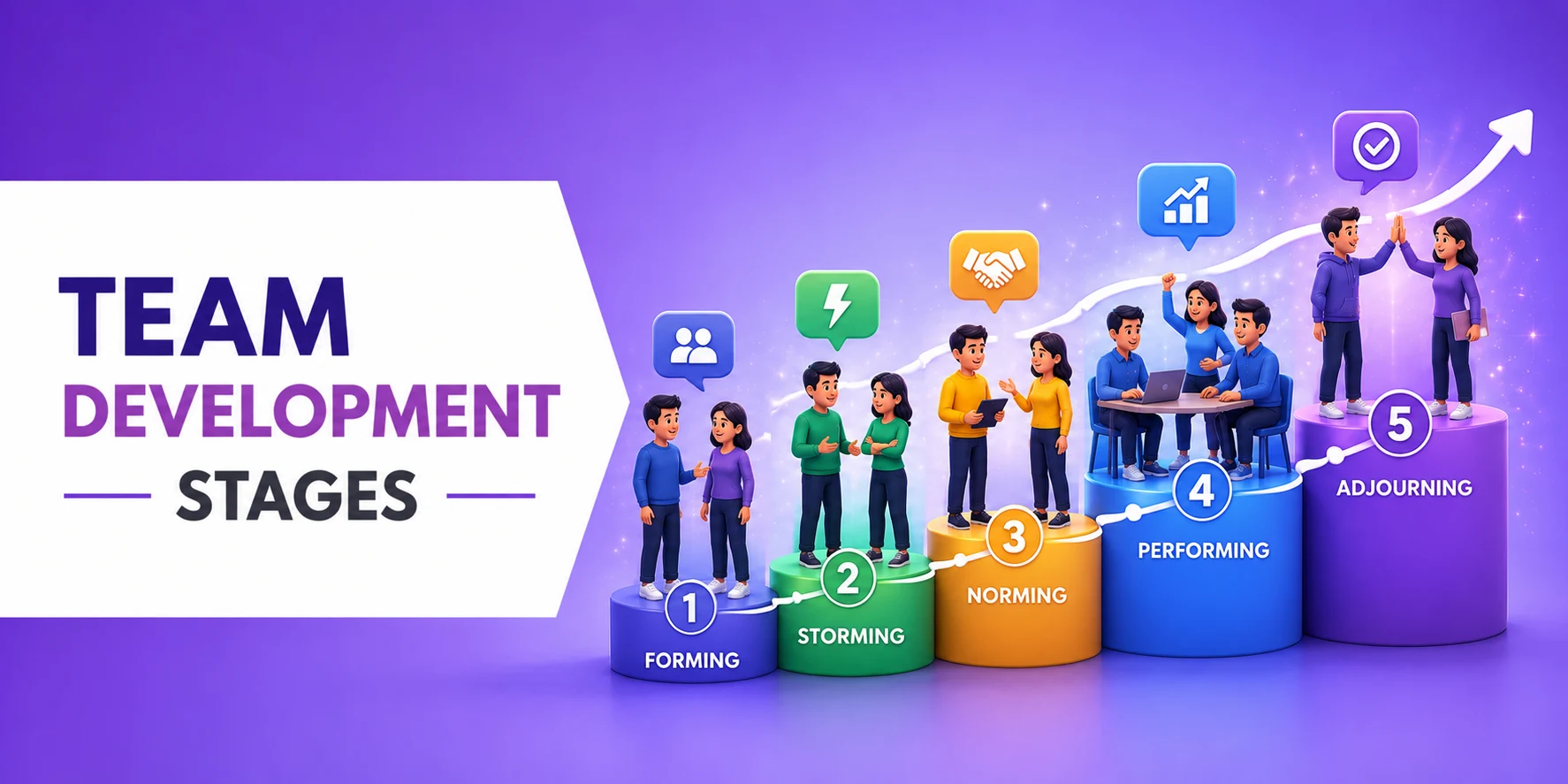

Building a successful team is not something that happens overnight. Every team goes through a structured journey before becoming productive, collaborative, and high-performing. Understanding the team development stages helps organizations improve communication, reduce conflicts, increase productivity, and build stronger workplace relationships.
The concept of team development stages was introduced by psychologist Bruce Tuckman in 1965. His framework explains how teams evolve over time through different phases of growth. These stages help managers, business leaders, HR professionals, project managers, and employees understand team behavior and improve team performance.
The five stages of team development are:
|
Stage |
Purpose |
Team Behavior |
Leadership Focus |
|
Forming |
Team members get introduced and understand goals |
Polite, cautious, uncertain |
Provide direction, clarify roles, build trust |
|
Storming |
Team members express opinions and face conflicts |
Disagreements, competition, tension |
Manage conflicts, improve communication |
|
Norming |
Team starts collaborating effectively |
Cooperation, trust, better teamwork |
Encourage collaboration and accountability |
|
Performing |
Team reaches high productivity and efficiency |
Independent, confident, goal-focused |
Empower team and support growth |
|
Adjourning |
Project ends and team reflects on outcomes |
Closure, reflection, transition |
Recognize achievements and capture learnings |
Each stage has unique challenges, behaviors, opportunities, and leadership requirements. Teams that successfully move through these stages develop stronger trust, clearer communication, better collaboration, and higher efficiency.
What Are Team Development Stages?
Team development stages refer to the natural progression teams experience while working together toward shared goals. These stages describe how team members interact, solve problems, build trust, and improve collaboration over time.
A newly formed team usually starts with uncertainty and limited communication. As members begin interacting more frequently, conflicts may arise due to different opinions, personalities, and working styles. Gradually, the team establishes trust, develops clear processes, and eventually becomes highly productive.
Understanding these stages allows organizations to:
- Improve team communication
- Reduce workplace conflicts
- Build employee trust
- Increase productivity
- Strengthen collaboration
- Improve leadership effectiveness
- Enhance project success rates
- Create a positive work culture
- Support employee engagement
- Encourage innovation and creativity
The team development model is widely used in businesses, startups, educational institutions, sports teams, healthcare organizations, and project management environments.
The 5 Team Development Stages
1. Forming Stage
The forming stage is the first phase of team development. At this stage, team members are introduced to each other and begin understanding the team’s goals, structure, and expectations.
This stage is usually characterized by excitement, curiosity, politeness, and uncertainty. Employees try to understand their responsibilities while learning about other team members.
Characteristics of the Forming Stage
- Team members are polite and cautious
- Roles and responsibilities are unclear
- Employees depend heavily on leadership
- Communication is limited and formal
- Team members avoid conflict
- Individuals focus on making positive impressions
- Productivity is generally low initially
- Team goals are still being understood
Challenges During the Forming Stage
Although the forming stage often appears calm and positive, teams commonly face several underlying challenges during this phase. Team members are usually unfamiliar with each other, which can create uncertainty and hesitation in communication. Employees may lack clarity about project goals, individual responsibilities, and overall expectations.
Many team members also fear being judged, making them less likely to share ideas openly or participate confidently in discussions. Trust levels are generally low in the beginning, and collaboration remains limited until stronger relationships are developed. In addition, uncertainty about leadership styles, decision-making processes, and team direction can make employees feel cautious and disconnected.
Leadership Role in the Forming Stage
Leadership plays a critical role during the forming stage because team members look to managers for direction, structure, and confidence. Effective leaders help reduce uncertainty by clearly defining goals, explaining team expectations, and introducing each member’s roles and responsibilities.
They encourage open communication and create a welcoming environment where employees feel comfortable sharing ideas and asking questions. Strong leaders also focus on building trust among team members while establishing basic workflows, communication methods, and team processes. Providing proper training, guidance, and continuous support during this stage helps teams build a strong foundation for future collaboration and success.
Example of the Forming Stage
A company launches a new marketing project and assembles employees from design, content, advertising, and analytics departments. Team members are initially polite and reserved while trying to understand the project and each other.
2. Storming Stage
The storming stage is often considered the most difficult phase of team development. As employees become more comfortable expressing opinions, disagreements and conflicts begin to appear.
Different personalities, work styles, ideas, and expectations may create tension within the team.
Although this stage can feel uncomfortable, it is essential for long-term team growth.
Characteristics of the Storming Stage
- Increased disagreements
- Competition among team members
- Resistance to authority
- Conflicts over priorities
- Communication challenges
- Emotional frustration
- Testing of boundaries
- Formation of subgroups
- Questions about leadership
Common Conflicts During the Storming Stage
The storming stage is one of the most challenging phases of team development because conflicts and disagreements begin to surface as team members express their individual opinions, working styles, and expectations. During this stage, teams may experience disagreements related to work processes, leadership decisions, deadlines, communication styles, role responsibilities, resource allocation, performance expectations, and decision-making authority. Differences in personalities, priorities, and approaches to work can create tension within the team, leading to frustration, misunderstandings, and reduced collaboration if not managed properly.
Leadership Role in the Storming Stage
Leadership becomes especially important during the storming stage because managers must guide the team through conflict while maintaining productivity and morale. Poor leadership during this phase can increase workplace tension and cause team performance to decline, while effective leadership can transform disagreements into opportunities for growth and collaboration. Strong leaders address conflicts quickly and fairly, encourage respectful discussions, and promote active listening among team members.
They also clarify expectations, reinforce team goals, support collaboration, and encourage accountability. Managing emotional tension and helping employees focus on shared objectives allows teams to move beyond conflict and build stronger working relationships.
Why the Storming Stage Matters
Although the storming stage can be difficult, it plays a vital role in long-term team success. This phase helps team members understand different perspectives, improve communication skills, and develop trust through open discussions and problem-solving.
Teams also learn how to handle disagreements professionally, clarify expectations, and establish more effective ways of working together. As conflicts are resolved, relationships become stronger, collaboration improves, and the team develops greater confidence in achieving shared goals.
Example of the Storming Stage
In a software development team, designers and developers may disagree about timelines, design complexity, or technical limitations. These discussions can create tension before the team learns how to collaborate effectively.
3. Norming Stage
The norming stage begins when team members start resolving conflicts and developing stronger relationships. Communication becomes more open, trust increases, and collaboration improves.
At this stage, employees understand their roles more clearly and begin working together more effectively.
Characteristics of the Norming Stage
- Improved communication
- Greater teamwork
- Higher trust levels
- Increased collaboration
- Clearer responsibilities
- Stronger team morale
- Better problem-solving
- Shared decision-making
- Reduced workplace tension
What Happens During the Norming Stage?
The norming stage is the phase where team members begin working together more smoothly and effectively. After overcoming initial conflicts and misunderstandings, the team starts developing stronger relationships, mutual respect, and a clearer sense of collaboration. Employees become more comfortable sharing ideas, supporting one another, and focusing on common goals rather than individual differences.
During this stage, teams establish clear group norms, communication systems, workflow structures, and conflict resolution methods that improve daily operations. Team members also develop stronger accountability and collaborative habits, allowing tasks to be completed more efficiently and with fewer disruptions. Trust continues to grow as employees better understand each other’s strengths, working styles, and responsibilities.
Leadership Role in the Norming Stage
Leadership during the norming stage becomes more supportive rather than highly directive. Since the team is gaining stability and confidence, managers can gradually reduce close supervision and focus more on guidance, motivation, and team development. Effective leaders encourage collaboration, recognize team achievements, and strengthen accountability among members.
Managers should also support team independence by allowing employees to take greater ownership of their responsibilities and decision-making. Promoting knowledge sharing, maintaining open communication, and encouraging continuous improvement help teams become more adaptable, productive, and self-sufficient.
Benefits of the Norming Stage
The norming stage greatly improves overall team efficiency because employees become more aligned, cooperative, and goal-oriented. Stronger communication and trust reduce misunderstandings and workplace tension, allowing teams to work more effectively together.
This phase leads to several important benefits, including better productivity, improved workplace culture, higher employee engagement, increased trust among team members, faster decision-making, and smoother collaboration. As the team becomes more organized and connected, it creates a strong foundation for high performance and long-term success.
Example of the Norming Stage
A customer service team that previously struggled with communication now develops clear workflows, shares information openly, and collaborates effectively to solve customer problems.
4. Performing Stage
The performing stage is the highest level of team development. At this point, the team operates efficiently with minimal supervision.
Team members trust each other, communicate effectively, solve problems collaboratively, and focus strongly on achieving goals.
High-performing teams are confident, adaptable, innovative, and productive.
Characteristics of the Performing Stage
- High productivity
- Strong collaboration
- Efficient communication
- Independent decision-making
- High trust levels
- Strong accountability
- Effective problem-solving
- Innovation and creativity
- Goal-focused performance
- Positive workplace culture
What Makes a Team High-Performing?
A high-performing team is one that works together efficiently, confidently, and consistently to achieve shared goals. At this stage of development, team members clearly understand their objectives, responsibilities, and individual contributions to the organization’s success. Collaboration becomes natural, communication is open and effective, and employees trust one another’s skills and decisions.
High-performing teams are also skilled at resolving conflicts professionally without allowing disagreements to disrupt productivity. They support continuous learning, adapt quickly to change, and remain flexible when facing new challenges or opportunities. Innovation becomes a key strength because employees feel comfortable sharing ideas, experimenting with solutions, and contributing creatively. Strong accountability within the team ensures that members remain committed to delivering consistent, high-quality results.
Leadership Role in the Performing Stage
During the performing stage, managers shift their focus from direct supervision to strategic support and long-term team development. Since the team is already functioning effectively, leaders primarily work to empower employees, encourage innovation, and create opportunities for growth.
Effective leaders remove obstacles that may slow progress, provide the necessary resources for success, and support professional development through mentoring, training, and career guidance. They also recognize achievements, maintain motivation, and encourage continuous improvement to help the team sustain high performance over time. Rather than controlling every task, leaders trust the team’s capabilities and focus on strengthening overall organizational success.
Benefits of the Performing Stage
Organizations gain significant advantages when teams reach the performing stage because productivity, collaboration, and efficiency improve at every level. High-performing teams complete projects faster, make better decisions, and consistently deliver strong results with minimal supervision.
This stage also leads to increased profitability, stronger innovation, improved customer satisfaction, and better employee retention because employees feel more engaged, valued, and motivated in their work environment. As teamwork and accountability strengthen, organizations experience smoother operations, greater adaptability, and long-term business growth.
Example of the Performing Stage
An experienced sales team collaborates smoothly, shares leads effectively, solves problems independently, and consistently exceeds revenue targets.
5. Adjourning Stage
The adjourning stage is the final phase of team development. This stage occurs when a project ends or the team disbands.
Some teams may feel satisfaction and pride, while others experience uncertainty or sadness due to the end of collaboration.
Although often overlooked, the adjourning phase is important for reflection, recognition, and learning.
Characteristics of the Adjourning Stage
- Completion of goals
- Project closure
- Reduced team interaction
- Reflection on achievements
- Emotional transitions
- Recognition and celebration
- Evaluation of performance
Leadership Role in the Adjourning Stage
The adjourning stage marks the conclusion of a team project or collaboration, making leadership especially important during this transition period. Managers play a key role in helping employees close the project positively while preparing for future responsibilities and opportunities. Effective leaders ensure that team members feel valued and appreciated for their efforts, which helps maintain motivation and strong workplace relationships even after the project ends.
During this stage, leaders should celebrate team achievements, recognize individual contributions, and conduct performance reviews to evaluate successes and areas for improvement. Encouraging reflection allows employees to discuss their experiences, challenges, and lessons learned throughout the project. Managers should also document valuable insights and best practices that can improve future team performance and organizational processes. Providing constructive feedback opportunities and supporting employees through future transitions helps create a smoother and more professional project closure.
Why the Adjourning Stage Matters
Although often overlooked, the adjourning stage is important because it allows organizations to capture valuable knowledge and strengthen long-term team development. This phase helps businesses identify successful strategies, improve future projects, and build stronger organizational learning practices.
Recognizing employee contributions during this stage also improves morale, encourages engagement, and reinforces a culture of appreciation within the workplace. In addition, maintaining positive workplace relationships after project completion helps employees collaborate more effectively in future teams and assignments. Overall, the adjourning stage supports continuous improvement, stronger teamwork, and long-term organizational success.
Example of the Adjourning Stage
After successfully completing a major product launch, the project team disbands and employees move to new departments or projects.
Importance of Team Development Stages
Understanding team development stages is important because every team progresses through different phases of growth, and each stage comes with unique behaviors, challenges, and expectations. Managers who understand these patterns can provide the right guidance, improve collaboration, and help teams perform more effectively. Recognizing team development stages also allows organizations to build stronger communication, reduce conflicts, and create a more productive work environment.
Without proper guidance and support, teams may face several workplace challenges, including miscommunication, role confusion, lack of accountability, poor collaboration, workplace tension, reduced productivity, low employee morale, delayed project completion, leadership difficulties, and resistance to change. These problems can weaken team performance and prevent employees from achieving common goals efficiently.
When organizations actively support team development, they benefit from:
Better Communication
Team members become more open, transparent, and collaborative. Communication improves as trust develops.
Higher Productivity
Teams that clearly understand their goals and responsibilities work more efficiently.
Stronger Problem Solving
Collaborative teams generate better ideas and solve problems faster.
Improved Employee Satisfaction
Healthy team relationships improve workplace happiness and employee retention.
Greater Innovation
High-performing teams encourage creativity, brainstorming, and innovation.
Better Leadership Development
Managers learn how to adapt their leadership style according to team needs.
Common Challenges in Team Development
Even strong teams face challenges during the development process. Differences in communication styles, personalities, expectations, and work habits can create obstacles that affect teamwork and productivity. Identifying these issues early helps organizations build stronger and more effective teams.
Communication Problems
Poor communication can lead to misunderstandings, confusion, mistakes, and workplace conflicts. Clear and transparent communication helps teams stay aligned and work more efficiently.
Lack of Trust
Trust is essential for successful teamwork. When employees do not trust each other or leadership, collaboration becomes difficult and team performance suffers.
Role Confusion
Unclear responsibilities can reduce accountability and productivity. Clearly defined roles help employees understand their tasks and contributions.
Resistance to Change
Employees may struggle to adapt to new systems, workflows, or leadership styles. Proper guidance and support help teams manage change more effectively.
Personality Conflicts
Different personalities and work approaches can sometimes create tension within teams. Respectful communication and healthy conflict resolution help maintain positive relationships.
Poor Leadership
Weak leadership can prevent teams from developing successfully. Strong leaders provide direction, support, and motivation to keep teams productive and focused.
Low Motivation
Employees may lose motivation when goals are unclear or achievements go unrecognized. Encouragement and recognition help maintain employee engagement and morale.
How to Build High-Performing Teams
Building a high-performing team requires strong leadership, trust, communication, and continuous improvement. Organizations that support teamwork create more productive and collaborative work environments.
- Set Clear Goals - Clearly defined goals improve focus, accountability, and team alignment.
- Encourage Open Communication - Transparent communication strengthens trust, collaboration, and problem-solving.
- Build Trust Early - Strong trust helps teams communicate openly and work together more effectively.
- Define Roles Clearly - Employees perform better when they understand their responsibilities and expectations.
- Support Collaboration - Teamwork, brainstorming sessions, and collaborative tools improve creativity and productivity.
- Resolve Conflicts Quickly - Addressing conflicts early prevents workplace tension and protects team relationships.
- Recognize Achievements - Employee recognition boosts motivation, morale, and overall team performance.
- Promote Continuous Learning - Training and skill development help teams adapt, improve, and grow professionally.
- Encourage Feedback - Constructive feedback improves communication, teamwork, and employee performance.
- Use Team-Building Activities - Team-building activities strengthen trust, collaboration, and workplace relationships.
Leadership Styles for Different Team Development Stages
Effective leaders adapt their management style according to the team’s development stage.
|
Team Stage |
Best Leadership Style |
|
Forming |
Direct and instructional |
|
Storming |
Coaching and conflict resolution |
|
Norming |
Supportive and collaborative |
|
Performing |
Delegative and empowering |
|
Adjourning |
Reflective and appreciative |
Adaptive leadership improves team performance and helps teams transition smoothly between stages.
Team Development in Remote and Hybrid Workplaces
Modern workplaces increasingly rely on remote and hybrid teams. Although virtual teams experience the same development stages, communication challenges may become more complex.
Challenges in Remote Team Development
- Limited face-to-face communication
- Misunderstandings in digital communication
- Reduced social interaction
- Isolation among employees
- Time zone differences
- Collaboration difficulties
Strategies for Remote Team Success
Organizations can strengthen remote teams by:
- Using collaboration tools
- Scheduling regular meetings
- Encouraging video communication
- Building virtual team culture
- Supporting transparency
- Encouraging employee engagement
- Creating clear workflows
Remote teams that maintain strong communication and trust can become highly effective.
Signs Your Team Is Progressing Successfully
As teams move through different stages of development, their overall performance, communication, and collaboration begin to improve. Organizations can evaluate team progress by observing workplace behavior, productivity levels, and employee interactions. Successful teams usually demonstrate stronger trust, better coordination, and a shared commitment toward achieving common goals. Monitoring these positive signs helps managers understand whether the team is developing effectively and moving toward high performance.
Positive signs of successful team development include:
- Open and transparent communication
- Increased trust among team members
- Faster and more effective decision-making
- Higher productivity and efficiency
- Better collaboration and teamwork
- Reduced workplace conflicts
- Greater accountability and responsibility
- Improved employee morale and engagement
- Stronger creativity and innovation
- Consistent achievement of team goals
Benefits of Understanding Team Development Stages
Understanding team development stages provides long-term organizational benefits.
- Improved Team Performance: Teams become more efficient and productive.
- Better Employee Relationships: Trust and collaboration improve workplace culture.
- Stronger Leadership: Managers learn how to support teams effectively.
- Reduced Workplace Conflict: Teams develop healthier communication habits.
- Higher Employee Engagement: Employees feel more connected and motivated.
- Greater Organizational Success: Strong teams contribute directly to business growth and profitability.
Real-World Examples of Team Development Stages
Corporate Teams
Business departments often move through development stages while launching new products or services.
Sports Teams
Athletes gradually build chemistry, trust, and coordination over time.
Healthcare Teams
Doctors, nurses, and healthcare professionals improve collaboration while managing patient care.
Educational Teams
Teachers and students develop teamwork skills during academic projects.
Startup Teams
Startup employees often experience rapid team development while scaling operations.
Mistakes Organizations Should Avoid
Many organizations unintentionally slow team development.
Common mistakes include:
- Ignoring workplace conflicts
- Poor communication
- Micromanagement
- Lack of employee recognition
- Unclear expectations
- Weak leadership support
- Limited collaboration opportunities
- Failure to build trust
- Resistance to employee feedback
Avoiding these mistakes helps teams grow more effectively.
Future of Team Development
The future of team development is increasingly influenced by technology, remote work, diversity, and workplace flexibility.
Organizations are now focusing on:
- Emotional intelligence
- Digital collaboration
- Employee well-being
- Inclusive leadership
- Agile teamwork
- AI-powered collaboration tools
- Continuous learning
- Cross-functional teams
Businesses that invest in team development are more likely to achieve long-term success.
Conclusion
The team development stages provide a powerful framework for understanding how teams grow, collaborate, and succeed. From forming and storming to norming, performing, and adjourning, each stage plays an essential role in building strong workplace relationships and improving organizational performance.
Teams rarely become high-performing immediately. Growth requires communication, trust, leadership, collaboration, and continuous improvement. Organizations that understand these stages can reduce workplace conflicts, improve employee engagement, strengthen leadership, and increase productivity.
Whether managing corporate teams, startups, project groups, remote employees, or educational teams, understanding team development stages helps create healthier, more efficient, and more successful workplaces.
Frequently Asked Questions
1. What are the five stages of team development?
The five stages are Forming, Storming, Norming, Performing, and Adjourning.
2. Who created the team development model?
Psychologist Bruce Tuckman developed the team development model in 1965.
3. Why are team development stages important?
They help organizations improve communication, collaboration, leadership, and productivity.
4. Which team development stage is the most challenging?
The storming stage is usually the most difficult because conflicts and disagreements often arise.
5. What is the goal of the performing stage?
The performing stage focuses on achieving high productivity, strong collaboration, and efficient teamwork.
People are also reading: