
The world is divided on mingling artificial intelligence with creativity. With many big-shot names considering it a much-needed respite, not everyone is happy with AI taking over.
As of now, the situation is in a writer’s favor, as Google safeguards every writer or business that believes in pushing organic content. Moreover, in 2026, it is expected that Google will rely heavily on trust factors and relevant clusters. But not everyone is willing to consider these aspects.
Even though, technically, we are expected to reject AI-generated content, the recent development in AI has opened up a space for a “what if”. This curiosity has prompted brands to replace writers and their creatives with cheap AI alternatives.
All of us are still trying to figure out where we stand with AI’s growing capabilities and its credibility. But as we navigate towards clarity, this unwanted radar on human creativity has raised some questions. Today, we’ll help you break down the situation and understand where we could be heading.
What is AI Written Content?
AI-written content is a piece of writing that is generated by artificial intelligence. It works on a command-based system where you instruct a tool what to do. The science behind it is simple; it has been programmed with numerous data sets on human communication and enhancing the creative flair.
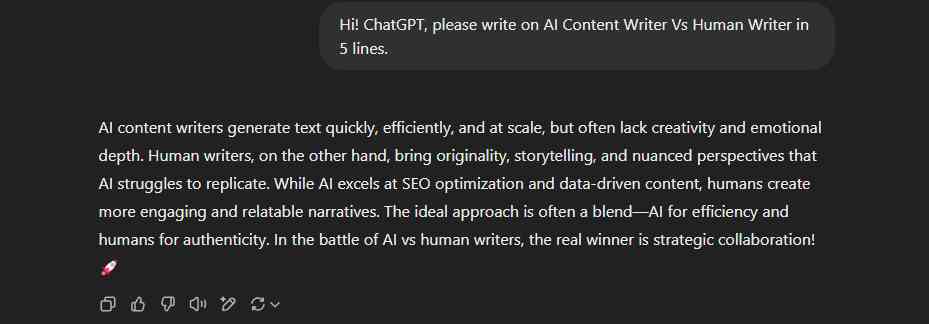
As in, it reads your prompt, checks its database to understand it, and then generates the results. Science calls it Natural Language Processing, the critics call it an attack on creativity. To cite an example for this blog, I have asked ChatGPT to write a short description.
An example of ChatGPT-generated content.
How Does AI Content Compare to Human Writing?
AI writing is sophisticated and grammatically correct, but has no personal touch. The experience AI pretends to know about is all shared experience. It is the data set that’s telling it how to navigate the prompt at hand, and that's it.
With AI in the front seat, you will never be able to establish a personal connection, as there is no trust factor at play. But to make things more interesting, we’ve asked AI to write an introduction for this blog itself.
Here is the generated result:
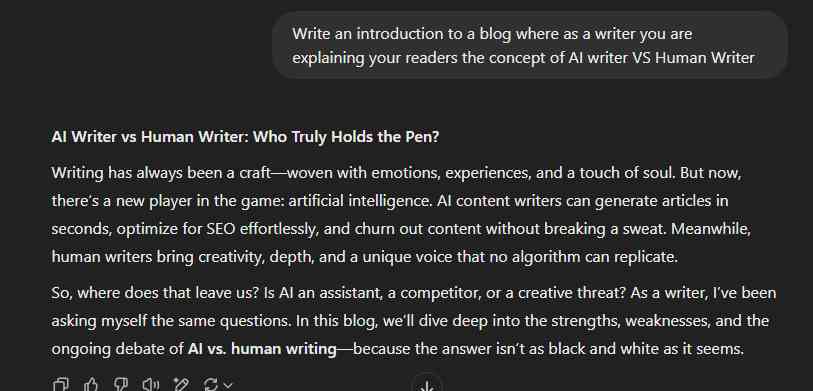
AI-generated blog introduction sample.
As you can see, the key features, or luckily, the drawbacks of AI-generated writing, can be easily understood from this generated text.
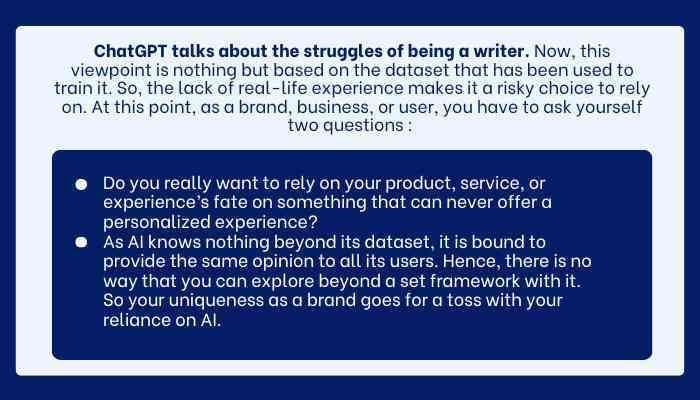
- If you look at this sentence construction, it is undoubtedly polished but has an excessively apprehensive formal tone to it. It is not that artificial intelligence’s approach will not work at all with your setup, it will, but with a heavy dependency on its human counterpart.
- Secondly, anything written by a human has a lot of space for possibilities to accommodate each type of user or audience in the conversation. Unfortunately, or in our case luckily ,with AI, we are yet to get there.
Consider a simple example: Imagine Brand A sells a laptop and wishes to write a blog on its website to bring in more traffic.
|
I know how frustrating a slow laptop can be and what features are suited to which set of functions. Throughout the blog, not only will I discuss the product but also assert the many real-life problems it intends to solve. In the above point, people will relate to the pain point of a slow laptop that’s been established by the writer. This highlights their experience with slow laptops and the need for better resources. However, this is what artificial intelligence will do:
|
Google Gemini generated prompt.
How Is AI Used in Modern Content Creation
Now, the most obvious question to ask at this point is if AI has so many lacks, why are we even considering it in mainstream conversation?
- Google restricts content that has used AI to manipulate search rankings. It has not yet declared a complete ban on artificial intelligence. Google doesn't allow a brand or a website to divulge into multiple things at once, it wishes to build a credible space. But it is yet to draw a line on machine-generated content. This has opened up a middle ground for all those businesses that tend to produce content in bulk.
- AI reduces research work to zero (if you’re not fact-checking manually) and can generate an entire piece of writing in a second. With artificial intelligence becoming more advanced, it has started to react to prompts in the most ideal way possible.
But, thankfully, there is a catch: AI is not yet a fundamental identity, so for it to generate the ideal piece of content, it has to rely heavily on humans.
You have to keep feeding it repeated prompts to arrive at the desired result. Not only that, AI is not capable of efficient fact-checking, which makes trusting it without any supervision a risky endeavor.
The Need for Human Creativity in Brand Storytelling
It is safe to say that as long as Google doesn't declare a full-blown war on writers, which is rarely a possibility, AI cannot thrive without humans. Even if in the next two years, AI is able to understand the nuances of human communication, a business has to depend on creative insights to thrive.
Experts have predicted a shift in Google’s pattern where it will rely more on content that values personalization and is a credible source to rely on.
If you look at the SEO side of things, we are seeing a growing dependency on long-tail keywords and voice search optimizations for better ranking.
If we are heading towards a direction where businesses will be forced to rely on a more personalized approach, letting go of human creativity will be a catastrophe.
Yes, AI is fast, organized, and highly efficient. But it lacks emotional intelligence, originality, and the ability to craft narratives that truly resonate with an audience. A brand isn't just about selling a product; it's about building relationships, trust, and a unique identity that stands out.
|
From an SEO standpoint Google is getting smarter about the kind of content it prioritizes. It’s no longer just about stuffing keywords into an article and hoping for the best. Instead, Google wants content that feels real, offers genuine insights, and comes from a place of expertise. It wants something that an actual human with experience can provide. Google's algorithms are evolving to prioritize helpful, experience-driven, and authoritative content (EEAT: Experience, Expertise, Authoritativeness, Trustworthiness). |
Factors to Consider When Choosing Between AI Writing vs Human Content
When choosing between AI vs human content, only speed and cost are not the factors that need to be considered. Each of them brings a different tone, quality, and credibility to your writing. AI tools can deliver content with efficiency and scale, whereas human writers provide:
- Depth
- Cultural awareness
- Emotional connection
Understanding of the distinctions will help you ensure that your content will:
Resonate with your brand voice
Meet audience expectations
Achieve the desired results
1. Emotional Connection and Creativity
The ideas and the rough drafts generated by AI are speedy by having weak nuancHumaWhereas, human writers use subtleties to create a shift in the emotion.
Consider a blog post on mental wellness. An AI generated blog post will deliver only the facts, but a human will add the sensitivity so make the content more connected and personal.
This emotional depth is important in the success of content as it makes the people act and inspire loyalty into them.
2. Speed and Scale
Speed scale is another factor to be looked upon when choosing between AI vs human content. AI can create many drafts of a document within minutes. For example, this method will be preferred by an e-commerce website to bring in thousands of products it sells to market quickly and systematically.
However, human writing is slower and more contemplative. It often makes the content more appealing and authoritative.
Human writers bring out the originality to the writings by adding a variety of narratives and perspicacious angles. These features are indispensable for campaigns having high income potential.
3. Expertise, Experience and Reliability
AI lacks the understanding to discern facts from misinterpretations or errors. The facts provided by AI can be partially or completely inaccurate. This inaccurate data can lead to loss of credibility and penal liability in highly reputable fields like healthcare and finance.
On the other hand, human writers research and check facts. They also use their knowledge about a particular field in writing the content. This is important to ensure that their copy-highlights are true. This helps generate credibility and authority, giving readers a sense of reliability on the content.
4. Consistency of Tone
AI directly reflects the dataset it is trained on. It has no inherited style of its own. It may slip when the topic shifts or audience expectations change. Whereas, human writers always keep you engrossed by moving fluidly from whitepapers to blogs and social media posts.
This adaptability of human writers doesn't make them sound cliché or mechanical. This is important when a brand voice needs to be consistently authentic, coherent, and dependable on all platforms. Also, this essence of writing will build trust among the audience.
5. Managing Resources and Costs
The upfront costs of using AI is cheap. But the cost of editing and fact-checking of the content generated by AI can be more than your expectations. While a skilled human writer is expensive at first. But the content delivered by a human writer is highly finished, reducing the costs of revisions and iterations.
The right choices depend on the goals, budget, and risk taking capacity of your business.
If you want quantity, you can go with AI. But if quality matters more, then you have to pay for human writers.
How TechAtom can help in your Content Journey?
We believe in crafting personalized content that resonates with your brand. Yes, sometimes we do wish it were easy and there was a quick template for everything. But the moment we realize we need to sacrifice on the creative process to make things easier, we do not even consider it an option.
We love putting our heart and soul into your brand’s story, as that’s the only thing we know: how to have our way with words. Plus, we understand how critical it is right now to weave authentic stories.
Whether it’s blog posts, website copy, social media content, or SEO-driven articles, TechAtom helps you navigate the content landscape with clarity, strategy, and originality. We know that in a world of automated writing, real connections are what matter.
Conclusion
For now, AI’s creative process is mostly a miss. Using AI might seem like a quick and easy fix, but it still has to work a lot on authenticity, creativity, and connection.
For businesses, AI-generated content might seem like an easy shortcut, but it comes at a cost. It lacks the depth needed to build a strong brand, connect with audiences, and rank well on search engines. As Google shifts its focus toward authenticity, expertise, and trust, human-written content that resonates with the audience and provides a personalized experience will prevail!
People are also reading: