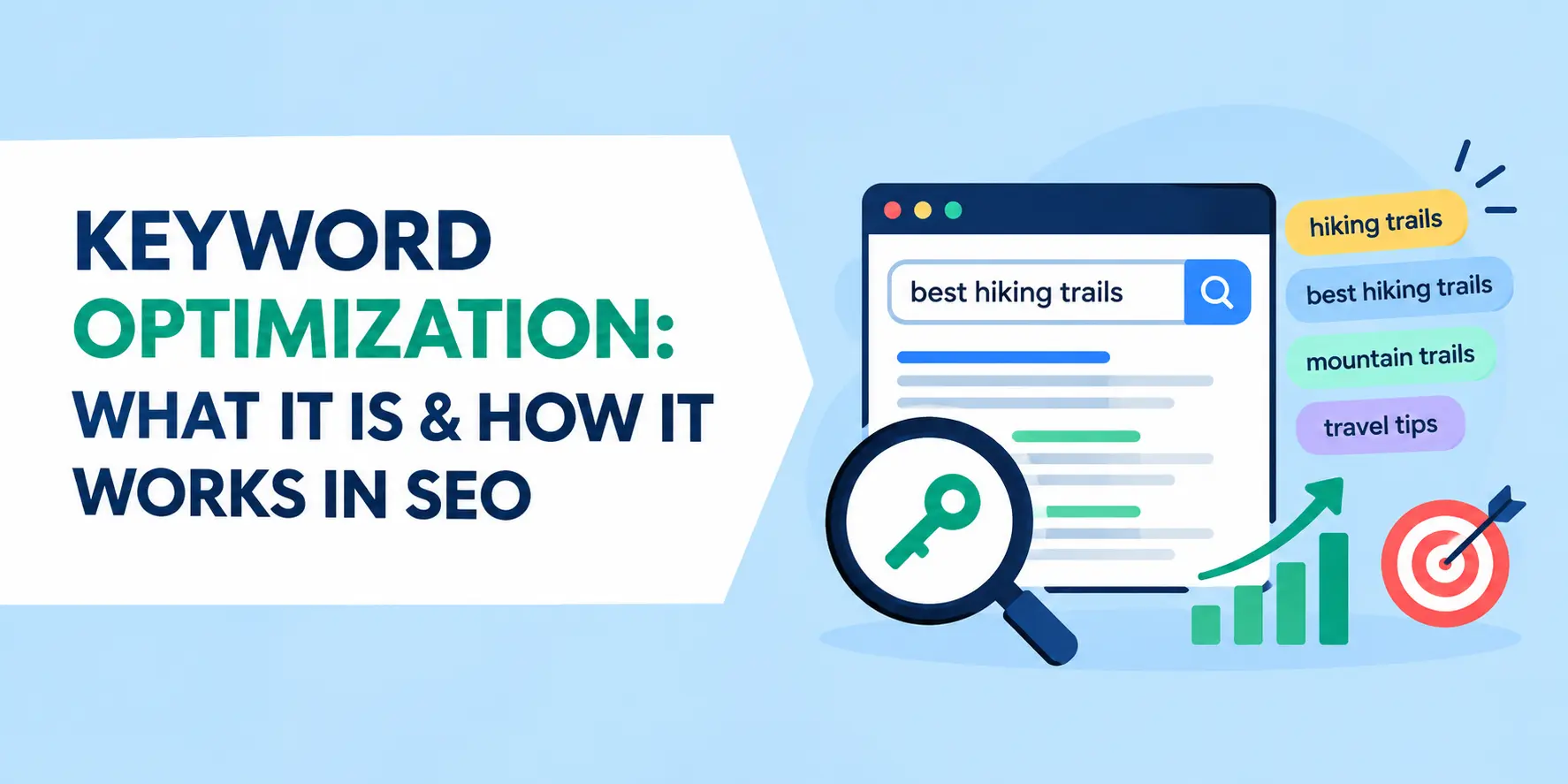

Keyword optimization is an important part of search engine optimization that helps search engines understand the topic and relevance of a webpage. It involves researching the terms people use when searching online, selecting relevant keywords, and incorporating them naturally into content and important page elements. The importance of organic search makes this process particularly valuable for businesses.
Organic search drives roughly 53% of all website traffic, highlighting why SEO and keyword optimization remain important parts of a broader digital marketing strategy. However, keyword optimization is not about repeating a phrase as many times as possible. Modern SEO focuses on relevance, search intent, context, content quality, and user experience. When keywords are optimized correctly, they help search engines understand your content while giving users information that closely matches what they are looking for.
What Is Keyword Optimization?
Keyword optimization is the process of researching, analyzing, selecting, and strategically using relevant search terms in website content. These terms connect the language people use in search engines with the information, products, or services a website provides. For example, a website selling running shoes might target terms such as "running shoes," "best running shoes for beginners," and "running shoes for women." Each keyword represents a different level of specificity and potentially a different search intent. Instead of placing all of these keywords repeatedly on one page, an effective strategy assigns them to relevant pages and uses them naturally where they provide useful context. Keyword optimization applies to both new and existing content. For new content, keyword research can guide the topic, structure, headings, and content. For existing pages, optimization can reveal opportunities to improve keyword targeting, address missing search intent, and strengthen topical coverage.
Why Keyword Optimization Matters for SEO
Keyword optimization helps search engines understand what your webpage covers and which searches may be relevant to it. Using meaningful keywords in titles, headings, content, URLs, and other appropriate areas provides additional context about the page. This can increase opportunities for your content to appear when users search for related topics. It can also help attract more qualified organic traffic. A page ranking for a specific keyword may bring more valuable visitors than one ranking for a broad term with a larger audience. For example, someone searching for "buy ergonomic office chair online" generally has a more specific need than someone searching for "office chair."
Keyword optimization can help you:
- Improve search visibility: Relevant keywords help search engines associate your page with appropriate search queries and can increase opportunities to appear in organic results.
- Attract targeted traffic: Specific keywords can bring visitors whose needs closely match your content, products, or services, improving the quality of organic traffic.
- Match search intent: Understanding why someone searches for a particular term allows you to create content that answers their question or supports their buying decision.
- Support conversions: Commercial and transactional keywords can attract users who are already researching products or are closer to taking an action.
- Improve content organization: Relevant keywords in titles and headings make content easier to understand and scan while providing search engines with additional context.
- Build topical relevance: Covering related terms and subtopics allows a page to address a subject more comprehensively instead of focusing on one isolated phrase.
How Keyword Optimization Works
Keyword optimization works through several connected stages. You first identify relevant search terms, understand what users expect from those searches, and create or improve content that satisfies those expectations. Keywords are then incorporated into important page elements without compromising readability or usefulness. After publication, search engines crawl and index the page and evaluate its relevance for different search queries. Performance can then be monitored through rankings, impressions, clicks, organic traffic, engagement, and conversions.
1. Keyword Research
Keyword research means finding the words and phrases people use to search for information, products, or services. It helps you choose relevant keywords based on search demand, competition, and user intent. According to Ahrefs, 94.74% of keywords receive 10 monthly searches or fewer, while only 0.0008% receive more than 100,000 monthly searches. Also, 34.71% of Google searches contain four or more words, showing why specific long tail keywords can be valuable for SEO.

During research, consider:
- Search volume: Estimates how frequently people search for a term and provides an indication of potential demand. However, volume should be considered alongside relevance and intent.
- Keyword difficulty: Helps estimate how challenging it may be to compete with existing ranking pages for a particular term.
- Search intent: Shows what users are trying to accomplish when they enter a query and helps determine the appropriate content format.
- Relevance: Determines whether the keyword genuinely relates to your page, products, services, and audience.
- Competition: Shows how many strong websites are competing for the same search opportunity.
- Business value: Helps identify terms that could contribute to leads, sales, registrations, or other meaningful business outcomes.
A strong keyword list should therefore contain a mixture of realistic ranking opportunities, valuable commercial terms, and specific long tail searches.
2. Search Intent Matching
Search intent is the reason behind a user's search. Understanding intent is essential because two keywords covering a similar subject may require completely different types of content.
The four common types of search intent are:
- Informational intent: The user wants to learn something or find an answer. Examples include "what is keyword optimization" and "how does SEO work."
- Navigational intent: The user wants to reach a particular website, brand, or page. Examples include "YouTube login" or "Semrush."
- Commercial intent: The user is researching products, services, or solutions before making a decision. Examples include "best SEO tools" and "Ahrefs vs Semrush."
- Transactional intent: The user is ready to complete an action such as purchasing or signing up. Examples include "buy SEO software" or "Semrush pricing."
The content should reflect the intent behind the keyword. An informational search may require a detailed guide, while a transactional search may require a product page with pricing, features, benefits, reviews, and a clear next step.
3. Strategic Keyword Placement
Once keywords are selected, they should be placed naturally in areas that help communicate the page's topic. Important locations include the title tag, H1, relevant H2 and H3 headings, introduction, body content, URL, meta description, and image alt text when appropriate. Keyword placement should support the content rather than control it. Search engines can understand related terminology and context, so natural variations can often communicate a topic more effectively than repeatedly using an exact phrase.
4. Search Engine Crawling and Evaluation
Search engines use automated crawlers to discover and analyze webpages. Crawlers examine page content and structure to understand what a page covers and whether it should be included in the search index. Search systems can evaluate context, related terminology, content structure, links, page experience, and many other signals. This means a page does not need to repeat an exact keyword dozens of times to demonstrate relevance. Comprehensive topic coverage and clear relationships between concepts can provide stronger context.
5. Ranking and Search Visibility
After a page has been crawled and indexed, search engines determine when it may be relevant to particular searches and where it should appear. Ranking depends on many factors, including relevance, content quality, authority, competition, technical performance, and other search signals. Search visibility is important because clicks are concentrated toward the top of the results. Several SEO studies estimate that the first organic result can capture a substantial share of clicks, while the top five organic results receive a large majority of clicks. This is why keyword optimization should focus on ranking for relevant and valuable searches, not simply accumulating rankings for as many keywords as possible.
Types of Keywords to Optimize
Different keyword categories help you reach users with different needs and levels of purchase intent. A balanced keyword optimization strategy considers both the purpose of the search and the specificity of the phrase.
1. Intent Based Keywords
Informational keywords are used when people want knowledge, explanations, instructions, or answers. They are useful for blog posts, tutorials, guides, educational articles, and FAQs. Navigational keywords are searches for a particular brand, website, or page. These searches often indicate that the user already knows where they want to go.Commercial keywords are used when users are researching before making a purchase. Searches containing terms such as "best," "top," "review," and "comparison" often indicate commercial investigation. Transactional keywords indicate stronger action or purchase intent. Words such as "buy," "order," "pricing," "book," and "subscribe" commonly appear in these searches.
2. Length Based Keywords
Keywords can also be categorized according to their length and specificity.
- Short tail keywords: Usually contain one or two words, such as "shoes" or "SEO." They can have high search volume but often have broad intent and strong competition.
- Mid tail keywords: Usually contain two or three words, such as "running shoes" or "SEO strategy." They provide more context while still reaching a relatively broad audience.
- Long tail keywords: Usually contain four or more words and describe a specific need, such as "best affordable running shoes for women." They may have lower search volume but can attract highly relevant visitors.
The large number of low volume and long tail queries means these terms should not automatically be dismissed because their individual search volumes are small. Collectively, they can represent meaningful search demand.
3. Other Keyword Categories
Other useful keyword categories include:
- Branded keywords: Include a company, product, or brand name, such as "Ahrefs SEO tool." These searches can help capture users who already know a particular brand.
- Geo targeted keywords: Include a specific location, such as "SEO agency in Delhi." They are useful for businesses targeting customers in specific cities or service areas.
- Primary keywords: Represent the central topic of a webpage and normally receive the strongest optimization focus.
- Secondary keywords: Cover related phrases, variations, questions, and subtopics that help expand the page's topical coverage.
Where to Place Keywords for SEO
Keyword placement in SEO helps search engines and users understand the primary subject of a page. However, every keyword does not need to appear in every location. Use the primary keyword in the most relevant areas and use variations where they improve clarity.
1. Title Tag and H1
The title tag communicates the subject of a page and often appears as the main clickable headline in search results. Including the primary keyword naturally can make the topic clear to search engines and users. The H1 is the main heading visible on the page. It should accurately describe the page's primary topic. The title tag and H1 can be similar, but they do not have to be identical. Avoid making titles unnecessarily long just to include additional keywords. Search engines may rewrite titles when they believe another version better represents the page or search result.
2. Meta Description
The meta description provides a short summary of the page. Including the primary keyword or a close variation can be useful when it fits naturally, but the description should primarily explain what users will gain from visiting the page. Meta descriptions are also not guaranteed to appear exactly as written. Search engines may generate or modify snippets depending on the query and page content. Therefore, write a useful description, but do not rely on it as a guaranteed ranking or click signal.
3. URL
A clean URL makes the topic of a page easier to understand. Including the primary keyword can be useful when it creates a short and descriptive URL.
For example: example.com/keyword-optimization/
is clearer than a long URL containing several keyword variations or unnecessary words. Some SEO studies have reported higher CTR for pages with keywords in their URLs. However, such findings should be treated as correlation rather than a guarantee that adding a keyword to every URL will increase clicks.
4. Headings and Body Content
Headings should describe the sections that follow them. Use the primary keyword in the H1 and relevant secondary keywords in H2 or H3 headings when they naturally fit the subject. Within body content, use keywords and related terms naturally. Instead of repeating "keyword optimization" in every paragraph, discuss connected concepts such as search intent, keyword research, keyword placement, organic traffic, rankings, and content relevance.
5. Image Alt Text
Image alt text should describe the image accurately and support accessibility. If a target keyword genuinely describes what the image shows, it can be included naturally. For example, an image showing a keyword research workflow could use alt text such as "keyword research and optimization workflow." Avoid adding keywords to alt text simply for SEO when they do not describe the image.
How to Create a Keyword Optimization Strategy
A strong keyword optimization strategy connects keyword research with your content and business goals. It helps you choose the right search terms, assign them to the right pages, and create content that matches what users are looking for. Instead of adding as many keywords as possible, focus on relevance, search intent, competition, and the value a keyword can bring to your website.
1. Define Your SEO Goals
Start by deciding what you want your SEO strategy to achieve. Your goal could be increasing organic traffic, generating leads, driving product sales, building brand awareness, or attracting users to specific services. Your goals help determine which keywords are most valuable. For example, an ecommerce website may focus on product related and transactional keywords, while an informational website may prioritize keywords that answer common questions.
2. Understand Your Target Audience
Learn what your audience needs, what problems they want to solve, and how they search for information online. Consider the questions they ask, the products or services they need, and the language they use when searching. Understanding your audience helps you choose keywords that reflect real search behavior rather than terms that only sound relevant to your business.
3. Research Relevant Keywords
Find keywords related to your products, services, topics, and audience needs. Evaluate factors such as search volume, keyword difficulty, competition, search intent, and business value. Do not focus only on keywords with high search volume. Lower volume and long tail keywords can often be more specific and may attract users who are closer to taking action.
4. Analyze the Search Results
Before targeting a keyword, review the pages already ranking for it. Look at the type of content appearing in search results, the topics covered, the format used, and the level of detail provided. This helps you understand the search intent behind the keyword. If most results are detailed guides, for example, creating a short promotional page may not satisfy what users are looking for.
5. Group Related Keywords
Organize similar keywords into logical topic groups. Keywords with the same or closely related search intent can often be covered on one comprehensive page instead of creating a separate page for every keyword variation. For example, terms such as “SEO keyword research,” “keyword research for SEO,” and “SEO keyword research process” may belong to the same topic group when they serve the same search intent.
6. Map Keywords to the Right Pages
Assign each keyword group to the page that can best satisfy its search intent. Give every important page a clear primary topic and use related keywords to support that topic. Keyword mapping prevents multiple pages from competing for the same search terms and helps create a more organized website structure.
7. Optimize Your Content
Once keywords are mapped, use them naturally throughout the relevant page. Include the primary keyword in important areas such as the title, H1, relevant headings, introduction, URL, and body content when appropriate. Use secondary and related keywords where they add useful context. Avoid forcing keywords into sentences simply to increase their frequency. Content should always remain natural and easy to read.
8. Strengthen Topical Coverage
Go beyond the primary keyword by covering related questions, concepts, examples, and subtopics. This gives readers more complete information and helps search engines understand the broader subject of the page. For example, an article about keyword optimization could also cover search intent, keyword placement, long tail keywords, keyword research, keyword density, and common optimization mistakes.
9. Monitor SEO Performance
After publishing and optimizing your content, track how it performs in search results. Important metrics include keyword rankings, impressions, clicks, organic traffic, engagement, and conversions. Performance data can show which keywords are generating results and which pages need further improvement. A page may receive many impressions but few clicks, for example, indicating that its title or search result presentation may need improvement.
10. Refresh and Update Content
Keyword optimization is an ongoing process. Review important pages when rankings decline, search behavior changes, competitors publish stronger content, or new keywords become relevant. Update outdated information, improve weak sections, add useful related topics, and adjust keywords when search intent changes. Regular updates can help keep your content relevant and aligned with what users are searching for.
Keyword Optimization Best Practices
Effective keyword optimization focuses on making content relevant and useful rather than simply repeating keywords. Use the following practices to create content that satisfies users and supports better SEO performance.
Prioritize Relevance Over Search Volume
Choose keywords that closely match your topic, audience, products, or services. A keyword with lower search volume can bring more valuable traffic if it attracts users who are genuinely interested in what you offer. Relevance helps ensure that the visitors reaching your page are more likely to engage with your content.
Match Content to Search Intent
Understand why users search for a particular keyword before creating or optimizing content. Check the current search results to determine whether users want a guide, product page, comparison, tutorial, or another type of content. Creating content that matches this intent can improve its usefulness and search performance.
Use Primary Keywords Strategically
Place your main keyword in important areas such as the title, H1, introduction, relevant headings, URL, and body content when it fits naturally. You do not need to repeat the keyword in every section. Strategic placement gives search engines clear signals about the main topic of the page.
Use Related Keywords and Terms
Include synonyms, variations, related questions, and supporting terms where they add useful context. This helps cover the topic more completely and makes the content more natural for readers. Related terms can also help address different ways users search for the same topic.
Maintain Natural Language
Write for people first and avoid forcing exact match keywords into sentences. Keyword stuffing can make content difficult to read and may weaken the overall user experience. Clear and natural writing should always take priority over achieving a specific keyword frequency.
Balance Short Tail and Long Tail Keywords
Use broader keywords to target wider topics and long tail keywords to reach users with more specific needs. Combining both types can help your website attract different types of searches. Long tail keywords can be especially useful for addressing specific questions and niche topics.
Consider Keyword Difficulty
Check how competitive a keyword is before targeting it. Choose keywords that match your website's current authority and ability to compete with the pages already ranking in search results. Targeting realistic opportunities can make it easier for newer or smaller websites to gain visibility.
Optimize Existing Content
Review your existing pages before creating new ones. If an older page already covers a related topic and has authority or traffic, improving it may be more effective than creating another page targeting the same keyword. Updating an established page can also preserve its existing rankings, traffic, and backlinks.
Connect Keywords to Business Goals
Prioritize keywords that can support meaningful outcomes such as leads, sales, signups, bookings, or brand awareness. High traffic is useful, but relevant traffic that supports your business goals is more valuable. This approach helps connect SEO efforts with measurable business results.
Monitor and Update Regularly
Track keyword rankings, impressions, clicks, traffic, and conversions to measure performance. Update your keyword strategy when search trends, user behavior, competition, or business priorities change. Regular monitoring helps you identify new opportunities and improve pages that are not performing as expected.
Common Keyword Optimization Mistakes
Keyword optimization becomes ineffective when the focus shifts from helping users to manipulating keyword frequency. Keyword stuffing is one of the most common mistakes because repeatedly inserting an exact phrase can make content unnatural without providing additional value.
Other mistakes include:
- Ignoring search intent: Targeting a keyword without understanding what users expect can result in content that does not satisfy the query.
- Targeting only high volume keywords: Broad terms can have significant competition and may not attract visitors who are ready to take action.
- Keyword stuffing: Repeating keywords excessively can reduce readability and make content feel written for search engines rather than people.
- Keyword cannibalization: Multiple pages targeting the same keyword and search intent can create unnecessary competition between pages on the same website.
- Using irrelevant keywords: Adding popular terms that do not genuinely relate to your content can attract the wrong audience.
- Ignoring long tail searches: Overlooking specific queries can cause you to miss lower competition opportunities with highly relevant intent.
- Over optimizing page elements: Adding keywords to every heading, image, URL, and sentence can make content repetitive and unnatural.
- Focusing only on rankings: A page can rank well but still produce poor results if the traffic is irrelevant or visitors do not take meaningful actions.
Keyword Optimization vs Keyword Research
Keyword research and keyword optimization are closely connected but represent different stages of SEO. Keyword research focuses on finding and evaluating the terms your audience uses. It helps you understand demand, competition, intent, and potential opportunities.
Keyword optimization takes those findings and applies them to actual webpages. It involves selecting the most appropriate terms for each page and using them naturally in content, headings, metadata, URLs, and other relevant elements.
|
Keyword Research |
Keyword Optimization |
|
Finds relevant search terms |
Applies selected terms to webpages |
|
Analyzes search volume and competition |
Improves page relevance and structure |
|
Identifies search intent |
Aligns content with user intent |
|
Finds content opportunities |
Optimizes new and existing pages |
|
Supports content planning |
Improves on page SEO |
In simple terms, keyword research tells you what people are searching for, while keyword optimization determines how to use those insights effectively.
How to Measure Keyword Optimization Success
Measuring keyword optimization requires more than checking whether your primary keyword reaches a particular ranking. SEO performance should be evaluated based on whether optimization increases relevant visibility, attracts useful visitors, and contributes to your broader goals.
Important metrics include:
- Organic traffic: Measures visitors arriving through unpaid search and helps determine whether overall search visibility is increasing.
- Keyword rankings: Shows how your pages perform for target terms and whether they are moving toward stronger positions.
- Search impressions: Indicates how often your pages appear in search results and can reveal growing visibility before traffic increases significantly.
- Click through rate: Shows how effectively your search result attracts clicks when it appears for a query.
- Engagement: Helps determine whether visitors find your content useful after arriving from search.
- Conversions: Measures meaningful actions such as purchases, leads, form submissions, registrations, or subscriptions.
- Keyword coverage: Shows whether your website is gaining visibility across a broader range of relevant searches.
A strong strategy should improve both visibility and traffic quality. If rankings increase but visitors leave quickly or fail to convert, the problem may involve search intent, content quality, or audience targeting rather than keyword placement alone.
Keyword Optimization Tools
SEO tools can make keyword research, competitive analysis, and performance monitoring more efficient.
- Semrush: Useful for keyword research, competitor analysis, keyword difficulty, search intent insights, and position tracking. It can help identify opportunities and monitor ranking performance.
- Ahrefs: Provides keyword research and competitor analysis features, including keyword difficulty, search demand, ranking pages, and backlink information.
- Google Keyword Planner: Provides keyword ideas and search volume estimates and can be useful for discovering terms related to products, services, and advertising campaigns.
- Moz Keyword Explorer: Helps evaluate keyword difficulty, search volume, organic click opportunities, and related keyword suggestions.
Remember that keyword tool data represents estimates rather than exact measurements of future traffic. Search volume can vary between tools, markets, and time periods. Use keyword data as a decision making input rather than treating any single number as an absolute prediction.
Keyword Optimization Example
Suppose a digital marketing website wants to create an article targeting the primary keyword "digital marketing strategy." A keyword optimization plan could look like this:
- Primary Keyword: digital marketing strategy
- Title Tag: How to Build an Effective Digital Marketing Strategy
- H1: How to Build an Effective Digital Marketing Strategy
- H2: Core Steps for Your Online Marketing Strategy
The introduction can explain what local SEO is and why it matters for businesses that serve specific locations. The article can then cover Google Business Profile optimization, local keyword research, customer reviews, local citations, location pages, and tracking local rankings.
Related keywords should be included naturally in the sections where they provide useful context. For example, “Google Business Profile” can be used in the profile optimization section, while “local search rankings” can be included when discussing how to measure SEO performance. This creates a useful and well structured page without unnecessarily repeating the primary keyword.
Conclusion
Keyword optimization connects your content with the searches your target audience makes by using relevant keywords naturally. A balanced strategy should include long tail and niche keywords, not just high volume terms. Focus on search intent, useful content, and avoiding keyword stuffing or unnecessary repetition. When combined with technical SEO, internal linking, and performance tracking, keyword optimization can improve visibility, attract relevant traffic, and support business growth. Regularly reviewing and refining your keyword strategy can also help your content stay relevant as search behavior changes.
Learn More About SEO With TechAtom
Keyword optimization is only one part of a successful digital marketing strategy. If you want to learn more about SEO, content strategy, technology, and digital growth, TechAtom offers practical guides and insights designed to help businesses and marketers keep up with changing digital trends. From improving search visibility to understanding new technologies and marketing strategies, TechAtom can be a useful resource for building a stronger online presence.
Frequently Asked Questions
1. How Do I Choose the Right Keywords for My Website?
Choose keywords based on relevance, search intent, search volume, competition, and business value. Use a mix of broad and long tail keywords that match what your audience is searching for.
2. What Is Keyword Density in SEO?
Keyword density is the percentage of times a keyword appears on a page compared with the total text. There is no ideal percentage. Focus on natural writing, useful content, and relevant keyword usage instead of repeating keywords.
3. Should I Use the Same Keyword on Multiple Pages?
Avoid targeting the same keyword and search intent on multiple pages unless each page serves a different purpose. Assign each page a clear primary topic to prevent keyword cannibalization.
4. How Often Should I Update My Keywords?
There is no fixed schedule. Review your keywords when rankings drop, search trends change, competitors improve their content, or you add new products, services, or topics.
5. Can Keyword Optimization Improve Organic Traffic?
Yes. Keyword optimization helps search engines understand your content and match it with relevant searches. However, traffic also depends on content quality, competition, authority, technical SEO, links, and search intent.
People are also reading