
When it comes to web development, you cannot ignore the frameworks. As the website development process rapidly improves, the intricacy of technologies is also rising. But when you include a well-structured framework in your plan, you can easily create a website and an impactful user experience.
And since the website consists of two server-sides: backends and client-ends, you will need frameworks suitable for both purposes. Businesses that need both front-end and back-end integration can opt for full-stack frameworks. These frameworks provide an all-in-one solution for faster deployment and seamless workflows. This article will include backend and front-end web frameworks that you can use in 2026.
What Are Web Development Frameworks?
A web development framework consists of collections of tools and libraries that help developers create web applications. The purpose of a web development framework is to provide developers with some pre-written code, components, and patterns to improve the efficiency of the development process. Web development frameworks can be categorized into the following types:
- Front-end frameworks - These frameworks are focused on user interface and experience (UI/UX). Examples include React, Angular, and Vue.js.
- Back-end frameworks - Back-end frameworks along with backend development tools are focused on server-side logic, database management, and application integration. Examples are Node.js (Express), Django, and Laravel.
Having a proper mix of frontend and backend development tools will provide the developer with capability, performance, scalability, and the perfect experience for the user.
Why Use a Web Development Framework?
Modern web frameworks are designed to keep up with today’s performance, security, and scalability requirements while ensuring developers can innovate quickly.They also provide a way of doing the binding work such as routing, authentication, data access, and security, allowing for a decrease in time spent developing and errors in the code. With the help of active communities and continual updates, frameworks also help with code quality, maintainability, scalability, and adapting to modern expectations for web development best practices. There are many advantages to using web development frameworks in the development process, including:
- Speed and Efficiency: It allows developers to create applications faster with less coding.
- Consistency and Flexibility: It is easy to maintain applications in the long term and easy to add features.
- Security: It will have built-in security features to help with security vulnerabilities.
- Community Support: This supports a large community of developers to help and provide resources to developers.
- Scalability: Frameworks will scale applications as they grow more in size and complexity.
- Testing and Debugging: Development frameworks will usually have tools and features that will improve testing and debugging.
10 Top Web Development Frameworks in 2026
1. Backend Frameworks: Express
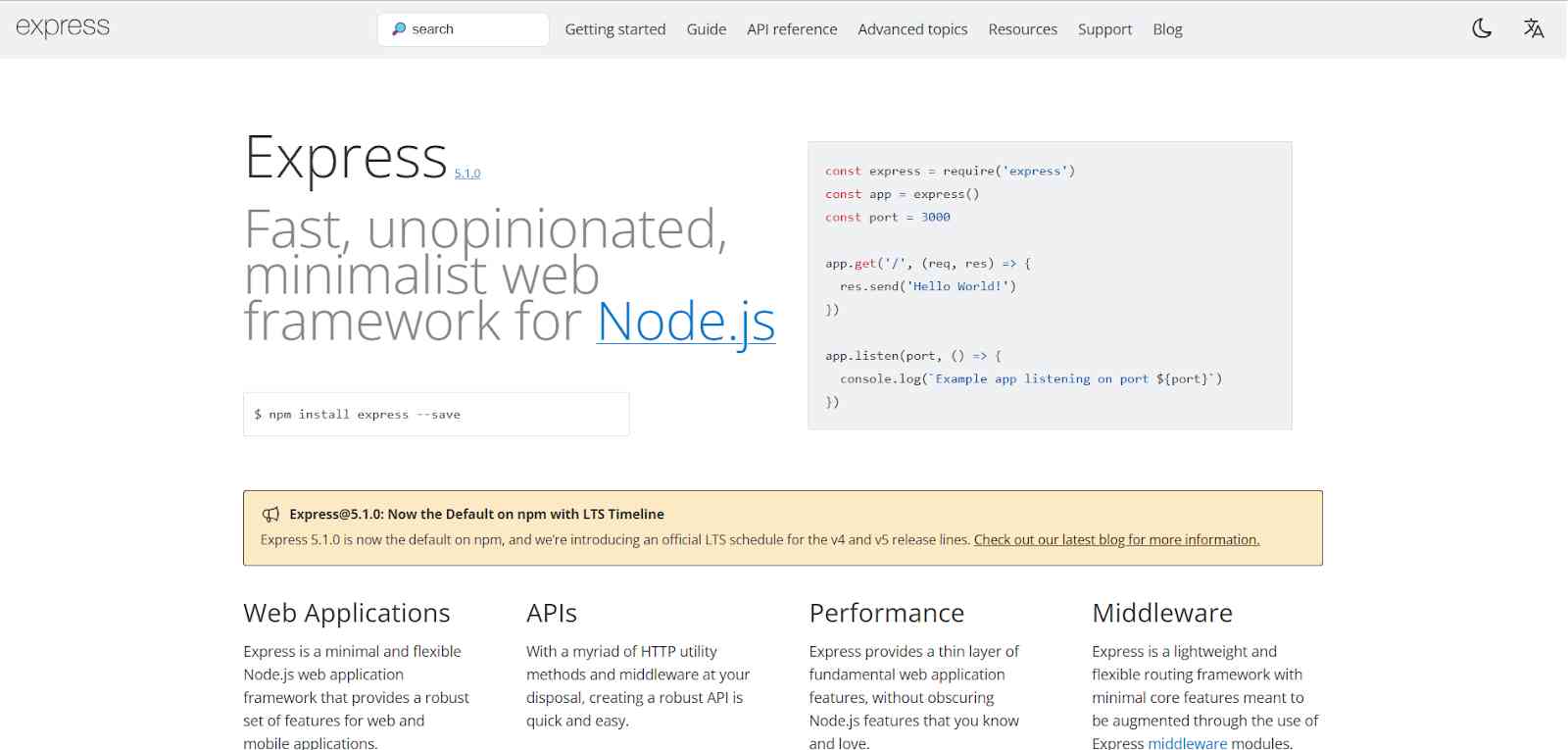
Express is a Node.js framework designed for the backend of web apps and APIs of websites. It is a popular framework used by IBM, Accenture, Uber, and many high-end companies. It is also known to be a server-side framework and is fast, lightweight, and minimalistic.
Over the years, Express has gained so much popularity that some frameworks have been built on Express.js, such as KeystoneJS, ItemsAPI, etc. The Express framework has become a vital part of the JavaScript programming language. In 2022, Express was voted one of the most popular backend frameworks because it is powerful, flexible, and supports REST APIs and entire applications.
But the only disadvantage we have witnessed to Express is that it has a very small library, and most of its functions are managed by plugins. Still, it is a great choice for beginners.
Key features
- Caching supported
- Middleware support
- It has numerous templates to design HTML pages
- Minimalistic web apps
Pros
- Flexible
- It is simple to grasp.
- Scalable
- Low maintenance cost
- Great community support.
Cons
- The small core library
2. Backend Frameworks: Django
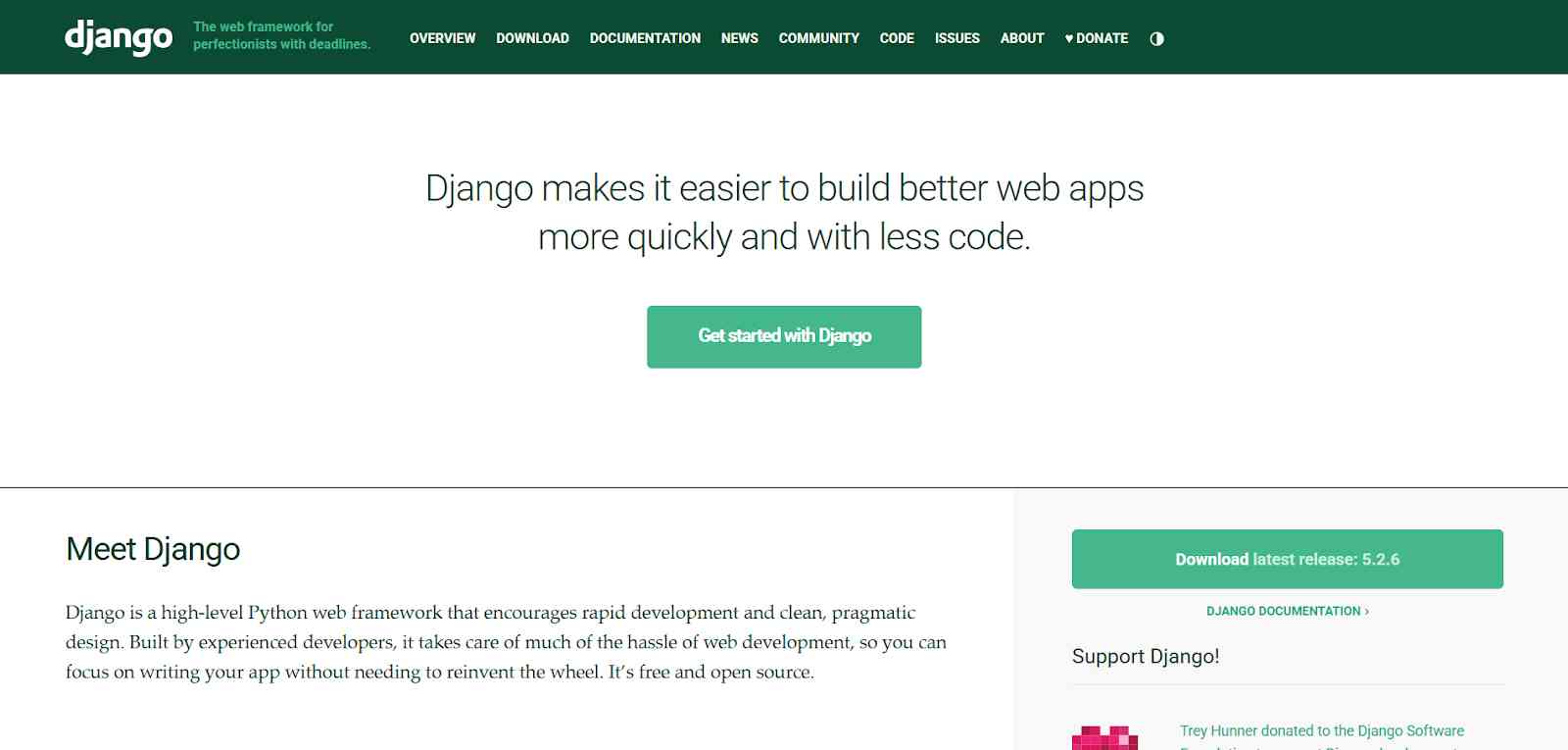
Django is one of the best backend frameworks that has become popular for creating scalable web apps. This Python-based framework is mostly used for social networking sites but works well with client-side applications. You can use it with any data format, such as JSON, XML, or HTML. Since it is open-sourced, you can change its codes anytime to create a more suitable design for your website.
However, the framework was created for seasoned web developers, and it is the best choice for API integrations such as GraphQL. Django offers several benefits.
According to the Stack Overflow Developer Survey, Django is the hottest framework for backend website development in 2023. Popular online platforms like YouTube, Google, Instagram, etc., are created with this framework. Another thing we must include while talking about Django is its battery-included features. That means you will only get what you need from this framework.
For example, you can choose two-factor authentication, messaging, etc., for your website. But don’t worry; no matter what additional feature you choose, security will always come by default.
Key features
- Top-notch security features
- Highly scalable
- Built on top of Python
- Battery included; you don’t have to write codes from scratch.
Pros
- SEO optimized
- Fast development
- Versatile, wide community support
Cons
- URL spacing is difficult
3. Backend Frameworks: Spring
Spring is widely adopted in enterprise web development and is mainly responsible for creating Java-based enterprise apps on top of any kind of deployment platform. It comes with a convenient programming and configuration model that also supports creating web apps on top of Java EE.
Spring is an open-sourced framework with high ratings on GitHub and some great reviews from top-notch companies like Deleo Korea, Craftbase, Meisterplan, and more. And if you want to talk about the security integration of the Spring framework, then you must know that it is integrated with MySQL, AngularJS, Axon, Apache Dubbo, etc., tools.
However, learning how to use the Spring framework might be a little complex if you don’t have experience with the Java programming language. Nevertheless, if you know Java, then you can scale your projects in a jiffy with Spring.
Key features
- Lightweight
- Aspect-Oriented Programming (AOP)
- Container
- Transaction Management
- Integrated with other frameworks
- Dependency injection
Pros
- Developers can employ the Spring framework in web applications.
- It allows link modules for free.
- Different configuration methods
- POJO models that are lightweight
- Middleware support
Cons
- only suitable for large-scale projects
4. Frontend Frameworks: Angular
Google introduced Angular in 2010 and has become instantly popular due to its open-sourced nature. It was rewritten from scratch in 2016 to be appropriate for creating large-scale JavaScript-based web applications with high performance. The framework is suitable for creating web pages, SPAs, and smartphone and desktop applications.
According to a report by Statista, Angular is the most popular framework for front-end web development, used by about 30% of developers worldwide. If you view Angular on GitHub, you will see it has over 75.9k ratings. And since popular companies like Xbox and BMW have used Angular, it is reasonable why the framework has become so popular. Angular applies TypeScript as well as CSS and HTML to create consistency in web development. It also sets benchmarks for frontend development trends, influencing how user interfaces are built globally.
Key features
- It reduces the development time.
- The templates are defined with HTML tags.
- Reuse codes
- Open-source libraries
- Angular CLI
- Chrome/Firefox developer tools support
Pros
- Cross-platform compatible
- secure and reliable
- Fast development
- Excellent performance
- Open-source libraries
- Suitable for creating complex websites,
- Examples: YouTube, Xbox, Google Translate
Cons
- SEO options are limited.
5. Frontend Frameworks: Vue
Vue is the alternative to Angular and React. It was created in 2010 and became famous due to its attractive UI. Vue is one of the JavaScript web frameworks that combines the View Layer from Angular and the Virtual Dom from React. Because of the impressive combination of traits from the most popular frameworks, it won developers’ choice awards in 2014. And nowadays, developers use Vue to create responsive web applications.
If you go to GitHub, you will see it has over 180k user ratings. More than 167k websites have been built using Vue in just a few years. You can create interactive user interfaces with a flexible design supporting TypeScript with Vue. It also offers two-way data binding.
This means that if you change the user interface, that change will be effective on both the data and the interface and the other way around.
Key features
- Virtual DOM
- CLI (Command-line Interface)
- Data Binding
Pros
- Fast and lightweight,
- Flexible
- Easy integration
- community
- easy to understand
- Used by Grammarly, Xiaomi, Alibaba, etc.
Cons
- Instructions and descriptions are written in Chinese
6. Frontend Frameworks: React
Developed by Facebook in 2013, React quickly became one of the dominant technologies for creating dynamic web frontend interfaces. Although technically a library, React is often grouped with web development libraries and frameworks because it is flexible and capable of handling complex applications where users interact a lot.
The introduction of the virtual DOM changed how developers saw updating the UI of an application. Using the virtual DOM, React intelligently determines what pieces of the UI require rendering, and only does so with the components that change, permitting very efficient updates to the user interface. React gained traction with a very popular component model, which is still in use today, allowing teams to create larger, more sustainable, and faster applications that span a wider variety of digital experiences.
Key features
- Declarative syntax
- Component-based
- Virtual DOM
- JSX
- Unidirectional data flow
- Hooks
- Reusable components
- Strong ecosystem
Pros
- Fast development
- Modular UI
- Improved performance
- Debugging tools
Cons
- Smaller community
- Frequent updates/documentation gaps
7. Backend Framework: Laravel
Laravel is a free and one of the popular open-source frameworks developed for PHP by Taylor Otwell. Laravel emphasizes an elegant and expressive syntax to facilitate the development process, especially for common web development tasks. Laravel makes use of the Model-View-Controller (MVC) pattern, and the orientation of Its documentation supports building an application efficiently and consistently. Laravel is one of the most widely used PHP frameworks in the world, and Laravel allows you to easily develop websites with its powerful set of common tools for development, and supports common tasks like web routing, authentication, or to support simple to complex database models. Laravel is recognized for its ease of use and its ease of learning. The Laravel framework contains features that can assist a developer, or team of developers, to build everything from a simple web project to a more large services orientated application. It encourages developers to write clean, sustainable code, to support modern websites.
Key Features
- MVC architecture
- Easy routing
- Built-in authentication
- Blade templating
Pros
- Artisan CLI
- Simple templates
- Eloquent ORM
- Flexible routing
Cons
- Relies on packages
- Limited support
- Complex for beginners
8. Backend Framework: ASP.NET Core
Developed by Microsoft, ASP.NET Core is a free and open-source web development framework that can be used to develop scalable web applications and services. It is the successor of ASP.NET, which is a prominent framework used to develop web applications. In order to accommodate many applications, from simpler websites to more complex cloud-based applications, the scope of the framework was designed to provide a lightweight, fast, and flexible plugin system.
ASP.NET Core is built on the .NET platform, which supports multiple programming languages including C#, F#, and many more. ASP.NET Core is a powerful and versatile framework that can be used to develop a myriad of web applications and services. Overall, ASP.NET Core is a fitting framework for developers that harness a host of easily accessible features to build high-performance, secure, and scalable applications.
Key Features
- Cross-platform, open-source framework
- High performance and fast scalability
- Built-in security protections
- Modular architecture and active community
- Free cloud hosting options
Pros
- Modular, reduces app size
- Integrates with HTML, CSS, JavaScript
- Strong security features
Cons
- Higher development/deployment costs possible
- Customization limits for complex needs
9. Backend Framework: Flask
Flask is lightweight and one of the unbiased Python web frameworks. It is designed to speed up web app development and to make possible the simple construction of applications. Flask offers essential features for developers to build simple or moderately complex web projects by not overwhelming them with tools and features that aren't needed. Flask’s lightweight nature enables quick prototyping, building single page applications, or using Flask in situations when the developer wants to maintain a more full control of the application stack and architecture.
Key Features
- Jinja2 templating
- Simple routing
- Python environment
- Web socket support
Pros
- Minimalistic
- Fast, lightweight
- Flexible
- Easy integration
Cons
- Limited features
- External library reliance
10. Frontend Framework: Svelte
Svelte is a new web-building framework started by Rich Harris in 2016. It demonstrates a different way of constructing web interfaces than other frameworks in the frontend ecosystem using a positive environment for its use. Its difference lies in the fact that it does not use a virtual DOM like other front-end frameworks, but instead compiles the application code into highly optimized, vanilla JavaScript during the build process. This approach leads to faster runtime performance and smaller bundle size, making Svelte an appealing fit for developers who appreciate simplicity but need runtime speed when constructing modern web applications.
Key Features
- Compiles to JavaScript
- Reactive declarations
- Minimal boilerplate
Pros
- Easy to learn
- High performance
- Attractive APIs
- Reduced runtime overhead
Cons
- Build-time complexity
- Not ideal for large projects
Conclusion
So these are the top 10web application frameworks that will be in high demand in 2026. Among these frameworks, JavaScript and Python are the most advanced options for creating fast and well-developed websites.
There are, of course, many other frameworks that could be suitable for your particular kind of project, but most of the time, these five are universal and versatile for all kinds of web application development. If you want more guidance on when to use which framework for your business, then you can refer to our other articles.
The five options that we have mentioned in this post are based on our survey data. Feel free to choose one that is compatible with your project. If you need help, we are always available in the comment box below.
Frequently Asked Questions
1. What is the difference between a library and a framework?
A library consists of reusable functions that a developer is able to call as they wish, most times controlling the flow of the application. A framework consists of a predefined structure and mostly controls the flow of the application, which may require developers to make allowance for the framework's structure which may include developer conventions, structures, libraries, and/or functionality.
2. Which framework is best for full-stack development in 2026?
Some popular frameworks/libraries that are best for 2026 and beyond are Express, Django, React.js (MERN stack), Angular, and ASP.NET Core which offer the best front-end to back-end connection and performance.
3. Which frameworks are best for enterprise-level applications?
ASP.NET Core, Spring Boot, and Django stand out for performance, security, scalability, and built-in enterprise design features for larger applications used in the enterprise domain.
4. What are the two most popular frameworks for small business web development?
Ruby on Rails and Flask have become widely popular for web projects for small businesses and web sites due to their simplicity, development cycles, developer costs, and open-source costs.
5. Are there any Web Frameworks for beginners?
Flask, Django, and Ruby on Rails are easy to learn for beginners with extensive documentation, communities, and quick setups.