
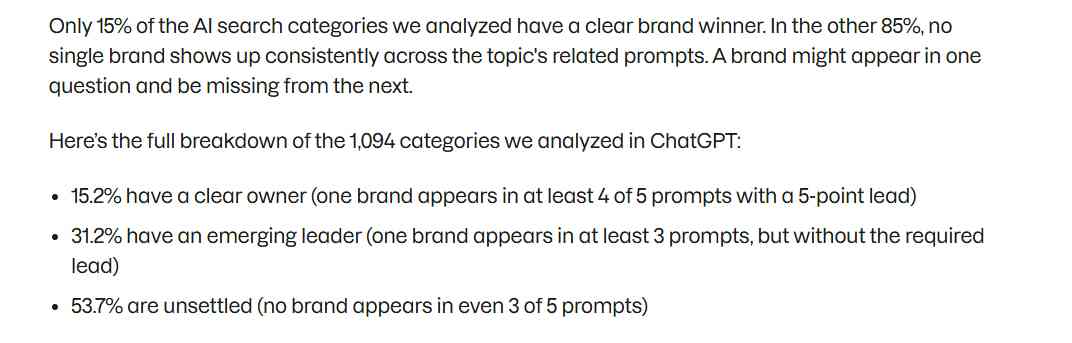
Topical authority is the depth and relevance a website demonstrates around a specific subject. Instead of targeting individual keywords with disconnected articles, it involves creating useful content that covers the main topic, related subtopics, and different search intents. Topical coverage is also becoming relevant to AI search. A 2026 Semrush study of 1,094 ChatGPT categories found that only 15.2% had a clear brand owner, while 53.7% remained unsettled across related prompts.
In this guide, we'll cover how topical authority works, why it matters for SEO, how to build it, and the key metrics you can use to measure your progress.
What Is Topical Authority?
Topical authority is the expertise and depth a website shows on a specific subject. It is not about repeating one keyword. Instead, it means creating useful content that covers the important questions and related topics around a subject.
For example, a website targeting content marketing could cover:
- Content marketing strategy
- Content calendars
- Content distribution
- Content optimization
- Content marketing tools
- Content marketing metrics
- B2B content marketing
- Content marketing examples
When these pages are useful and connected through relevant internal links, they create stronger coverage of the overall topic.
Topical authority is not an official Google score. It is an SEO concept used to describe how comprehensively and credibly a website covers a subject.
The main idea is simple: covering a topic deeply is more valuable than targeting a single keyword repeatedly.
How Does Topical Authority Work?
Topical authority develops when a website consistently creates useful, relevant, and well-connected content around a specific subject. Search engines can better understand the website’s expertise when its pages cover the main topic, related subtopics, different search intents, and the connections between them. No single factor creates topical authority on its own. It comes from the overall depth, relevance, quality, and structure of the website’s content.
Topic Depth and Coverage
Topic depth means covering the important subtopics around a subject in a useful and detailed way. Instead of publishing many thin pages, focus on creating valuable content that answers different questions related to the main topic.
- Crawling and indexing
- XML sitemaps
- Robots.txt
- Canonical tags
- Redirects
- JavaScript SEO
- Structured data
- Core Web Vitals
- Technical SEO audits
This creates deeper coverage than a single general article. However, topical authority does not mean publishing dozens of thin pages. The goal is to cover important subtopics thoroughly and usefully.
Search Intent
Search intent refers to what users are actually looking for when they search. Covering informational, commercial, and practical queries helps your website address different needs within the same topic.
For example:
- “What is keyword research?” is informational.
- “Best keyword research tools” shows commercial investigation intent.
- “How to do keyword research” has practical informational intent.
Although all three relate to keyword research, each requires a different type of content. Covering these different intents helps create a more complete topic.
Internal Linking
Internal links connect related pages across your website, creating a clear content structure that helps users navigate between related topics while helping search engines understand the relationships and depth of your content.
For example, a main SEO guide could link to detailed pages about keyword research, technical SEO, search intent, and link building. Those pages can link back to the main guide when relevant.
The links should be natural and useful. Simply adding large numbers of internal links does not create topical authority.
Expertise and Trust
Your content should also demonstrate that the information is reliable and useful. This is particularly important for topics such as health, finance, law, and cybersecurity.
You can strengthen your content with:
- Experienced authors
- First-hand experience
- Original research
- Expert contributions
- Case studies
- Testing and examples
- Reliable references
- Clear author information
Google's guidance emphasizes helpful, reliable, people-first content and encourages publishers to demonstrate relevant experience and provide substantial value.
The Evolution of Topical Authority
Topical authority has evolved as search engines have become better at understanding context and relationships between topics. Earlier SEO focused heavily on individual keywords, but modern search looks beyond exact keyword matches to understand the broader subject and search intent.
For example, a comprehensive technical SEO article may naturally cover crawling, indexing, redirects, sitemaps, JavaScript SEO, and structured data instead of creating separate pages for every keyword variation.
AI-powered search is pushing this shift further. Google reported that AI Overviews had reached more than 1.5 billion users per month by May 2025 and were available in 200+ countries and territories and more than 40 languages by May 2025 .
Topical authority is not an official Google ranking score, but comprehensive and trustworthy topic coverage has become increasingly relevant as search evolves.
Why Is Topical Authority Important for SEO?
Topical authority can help a website build broader search visibility and establish a stronger reputation around a subject. It also gives your content strategy a clear structure by connecting related pages around a central topic.
More Organic Traffic
Covering a subject from multiple relevant angles gives your website more opportunities to appear for related searches.
For example, an SEO website can create useful content around keyword research, technical SEO, on-page SEO, local SEO, link building, and search intent. Each topic can target different searches and bring new visitors to the site.
However, the goal is not to create a separate page for every keyword. When multiple keywords have the same search intent, one strong page may be more useful than several similar articles.
More Relevant Backlinks
Useful, comprehensive content is more likely to attract backlinks when it provides something worth referencing.
This could include original research, industry data, case studies, expert insights, or detailed guides. A well-researched SEO study, for example, may earn links from marketing websites and industry publications that reference its findings.
The focus should be on creating content people want to cite rather than publishing pages simply to increase the number of URLs on your site.
Increased Brand Reputation
Consistently publishing useful content around a subject can strengthen your brand's association with that topic.
For example, a company that regularly publishes high-quality content about technical SEO, keyword research, and content optimization may become more recognizable as an SEO resource.
Over time, this can contribute to brand searches, referrals, backlinks, and greater audience trust.
Supporting E-E-A-T
E-E-A-T stands for Experience, Expertise, Authoritativeness, and Trustworthiness. It is not a single Google ranking score, but Google's guidance uses these qualities when discussing helpful and reliable content.
Topical authority can support E-E-A-T when a website consistently demonstrates genuine knowledge and experience. This can include first-hand testing, original research, expert contributions, accurate references, and clear author information.
Topical authority and E-E-A-T are related, but they are not the same thing. One focuses on the depth of a website's coverage, while E-E-A-T describes qualities that help make content and its source trustworthy.
Signs a Website Has Topical Authority
There is no single metric that proves a website has topical authority. Instead, look at several signals together, including content coverage, internal links, relevant rankings, and visibility across related searches.
A Strong and Relevant Domain
A website that consistently publishes useful content around a subject can develop stronger topical relevance than a site with only a few articles on that topic. Relevant external references can strengthen this further.
For example, a website that regularly publishes cybersecurity research and is referenced by security publications demonstrates stronger subject relevance than a general website with one cybersecurity article.
However, overall domain authority does not mean a website is authoritative on every subject.
A Robust Internal Link Profile
A well-connected internal link structure is another sign of organized topical coverage.
For example, pages about keyword research, search intent, keyword clustering, and content strategy can link to one another where relevant. This helps users and search engines understand the relationship between different pages.
The goal is to create useful connections, not add links simply for SEO.
Ranking for Related Keywords
Websites with broader topic coverage often rank for multiple related searches rather than just one primary keyword.
For example, an email marketing website may rank for terms related to email strategy, automation, newsletters, segmentation, and campaign optimization.
The number of ranking keywords alone does not prove topical authority. What matters is whether those rankings represent meaningful coverage of the subject.
Visibility in AI Search and LLMs
AI search provides another way to look at topic-level visibility. A 2026 Semrush study analyzed 1,094 U.S. categories in ChatGPT and found that 15.2% had a clear category owner, 31.2% had an emerging leader, and 53.7% remained unsettled.
Semrush defined a clear category owner as a brand appearing in at least four of five related prompts and leading the next brand by at least five percentage points.
This is third-party research, not a Google ranking formula. It does, however, show how AI visibility can be evaluated across groups of related questions rather than a single search query.
Best Practices to Build Topical Authority
Building topical authority requires more than publishing a large number of articles. Your content should cover relevant subjects in depth, match user intent, demonstrate expertise, and create useful connections between related pages.
Create an Effective Content Strategy
Start with topics that are closely connected to your business, audience, and expertise.
Ask:
- What does our audience want to know?
- What problems do our customers face?
- Which topics are closely related to our products or services?
- Where do we have genuine expertise?
Once you identify your main topic, break it into meaningful subtopics. For example, an SEO website could cover keyword research, search intent, on-page SEO, technical SEO, link building, and local SEO.
This gives your content strategy a clear direction without creating unnecessary pages.
Build Topic Clusters
Topic clusters organize related content around a central subject. A pillar page covers the broad topic, while supporting pages provide deeper information about specific areas.
For example:
Pillar: SEO Guide
Supporting content: Keyword Research, Technical SEO, Search Intent, Link Building, Local SEO
Link these pages where it makes sense to create a logical content structure. However, do not create dozens of pages simply to complete a topic cluster. Every page should serve a clear purpose for your audience.
Understand User Intent
Before creating content, understand what the searcher actually wants.
A query such as “what is keyword research?” needs an explanation, while “best keyword research tools” suggests that the user is comparing options. Your content should match the format and depth users expect from the search results.
Build High-Quality Links
Relevant backlinks can strengthen the visibility and credibility of your content. Instead of focusing only on link quantity, create resources that other websites have a reason to reference.
Useful linkable assets include original research, industry data, case studies, expert insights, and detailed guides.
Define Your Brand Voice
Consistent writing helps your website develop a recognizable identity. Your tone should match your audience while remaining clear, useful, and consistent across different topics. A technology company may use a practical technical tone, while a travel website may use a more conversational style.
Add Subject Matter Expert Insight
Expert contributions can make content more useful and difficult to replicate with generic information. Experts can add practical advice, real examples, industry experience, original data, or case studies. This gives readers information that goes beyond simply summarizing what is already available online.
Keep Your Content Updated
Topical authority also requires maintaining your existing content. Review important pages regularly and update outdated statistics, examples, links, screenshots, product information, and recommendations.
Google's guidance emphasizes creating helpful, reliable, people-first content. Updates should make the content genuinely more useful rather than simply changing the publication date.
Topical Authority Metrics
There is no universal topical authority score, so it is better to measure several signals together.
|
Metric |
What to Measure |
|
Organic traffic |
Traffic from related topics |
|
Ranking keywords |
Relevant keywords your pages rank for |
|
Keyword coverage |
Important subtopics you cover |
|
Internal links |
Connections between related pages |
|
Backlinks |
Relevant links from other websites |
|
Referring domains |
Unique websites linking to your content |
|
AI mentions and citations |
Your brand or pages appearing in AI answers |
Look at these metrics together rather than relying on one number. If your content starts ranking for a wider range of relevant searches and earning links from relevant websites, it can indicate that your topical coverage is growing.
AI visibility can also be tracked separately. Semrush's 2026 research found that domain-level metrics such as Authority Score, organic traffic, and branded search volume aligned with ChatGPT topic ownership only about half the time in its dataset.
This shows why topical authority should be evaluated through multiple topic-level signals, rather than a single domain-wide metric.
Conclusion
Topical authority is about creating useful, in-depth content around a subject rather than targeting keywords one by one. Focus on covering relevant subtopics, matching search intent, connecting related pages, and demonstrating expertise.
The goal is simple: build a website that becomes a trusted resource for the topics that matter to your audience and business.
Frequently Asked Questions
1. What is topical authority in SEO?
Topical authority is the depth and credibility a website builds by consistently covering a specific subject with relevant and useful content.
2. Is topical authority a Google ranking factor?
No. Google does not publish a specific ranking factor called topical authority. It is an SEO concept used to describe strong topic coverage and relevance.
3. How do I build topical authority?
Focus on a clear subject, cover its important subtopics, match search intent, connect related pages with internal links, and demonstrate genuine expertise.
4. How many articles are needed to build topical authority?
There is no fixed number. It depends on the size and complexity of the topic. Focus on useful coverage rather than publishing a set number of articles.
5. Do backlinks help topical authority?
Relevant backlinks can support your content’s credibility and visibility, but backlinks alone do not create topical authority. Strong content coverage is still essential.
6. Does topical authority help with AI search?
It does not guarantee AI visibility. However, broader and consistent coverage of a subject can be relevant as search expands into AI-powered experiences.
People are also reading:
- SEO for Small Business
- SEO for App Store
- SEO for Fashion Ecommerce
- SEO for Real Estate Lawyers
- E-E-A-T in 2026
- SEO for AI Agents