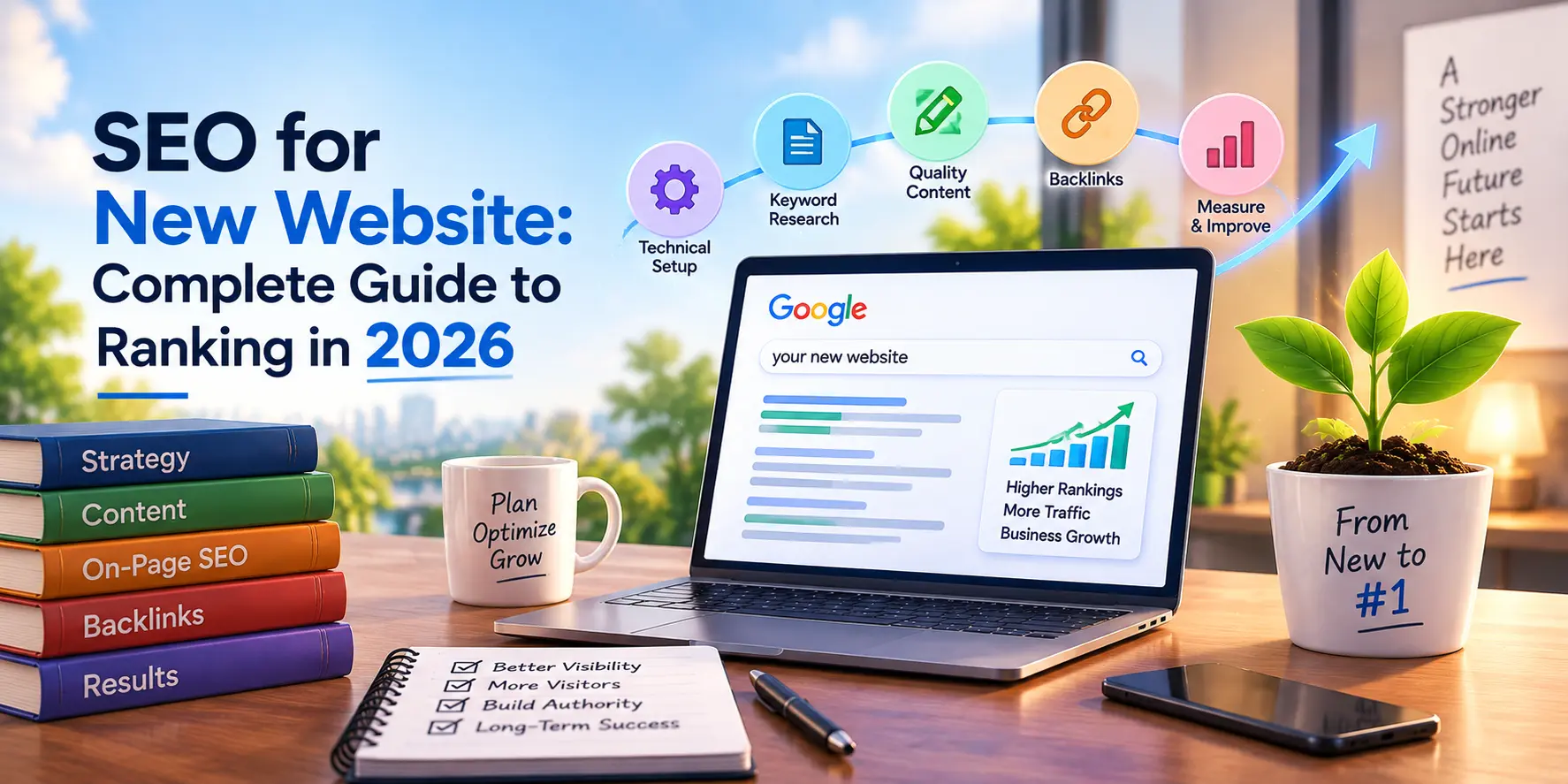

Launching a new website is exciting, but getting consistent visitors from Google takes more than simply publishing pages and waiting for rankings. A new website has little or no search history, authority, backlinks, or established trust, which means SEO needs to be built into the website from the beginning. Organic search drives around 53% of website traffic, making it an important source of long term visibility for businesses and publishers.

The good news is that a new website can build search visibility with the right approach. Instead of trying to rank immediately for highly competitive keywords, focus on creating a technically sound website, targeting relevant and achievable search terms, publishing genuinely useful content, building authority gradually, and measuring what works. This guide explains how to do SEO for a new website in 2026, from pre launch setup to content, backlinks, AI search visibility, and your first 90 days.
What Is SEO for a New Website?
SEO for a new website is the process of improving its technical structure, content, relevance, user experience, and authority so search engines can understand and rank its pages. It includes everything from choosing the right keywords and creating logical URLs to improving page speed, internal linking, content quality, and earning relevant backlinks. New website SEO is slightly different from optimizing an established site because there is usually little historical data or authority to work with. Your early strategy should therefore focus on building a strong foundation and earning visibility through relevant, lower competition searches before competing for broader, high volume terms.
Why SEO Matters for a New Website
Search engines remain one of the most important ways people find websites, products, services, and answers online. Around 68% of online experiences begin with a search engine, while the first organic result can receive roughly 27.6% to 34% of clicks depending on the query and study. At the same time, less than 1% of users typically click through to the second page, showing why search visibility matters.
A new website cannot depend on its domain being recognized immediately. SEO helps build that visibility over time by making your pages easier to crawl, understand, and match with relevant searches. It can also reduce dependence on paid advertising by creating a source of organic traffic that can continue generating visits after the initial content and optimization work is complete.
SEO Before Launch: What to Set Up First
SEO should start before your website goes live. Set up a clear site structure, clean URLs, HTTPS, mobile optimization, fast loading, robots.txt, an XML sitemap, Google Search Console, Google Analytics 4, and correct canonical and indexing settings from the beginning.
1. Plan Your Site Architecture and URL Structure
Your site architecture should make it easy for visitors and search engines to move from broad topics to more specific pages. A simple structure such as Homepage, Category, Subcategory, and Individual Page works well for many websites. Keep important pages within a reasonable number of clicks from the homepage and use descriptive URLs that clearly communicate what each page is about. Avoid creating complicated URL structures or changing URLs repeatedly after publication. Consistent URLs make it easier to manage internal links, redirects, indexing, and backlinks as your website grows.
2. Set Up HTTPS, Mobile Optimization and Website Speed
HTTPS should be enabled across the website because it protects the connection between the visitor and your site. Mobile optimization is equally important because Google uses the mobile version of a site for indexing and ranking under mobile first indexing. Your pages should therefore work properly across different screen sizes, with readable text, usable buttons, and content that is available on mobile.
Speed also affects the experience visitors have after clicking your result. For Core Web Vitals, Google considers an LCP of 2.5 seconds or less a good threshold. Mobile performance deserves particular attention because mobile devices account for roughly 60% to 63% of global web traffic, and industry research has found that even a one second delay can significantly reduce conversions.
3. Create robots.txt and XML Sitemap
A robots.txt file tells search engine crawlers which areas of your website they should or should not crawl. It should not be treated as a method for removing a page from Google's index because a blocked URL can still potentially appear in search results without its content being crawled.
An XML sitemap provides search engines with a list of important URLs that you want them to discover. A sitemap can improve URL discovery, especially for a new website, but submitting one does not guarantee that every URL will be crawled or indexed. Keep the sitemap clean and include only URLs that you want search engines to consider.
4. Set Up Google Search Console and Google Analytics
Google Search Console should be connected as soon as possible so you can monitor indexing, search queries, impressions, clicks, click through rate, and technical issues. It also allows you to see how Google is interacting with your website and identify pages that may need attention. Google Analytics 4 serves a different purpose by helping you understand what visitors do after reaching your website. Together, these tools give you a clearer picture of both search performance and user behavior.
Keyword Research for a New Website
Keyword research is essential for a new website because it helps you target searches you can realistically rank for. Instead of focusing only on high volume keywords dominated by established websites, choose relevant, lower competition and long tail keywords. Long tail searches account for more than 91% of searches and often have stronger user intent, helping new websites build visibility before targeting more competitive terms.
1. Find Low Competition and Long Tail Keywords
Start by identifying the main topics your audience cares about and then expand each topic into more specific searches. For example, instead of targeting only running shoes, a new website could target searches such as best running shoes for beginners, running shoes for flat feet, or how to choose running shoes for daily training. Look at relevance, competition, search intent, and business value rather than search volume alone. A keyword with fewer searches can be more valuable than a broad keyword if the people searching it are much closer to taking action.
2. Match Keywords With Search Intent
Search intent explains what someone actually wants when they enter a query into Google. Your page should satisfy that purpose instead of simply repeating the keyword. The four common types are informational, commercial, transactional, and navigational intent.
|
Search Intent |
Example Keyword |
Suitable Page |
|
Informational |
how to choose running shoes |
Guide or article |
|
Commercial |
best running shoes for beginners |
Comparison or buying guide |
|
Transactional |
buy running shoes online |
Product or category page |
|
Navigational |
Nike running shoes |
Brand or product page |
Matching intent correctly can improve the usefulness of your content and reduce the chance of creating pages that target a keyword but fail to satisfy what searchers actually want.
3. Map Keywords to the Right Pages
Once you have your keywords, assign them to specific pages before creating content. One primary search intent should generally have one clear page rather than several pages competing against each other for the same term. This process is called keyword mapping and can help reduce keyword cannibalization. For example, a website selling fitness products might have one category page focused on running shoes and separate articles covering topics such as choosing running shoes, running shoes for beginners, and running shoe maintenance. Each page has a distinct purpose while supporting the larger topic.
Create an SEO Content Strategy
A new website needs content that serves users and builds topical relevance. Start with essential product, service, category, and informational pages, then create supporting content around relevant questions and topics. Use topic clusters with a main pillar page and related supporting pages connected through internal links to help users and search engines understand your website.
1. Create Helpful and Original Content
Publishing large quantities of generic articles will not automatically improve rankings. In fact, 96.55% of newly published web pages receive zero organic search traffic from Google, according to a widely cited industry analysis, which highlights how difficult it is for new content to gain visibility without strong targeting, relevance, or authority. Your content should offer something useful that competing pages do not. This could include original research, first hand experience, expert commentary, comparisons, testing, original images, examples, data, or clearer practical instructions. The goal is not simply to make a longer article but to create a page that genuinely solves the searcher's problem.
2. Build Content Around User Questions
Questions provide a natural way to understand what your audience needs. Look at related searches, customer questions, product discussions, forums, support requests, and the questions appearing around your target topics. Answer important questions directly and add enough context to make the answer useful. This approach can also make content easier for search engines and AI systems to interpret because the relationship between the question and answer is clear.
On Page SEO for a New Website
On page SEO helps search engines and users understand what each page is about. Every important page should have a clear primary topic, descriptive title, logical heading structure, useful body content, relevant internal links, and an appropriate meta description. Avoid trying to insert the same keyword into every heading or paragraph. Search engines can understand related language and concepts, so write naturally while making the main topic clear.
1. Optimize Titles, Meta Descriptions and Headings
Your title should accurately describe the page and give users a reason to click. Keep it specific rather than stuffing multiple variations of the same keyword into it. Meta descriptions should summarize what the page offers and encourage a relevant click, although Google may generate a different snippet when it believes another section better matches the search.
Use one clear H1 for the main page topic and organize supporting information with H2 and H3 headings. A logical heading structure makes longer pages easier to scan and understand.
2. Optimize Images and Image Alt Text
Images can improve the usefulness and visual quality of a page, but large unoptimized files can slow down loading. Compress images, use appropriate file formats, and avoid uploading files that are significantly larger than the dimensions needed on the page.
Alt text should describe the meaningful content or purpose of an image when the image conveys information. Do not fill alt text with keywords that have little connection to the image.
Internal Linking Strategy for a New Website
Internal links connect pages within your own website and help users find related information. They also help search engines understand how different pages relate to each other and which topics are important to the site. When publishing a new page, look for older relevant pages that can naturally link to it. Likewise, add links from the new page to other useful resources. Use descriptive anchor text that tells users what they will find after clicking instead of relying heavily on generic phrases such as “click here.”
How to Build Authority and Backlinks
Backlinks can help a new website build authority, but quality matters more than quantity. Focus on earning relevant links from trustworthy websites by creating useful resources such as original research, statistics, detailed guides, case studies, or helpful tools, then promote them to relevant websites, publishers, and industry communities.
1. Build Relevant Brand Mentions and Backlinks
Not every authority building activity needs to produce an immediate backlink. Brand mentions, industry profiles, partnerships, expert contributions, digital PR, and useful community participation can increase awareness and create opportunities for people to reference your website naturally. Focus on relevance and quality rather than manipulating anchor text or buying large numbers of links. Sustainable authority comes from being useful and credible within your specific industry.
2. Avoid Spammy Link Building
New websites are often targeted by services promising hundreds or thousands of backlinks for a small fee. These shortcuts can create a large number of irrelevant or low quality links without building genuine authority. Avoid automated backlink software, link farms, excessive exact match anchor text, comment spam, bulk low quality directories, and paid links that violate search engine guidelines. A smaller number of relevant, editorially earned links is a much healthier foundation.
SEO for AI Search and AI Overviews
Search is changing in 2026 as AI Overviews, AI Mode, and conversational search experiences increasingly provide direct answers. However, Google has stated that websites do not need a separate technical SEO system specifically for AI Overviews or AI Mode. The same foundational SEO practices remain important. This means your website should still focus on crawlability, helpful content, clear organization, strong relevance, and authority. At the same time, content should be written in a way that makes important information easy to identify and understand.
1. Make Your Brand and Content Easy for AI Systems to Understand
Make it clear who your company is, what you offer, who you serve, where you operate, and what makes your business different. Author information, company information, contact details, expertise, experience, and supporting evidence can all help create a clearer understanding of your website. Use consistent information across important pages and avoid creating anonymous content with no clear source or expertise. A strong brand identity can become increasingly important as search shifts from traditional blue links toward systems that summarize information from multiple sources.
2. Create Clear and Extractable Content
AI systems need to understand the information on a page before they can use it effectively. Clear headings, direct answers, definitions, examples, tables, lists, statistics, and supporting evidence can make important information easier to interpret. This does not mean writing specifically for AI at the expense of people. The best approach is to make content easy for humans to read and easy for search systems to understand. With up to 87% of marketers now using AI to help create content, genuinely useful and original information becomes even more important for standing out.
Build Presence on Trusted Sources
Your website should not be the only place where your brand appears online. Relevant industry websites, publications, business profiles, expert interviews, reviews, partnerships, and other trustworthy sources can help establish broader brand recognition. This is particularly useful for businesses because search engines and AI systems can use information from multiple sources when understanding entities, brands, products, and organizations. Consistent and credible information across the web can strengthen that understanding.
SEO for a New Website: First 90 Days
The first 90 days should focus on building a reliable foundation rather than expecting immediate top rankings. A new website needs time for search engines to crawl pages, evaluate content, understand the site's topic, and collect signals about its relevance and authority.
Final Pre Launch SEO Checks
Before launching, check that important pages can be crawled and indexed, URLs work correctly, HTTPS is active, mobile pages function properly, internal links work, the XML sitemap is available, and unnecessary staging or test pages are blocked or removed. Also check page titles, headings, metadata, canonical settings, image optimization, redirects, structured data where appropriate, and analytics tracking. These checks can prevent technical problems from becoming larger issues after launch.
First 30 Days
During the first month, concentrate on getting the fundamentals right. Confirm that important pages are being indexed, monitor Search Console for problems, publish your core pages, and establish a reliable measurement system. Do not panic if rankings appear limited during this period. New websites often need time before meaningful search data begins to accumulate. Use early impressions and indexing information to identify whether Google is finding and understanding your pages.
Days 30 to 90
After the first month, start expanding your strongest topic areas and improving pages that are already receiving impressions. Look for queries where your pages are appearing but not yet attracting many clicks, then improve titles, content depth, intent alignment, internal links, and page usefulness where appropriate. This is also a good time to build relevant backlinks and brand mentions, strengthen your internal linking structure, improve conversion paths, and identify new content opportunities. Monitor organic traffic, rankings, queries, indexing, conversions, technical issues, and visibility in AI search experiences.
How to Measure SEO Performance for a New Website
SEO performance should not be judged only by rankings. New websites may take time to reach competitive positions, so early indicators such as indexing, impressions, search queries, and long tail visibility can provide useful evidence that the site is moving in the right direction.
Track the following metrics regularly:
- Indexed pages and indexing issues
- Search impressions and clicks
- Click through rate
- Search queries and keyword visibility
- Organic conversions and leads
- Relevant backlinks and brand mentions
- Organic traffic
- AI search visibility where measurable
- Technical SEO issues
Look for trends rather than expecting every metric to increase every week. A page moving from no impressions to regular impressions is meaningful progress even if it has not reached the first page yet.
Common SEO Mistakes New Websites Should Avoid
New websites often make the mistake of trying to do too much too quickly. The biggest problems usually come from weak targeting, poor technical foundations, low quality content, or strategies designed to manipulate rankings rather than provide value.
1. Publishing Before Checking Indexing
You can publish dozens of pages without realizing that important pages cannot be crawled or indexed. Check Search Console and your technical settings before assuming your content is visible in Google. After publishing, use the URL Inspection tool in Google Search Console to confirm that important pages are eligible for indexing.
2. Changing URLs Repeatedly
Frequent URL changes can create broken links, redirects, indexing changes, and unnecessary SEO complications. Choose a logical URL structure early and keep it stable whenever possible. If a URL must be changed, set up a relevant permanent redirect and update internal links to the new URL.
3. Targeting Only High Volume Keywords
High search volume does not automatically mean high value. Competitive keywords can take much longer to rank for, so new websites should balance broader terms with relevant long tail and lower competition opportunities. Build your initial keyword strategy around terms where your website has a realistic chance of competing based on relevance, intent, and existing authority.
4. Ignoring Search Intent
A page can contain the right keyword and still fail because it does not provide what searchers want. Always review the type of pages ranking for a query and make sure your content serves a similar intent while providing something useful. Before writing, examine the current search results to understand whether users expect a guide, comparison, product page, service page, or another type of content.
5. Publishing Thin or Repetitive Content
Creating many pages with little original value can make a website look less useful rather than more authoritative. Each page should have a clear purpose and provide information that deserves to exist separately. Before publishing a new page, ask whether it adds meaningful information or value that is not already covered elsewhere on your website.
6. Building Backlinks Too Early
A new website does not need hundreds of backlinks immediately. Build a useful content foundation first, then focus on earning relevant links and mentions naturally instead of relying on bulk link packages. Start with a small number of genuinely useful, link worthy resources that give other websites a reason to reference your content.
7. Overusing Keywords
Repeating a keyword unnaturally can make content difficult to read and does not guarantee better rankings. Use the primary keyword naturally and cover related concepts that help answer the user's question. Write for the reader first and use related terms naturally where they improve clarity and topic coverage.
8. Ignoring Mobile Users
A website that works well on desktop but performs poorly on mobile can create a frustrating experience. Check navigation, buttons, typography, images, forms, and loading performance on smaller screens. Test important pages on actual mobile devices as well as desktop tools to catch usability problems that automated checks may not fully reveal.
9. Treating AI Generated Content as Automatically Good
AI can help with research, outlines, editing, and content workflows, but generated text still needs human review, fact checking, originality, and useful insights. Simply publishing large amounts of generic AI content is unlikely to create the experience or authority a new website needs.
How Long Does SEO Take for a New Website?
There is no fixed timeline for SEO because results depend on competition, industry, website quality, content depth, authority, search demand, and how consistently the site is improved. A new website may start receiving impressions relatively early, but meaningful ranking movement commonly takes several months, while competitive keywords can take considerably longer. A practical expectation is to think in terms of months rather than weeks. During the early stage, focus on signals such as indexing, first impressions, long tail rankings, increasing organic clicks, early conversions, backlinks, brand mentions, and growing visibility rather than expecting immediate number one rankings.
New Website SEO Checklist
Use this checklist to make sure your basic SEO foundation is covered.
Technical SEO
- HTTPS enabled
- Mobile friendly design
- Fast loading pages
- Core Web Vitals monitored
- robots.txt configured correctly
- XML sitemap created
- Important pages crawlable and indexable
- Search Console connected
- Analytics tracking installed
Site Structure
- Logical navigation
- Clean and stable URLs
- Clear category structure
- Important pages easy to reach
- Relevant internal links
- No unnecessary duplicate pages
Keyword Research
- Primary topics identified
- Long tail keywords researched
- Search intent reviewed
- Keyword difficulty considered
- Keywords mapped to appropriate pages
- Keyword cannibalization avoided
Content
- Core pages published
- Topic clusters planned
- Content answers real user questions
- Original insights included
- Content reviewed for accuracy
- Pages updated when information changes
On Page SEO
- Unique page titles
- Useful meta descriptions
- Clear H1 headings
- Logical H2 and H3 structure
- Images optimized
- Relevant alt text
- Natural keyword usage
- Helpful internal links
Authority
- Link worthy resources created
- Relevant brand mentions pursued
- Industry relationships developed
- Quality backlinks earned
- Spammy link building avoided
Measurement
- Search Console monitored
- Organic traffic tracked
- Search queries reviewed
- Impressions and clicks measured
- Conversions tracked
- Technical issues monitored
- AI search visibility reviewed where possible
Conclusion
SEO for a new website is a gradual process, not a shortcut to instant Google rankings. A strong foundation of technical SEO, realistic keywords, useful content, clear site structure, internal linking, and relevant authority signals helps build long term visibility. In 2026, AI Overviews, AI Mode, and conversational search make clear, original, and trustworthy content even more important. Focus on achievable keywords, improve your website consistently, and use the first 90 days to understand what works. Over time, these efforts can turn a new website into a reliable source of organic traffic.
Stay Updated With the Latest Technology Trends
SEO is constantly changing as search engines, AI tools, and digital technologies evolve. For more practical insights on SEO, AI, technology, and the latest digital trends, visit TechAtom and keep up with useful information that can help you make smarter decisions for your website and online growth.
Frequently Asked Questions
1. How do I start SEO for a new website?
Start with technical SEO, site structure, keyword research, and core content. Then optimize individual pages, build internal links, earn relevant authority signals, and monitor performance through Google Search Console and Analytics.
2. How long does SEO take for a new website?
New websites can begin receiving impressions relatively early, but meaningful ranking growth usually takes several months. Competitive keywords may require considerably more time and authority.
3. What keywords should a new website target?
Focus on relevant long tail and lower competition keywords that match your audience's search intent. As your website gains authority, you can gradually target broader and more competitive terms.
4. How many blog posts should a new website publish?
There is no ideal number of posts. It is generally better to publish fewer high quality pages that answer specific user needs than to publish large amounts of repetitive content.
5. Does AI content hurt SEO?
Using AI does not automatically make content bad, but publishing generic, inaccurate, repetitive, or unhelpful content can create quality problems. AI should support the content process while human expertise, originality, fact checking, and useful insights remain central.
People are also Reading