
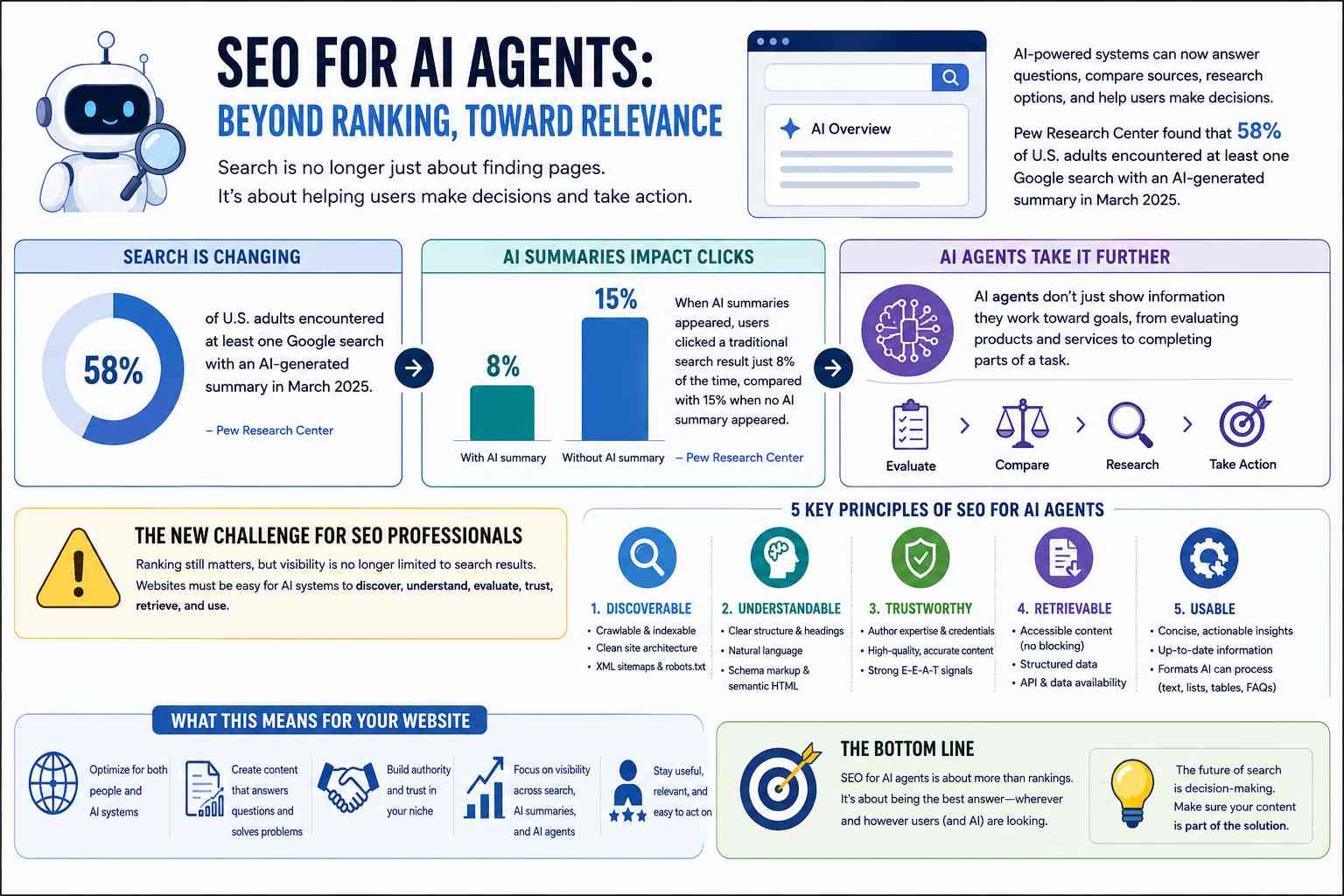
For years, SEO focused on one goal: rank higher, get visibility, and earn clicks. But search is changing. AI-powered systems can now answer questions, compare sources, research options, and help users make decisions. Pew Research Center found that 58% of U.S. adults encountered at least one Google search with an AI-generated summary in March 2025. When these summaries appeared, users clicked a traditional search result just 8% of the time, compared with 15% when no AI summary appeared.
AI agents take this shift further by working toward specific goals, from evaluating products and services to completing parts of a task.
This creates a new challenge for SEO professionals. Ranking still matters, but visibility is no longer limited to search results. Websites also need to be easy for AI systems to discover, understand, evaluate, trust, retrieve, and use.
That is the foundation of SEO for AI agents optimizing your website so it can remain visible and useful as search evolves from finding pages to helping users make decisions and take action.
What Is SEO for AI Agents?
SEO for AI agents is the practice of optimizing a website and its digital information so AI-powered systems can discover, understand, evaluate, retrieve, and use it when helping users complete tasks.
Traditional SEO focuses on helping search engines crawl, index, understand, and rank webpages. SEO for AI agents builds on these fundamentals while also considering AI-assisted research, comparison, recommendations, and actions.
To evaluate a business, product, or service, an AI system may need to understand:
- Who the business is
- What it offers
- Who it serves
- What problems it solves
- Its features and specifications
- How it compares with alternatives
- Whether the information is current
- Whether the source is credible
- What evidence supports its claims
- What the user can do next
For example, if a user asks an AI assistant to find a project management tool with automation, Slack integration, and transparent pricing, the system may need to research, compare, and evaluate several options.
SEO for AI agents does not replace traditional SEO. Technical SEO, crawlability, indexability, useful content, and internal linking remain essential foundations. Google confirms that its AI search experiences continue to rely on existing Search systems and SEO best practices.
AI Search Engines vs. AI Agents: What’s the Difference?
AI search engines and AI agents both use artificial intelligence to help users find information, but their roles are different. AI search engines primarily retrieve, understand, and summarize information, while AI agents can work toward a specific goal by researching, evaluating, comparing, and, where supported, taking actions.
AI Search Engines Focus on Information
AI search engines interpret a user's query, retrieve relevant information, analyze sources, and generate a direct or conversational response. They help users research topics, answer questions, and compare information without requiring them to manually visit multiple websites.
The process can be summarized as question, search, retrieve information, analyze sources, and generate an answer.
For example, a user might ask, “What are the best CRM tools for small businesses?” The AI system can gather relevant information from multiple sources and summarize the available options.
AI Agents Focus on Goals and Tasks
AI agents go beyond simply providing an answer. Depending on their capabilities, they can use information, reasoning, and connected tools to work toward a specific user goal.
The process can involve goal setting, research, information retrieval, evaluation, comparison, decision-making, and action.
For example, a user could ask, “Find three CRM tools for my five-person sales team, compare their pricing and automation features, and recommend the best option.” An AI agent may research different tools, compare their features and pricing, evaluate them against the user's requirements, and help identify the most suitable option.
This difference matters for SEO because AI-driven systems need clear, accurate, accessible, and trustworthy information to evaluate businesses, products, and services.
The Shift From Search Results to AI-Mediated Decisions
Traditional search generally follows a search, results, click, and website journey. AI-assisted discovery can involve a broader process of question, research, evaluation, Answer, recommendation, and action.
This shift means websites need to provide information that is clear, accurate, accessible, trustworthy, and useful for decision-making.
This does not mean traditional search is disappearing. Instead, the way users discover and evaluate information is expanding.
Rather than performing several searches, users can increasingly ask AI systems to research a complex question and compare relevant options. For SEO professionals, this means content needs to do more than rank for keywords. It should make important information easy to discover, understand, evaluate, and use.
Discovery
Can AI-powered systems find your website and relevant information?
Understanding
Can they clearly understand what your business, product, or service offers?
Evaluation
Does your content provide enough specific information to assess your offering?
Trust
Are your information, claims, sources, and expertise credible?
Retrieval
Can important facts and details be easily identified when needed?
Recommendation
Does your website provide enough relevant information for your brand to be considered for a user's specific needs?
Action
If the user wants to move forward, is the next step clear and accessible?
This is the broader shift behind SEO for AI agents: moving from simply ranking webpages to becoming a clear, useful, and trustworthy source throughout the AI-assisted discovery and decision-making journey.
Why Do AI Agents Matter for SEO?
AI agents matter for SEO because they are changing how users discover information, compare options, make decisions, and take action. Instead of manually visiting multiple websites and researching every option, users can increasingly ask AI systems to handle parts of that process.
For example, users may ask AI systems to:
- Research a topic
- Compare products or services
- Find suitable providers
- Evaluate software
- Summarize reviews and opinions
- Check product specifications
- Compare pricing and features
- Identify the best options for specific requirements
- Analyze alternatives
- Help complete a task or workflow
This creates a broader definition of search visibility. A website is no longer competing only to rank in traditional search results. It may also need to become a useful, credible, and relevant source that AI systems can retrieve and consider when answering questions or helping users make decisions.
For SEO professionals, the opportunity is clear: visibility is evolving from simply being found in search results to being understood, referenced, recommended, and ultimately chosen during AI-assisted journeys.
From Rankings to References, Recommendations, and Actions
Traditional search rankings still matter, but AI-driven search is expanding what visibility means. A website may now need to be visible at multiple stages of the user's journey, from discovering information to comparing options and taking action.
Search Visibility
Does your website appear prominently in traditional search results for relevant queries?
Information Visibility
Can AI-powered systems discover and retrieve useful information from your website?
Brand Visibility
Does your brand appear when users ask AI systems questions related to your industry, products, or services?
Recommendation Visibility
Is your business considered when AI systems compare options or recommend products and services?
Action Visibility
Can users clearly understand what they can do next, such as buy, book, contact, sign up, or request a quote?
The goal is not to replace traditional rankings with AI citations. Instead, SEO is expanding from optimizing for search-result visibility to building a website that can be discovered, understood, trusted, referenced, recommended, and acted upon throughout an AI-assisted user journey.
How AI Systems Discover and Evaluate Websites
There is no single formula that determines how every AI system discovers or selects information. Different platforms may use different models, search indexes, retrieval methods, tools, and ranking or source-selection systems. However, several core principles can make a website easier to discover, understand, evaluate, and trust.
1. Make Your Website Accessible
AI systems need access to the information they may retrieve. Important pages should be crawlable, indexable where appropriate, technically sound, and connected through clear internal links.
Review your:
- Crawlability and indexability
- Robots.txt
- XML sitemaps
- Internal linking
- HTTP status codes
- Canonical URLs
- JavaScript-dependent content
Strong technical SEO remains the foundation.
2. Provide Clear Context
Make it immediately clear what your business, product, service, or page is about. Avoid vague marketing language when specific information can communicate the same idea more effectively.
Instead of: “We provide powerful solutions for growing businesses.”
Write: “Our software helps small businesses automate invoice processing, approval workflows, and payment tracking.”
Specific information gives both users and AI-powered systems clearer context.
3. Build Strong Entity Clarity
Clearly define the important entities associated with your website, including:
- Business or organization
- Brand
- Products and services
- Authors and experts
- Locations
- Industry
- Areas of expertise
Keep this information consistent across your website and other credible sources. Clear and consistent brand information can make it easier for systems to understand who you are, what you offer, and where you fit within your industry.
4. Provide Complete, Useful Information
A page should answer the important questions users are likely to have instead of forcing them to search elsewhere.
For a SaaS product, this may include:
- What it does
- Who it is for
- Key features
- Integrations
- Pricing
- Use cases
- Limitations
- Documentation
- Support options
For an e-commerce product, provide details such as:
- Product name and brand
- Specifications
- Price
- Availability
- Variants
- Materials and dimensions
- Shipping
- Returns
The more clearly relevant information is presented, the easier it is for users and systems to evaluate the offering.
5. Add Original Value
Generic information is increasingly easy to reproduce. Your strongest advantage is information that provides something competitors cannot simply copy.
Prioritize:
- Original research
- First-hand experience
- Expert analysis
- Proprietary data
- Customer insights
- Product testing
- Case studies
- Original comparisons
- Unique examples
Before publishing, ask:
“What does this page provide that users cannot easily get from dozens of other websites?”
That question helps shift content from generic coverage to genuine value.
6. Strengthen Trust and Reliability
AI-powered systems can be used to support decisions, making the quality and reliability of information important. Build credibility through:
- Clear authorship and relevant expertise
- Accurate and up-to-date information
- Transparent sourcing
- First-hand experience
- Original research
- Evidence for important claims
- Clear company information
- Appropriate citations and references
- Regular content updates
The goal is not to create artificial “AI trust signals.” The goal is to build a website that genuinely deserves to be trusted.
How to Optimize for AI Agents
There is no single tactic that guarantees visibility in AI-powered search or agentic systems. The most reliable approach is to make your website technically accessible, easy to understand, trustworthy, useful, and clear about what users can do next. These principles build on strong SEO fundamentals while preparing your content for AI-assisted discovery and decision-making.
1. Structure Content for Clear Understanding
Organize each page so users and AI-powered systems can quickly identify the main topic and supporting information. Use descriptive headings, concise paragraphs, lists, tables, and direct answers where they improve clarity.
For example, a SaaS product page can clearly separate:
- Features
- Pricing
- Integrations
- Use Cases
- Who It's For
- Limitations
- Support
A clear structure makes important information easier to find without forcing unnecessary formatting or repetitive content.
2. Cover Topics, Concepts, and Relationships
Keywords still matter, but repeating the same phrase is not enough. Build content around the topic and the concepts that naturally belong to it.
For example, a page about email marketing software may need to discuss:
- Automation
- Segmentation
- Integrations
- Deliverability
- Templates
- Analytics
- Pricing
- Target users
The goal is not to include every related keyword. It is to explain the topic thoroughly and naturally so its important concepts and relationships are clear.
3. Make Your Brand and Entities Clear
AI systems need context to understand businesses, products, services, people, and organizations.
Clearly communicate:
- Who you are
- What you offer
- Who you serve
- What category you belong to
- Where you operate
- What you specialize in
- Why your business is credible
Keep important information consistent across your website and other relevant sources. Your homepage, About page, product or service pages, author information, and contact details should create a consistent picture of your brand.
4. Create Original, Non-Commodity Content
Generic content can be easily reproduced, while original insights give your website a stronger reason to be trusted and referenced. Focus on adding information that comes from real experience, research, testing, or expertise.
Prioritize:
- Original research, data, and findings
- First-hand experience and expert insights
- Product testing and real-world results
- Customer feedback and observations
- Detailed case studies
- Original comparisons and analysis
- Unique examples and practical recommendations
- Proprietary knowledge, processes, or insights
What useful information does this page provide that a generic AI-generated summary cannot easily reproduce?
Use AI to support content production where appropriate, but make sure the final content contains genuine expertise, evidence, and value.
5. Use Structured Data Accurately
Structured data can help search engines understand specific information on a webpage and may support eligibility for certain search features.
Depending on the page, relevant schema types can include:
- Organization
- Person
- Article
- Product
- SoftwareApplication
- LocalBusiness
- Service
- BreadcrumbList
However, structured data is not a guaranteed AI visibility or ranking factor. Only use markup that accurately represents the information on the page, and follow the relevant search-engine guidelines.
6. Keep Important Information Current
AI-assisted systems and users need reliable information. Regularly review pages containing information that can change, such as:
- Pricing
- Product specifications
- Services
- Availability
- Business information
- Statistics
- Policies
- Opening hours
- Documentation
An otherwise valuable page can become misleading when its important facts are outdated. Set a review process for content where freshness matters.
7. Strengthen Your Technical SEO
AI optimization does not replace strong technical SEO. Search engines and AI systems still need to crawl, understand, and access your content efficiently. A technically sound website also provides a better experience for users.
Review your:
- Crawlability and indexability
- Robots.txt configuration
- XML sitemaps
- Internal linking structure
- Canonical URLs
- Redirects and HTTP status codes
- JavaScript rendering
- Duplicate or thin content
- Page experience and Core Web Vitals
- Mobile usability
Make important information available in accessible text where appropriate rather than hiding essential details behind unnecessarily complex interfaces.
8. Make Important Information Easy to Retrieve
Important information should be easy to find without forcing users or systems to search through an entire page. Organize essential facts where they naturally fit so readers can quickly understand what you offer and what they need to do next.
For example, a service page should clearly explain:
- What the service is
- Who it is for
- What is included
- Pricing or how pricing is determined
- Important limitations or requirements
- Availability and service coverage
- How to get started
You do not need to artificially break every paragraph into short “AI-friendly” chunks. Write naturally and organize information logically.
9. Use Images and Videos When They Add Value
Visual content can make information easier to understand, particularly for products, locations, processes, demonstrations, and tutorials.
Use:
- Original product images
- Process diagrams
- Demonstration videos
- Tutorials
- Before-and-after examples
- Location or facility images
Optimize images with descriptive filenames and appropriate alt text where relevant. The goal should be to improve understanding and user experience—not to add visuals simply as an AI SEO tactic.
10. Make the Next Action Clear
AI-assisted journeys are often connected to a user's goal, so your website should clearly communicate what users can do next.
Depending on your business, this could be:
- Request a quote
- Book a demo
- Compare plans
- Check availability
- Start a trial
- Purchase a product
- Contact support
- Download documentation
- Make a booking
A strong page should answer both “What is this?” and “What can I do next?”
SEO for AI Agents by Website Type
The right approach to AI agent SEO depends on the type of website and the information users need. E-commerce sites need complete product data, SaaS companies need clear product and pricing information, local businesses need accurate business details, and publishers need original, trustworthy information.
SEO for AI Agents in E-Commerce
AI-assisted shopping depends on accurate and complete product information. Product pages should clearly communicate the product name, brand, category, price, availability, specifications, variants, materials, dimensions, shipping details, and return policies. Keeping this information accurate and up to date gives AI systems a stronger basis for understanding products, comparing alternatives, and helping users make purchasing decisions.
Incomplete or inconsistent product information can make comparison less reliable. The goal is to provide enough clear, structured information for both shoppers and AI systems to understand exactly what the product offers.
SEO for AI Agents for SaaS Companies
SaaS buyers often compare several products before choosing one. Your website should therefore explain what the software does, who it is designed for, its key features, integrations, pricing, use cases, documentation, security information, limitations, and support options.
A marketing page that only highlights broad benefits may not provide enough information for meaningful comparison. Clear product details, transparent pricing, practical use cases, and honest information about limitations make a SaaS website far more useful for evaluation.
SEO for AI Agents for Local Businesses
For local businesses, accurate information is essential because users may rely on AI systems to find a business, check whether it offers a particular service, or decide whether to visit or book an appointment.
Keep your business name, address, phone number, opening hours, services, service areas, and booking information accurate and consistent. If these details are outdated or incorrect, users may receive information that prevents them from completing their intended task.
SEO for Publishers and Content Websites
Publishers should focus on creating information that is genuinely worth citing, referencing, or recommending. This means going beyond generic summaries and investing in expert authors, original reporting, first-hand experience, primary sources, fact-checking, original research, and transparent editorial standards.
Generic content is increasingly easy to reproduce. Original reporting, expert analysis, unique data, and first-hand insights provide much stronger value because they contribute information that cannot simply be recreated from existing summaries.
Across all website types, the principle is the same: make information accurate, complete, trustworthy, and useful enough that both people and AI systems can confidently understand and use it.
SEO for AI Agents vs. SEO vs. AEO vs. GEO
SEO, AEO, GEO, and SEO for AI agents are closely related, but each emphasizes a different way users discover and interact with information.
|
Approach |
Main Focus |
|
Traditional SEO |
Improving visibility and rankings in search results |
|
AEO |
Structuring information to provide clear, direct answers |
|
Improving the likelihood of being surfaced or referenced in generative AI responses |
|
|
SEO for AI Agents |
Making information and digital experiences easy for AI systems to discover, evaluate, recommend, and act on |
These are not separate disciplines. Strong SEO fundamentals remain the foundation, while AEO, GEO, and AI-agent SEO extend optimization to newer search and AI-driven experiences.
How to Measure AI Visibility
AI visibility is still evolving, so there is no single metric that tells you how well your website performs across AI platforms. Use a combination of traffic, mentions, citations, search performance, and business outcomes.
AI Referral Traffic
Where AI platforms can be identified as traffic sources, monitor visits coming from them. Look at which pages receive this traffic and whether those visitors actually engage with your website.
Track:
- Landing pages
- Engagement
- Conversions
- Leads
- Revenue, where applicable
Brand Mentions
Regularly check whether your brand appears in relevant AI-generated answers. Use a consistent set of prompts covering your products, services, industry, competitors, and important use cases.
This helps you monitor how often your brand appears and the context in which it is mentioned.
AI Citations and References
When an AI platform displays sources, monitor whether your website is cited or referenced for relevant topics.
Track which pages are being referenced and which topics generate citations. This can help identify the content that AI systems consider useful or relevant.
Search Performance
AI visibility does not replace traditional SEO measurement. Continue tracking:
- Impressions
- Clicks
- Rankings
- Organic conversions
- Branded searches
Traditional search and AI-driven discovery can influence each other, so both should remain part of your measurement strategy.
Conversion Quality
Traffic volume alone does not tell you whether AI visibility is valuable. Measure what visitors actually do after reaching your website.
Look at whether they:
- Spend meaningful time engaging with your content
- Visit important product or service pages
- Submit forms
- Start trials
- Make purchases
- Become qualified leads
The ultimate goal is not simply to appear in an AI response. It is to turn AI visibility into qualified traffic, conversions, customers, and measurable business value.
Common SEO Mistakes When Optimizing for AI Agents
Optimizing for AI agents does not require abandoning established SEO practices or chasing shortcuts. The biggest mistakes usually come from focusing too much on AI visibility and not enough on usefulness, accuracy, clarity, and business value.
Mistake 1: Thinking Traditional SEO No Longer Matters
AI experiences still rely on strong foundations. Do not neglect crawlability, indexing, content quality, internal linking, site structure, and technical SEO.
Mistake 2: Chasing Every New AI SEO Hack
Be cautious of claims about guaranteed AI citations, special files, or shortcuts that supposedly make AI systems prefer your website. There is no universal AI SEO trick. Focus on useful content, clear information, and strong technical foundations.
Mistake 3: Publishing Generic AI Content at Scale
Publishing more content does not automatically build authority. Pages that simply repeat information already available elsewhere add limited value. Use AI where appropriate, but prioritize original insights, expertise, evidence, and genuinely useful information.
Mistake 4: Adding Schema Without a Clear Purpose
Structured data should accurately describe the content visible on the page. Do not add markup simply in the hope that it will force search engines or AI systems to select your content.
Mistake 5: Ignoring Brand Clarity
Users and AI systems should be able to quickly understand who you are, what you offer, who you serve, and why your business is relevant. Unclear positioning makes it harder to build visibility and trust.
Mistake 6: Optimizing Only for Mentions
A brand mention is not automatically valuable. Track whether AI visibility leads to qualified traffic, engagement, trust, leads, conversions, or revenue.
SEO for AI Agents Checklist
Use this checklist to prepare your website for AI-driven discovery.
- Ensure important pages are crawlable and indexable where appropriate.
- Create a clear internal linking structure.
- Use descriptive titles and headings.
- Make important information available in accessible text.
- Clearly explain what your business does.
- Define products and services clearly.
- Build strong entity and brand consistency.
- Create original, non-commodity content.
- Add first-hand experience and expert insights.
- Support important claims with reliable evidence.
- Keep critical information updated.
- Use structured data accurately.
- Improve JavaScript accessibility where needed.
- Reduce unnecessary duplicate content.
- Make product and service attributes easy to understand.
- Use high-quality images and videos when they genuinely help.
- Make the next user action clear.
- Monitor AI referrals and AI visibility.
- Track conversions alongside visibility.
- Continue investing in foundational SEO.
Conclusion
SEO for AI agents is not a replacement for traditional SEO. It is an extension of the same fundamental goal: make your website useful, accessible, understandable, and trustworthy.
Focus on strong technical SEO, clear information, original content, structured data where appropriate, and a frictionless user experience. Instead of chasing shortcuts, build a website that both people and AI systems can confidently understand and use.
The future of SEO is not just about being found. It is about being understood, trusted, and chosen.
Frequently Asked Questions
1. What is SEO for AI agents?
SEO for AI agents is the process of making website information easy for AI systems to discover, understand, evaluate, and use when helping users complete tasks.
2. How is AI-agent SEO different from traditional SEO?
Traditional SEO focuses mainly on search visibility and rankings. AI-agent SEO also considers machine understanding, information retrieval, recommendations, and task completion.
3. Does traditional SEO still matter for AI agents?
Yes. Crawlability, indexing, technical SEO, helpful content, internal linking, and good website performance remain important foundations.
4. Is SEO for AI agents the same as GEO?
No. GEO mainly focuses on visibility in generative AI responses, while AI-agent SEO covers the broader process of discovery, evaluation, recommendation, and action.
5. Does llms.txt improve AI visibility?
There is no universal requirement for llms.txt to achieve AI visibility. Prioritize crawlable content, technical SEO, and useful information first.
6. Does schema markup guarantee AI visibility?
No. Schema can help search systems understand your content, but it does not guarantee AI citations, rankings, or recommendations.