Artificial intelligence is rapidly transforming how people search for information online. Traditional search engines relied heavily on keywords and links, but modern AI-powered search systems focus on understanding context, intent, and high-quality information. As tools like generative search, AI assistants, and conversational search engines grow more common, businesses and content creators must rethink their SEO strategies.
Optimizing content for AI search means creating structured, authoritative, and contextually rich content that AI systems can easily interpret and reference when generating answers. Instead of simply ranking webpages, AI systems synthesize information from multiple sources to provide direct responses to user queries.
This guide explains how AI search works, what changes it brings to SEO, and the strategies required to ensure your content remains visible and authoritative in the AI-driven search ecosystem.
What is AI Search Optimization?
AI search optimization is the process of structuring content so artificial intelligence search systems can easily understand, extract, and reference information when generating answers.
Understanding AI Search
AI search refers to search systems powered by artificial intelligence models that analyze, interpret, and generate responses to user queries. These systems go beyond traditional keyword matching by understanding language, context, and user intent.
Unlike conventional search engines that present a list of links, AI search engines may provide direct answers, summaries, or generated responses based on information gathered from multiple sources.
AI search technologies typically rely on:
- Natural language processing (NLP)
- Large language models
- Knowledge graphs
- Semantic understanding
- Contextual search signals
Because of this shift, content creators must focus on clarity, expertise, and structured information rather than keyword stuffing.
How AI Search Works
AI search engines analyze and interpret queries differently from traditional search systems. Instead of matching keywords, AI systems attempt to understand the meaning and context behind a question.
The process generally includes several steps.
1. Query Understanding
AI models analyze the query to determine user intent. They evaluate context, phrasing, and possible meanings.
For example, the query “best running shoes for knee pain” may indicate:
- Product recommendations
- Medical advice
- Comparison content
AI systems determine the most helpful type of response.
2. Information Retrieval
Once the system understands the query, it retrieves information from trusted sources, structured data, knowledge graphs, and indexed webpages.
Content that is clearly written, structured, and authoritative has a higher chance of being selected.
3. Content Evaluation
AI models evaluate content quality using signals such as:
- Expertise
- Accuracy
- Content depth
- Author authority
- Website trustworthiness
- Structured information
4. Answer Generation
The system synthesizes information from multiple sources and generates a summarized response for the user.
This is why content must provide clear, authoritative, and well-structured information to be included in AI-generated answers.
|
Feature |
Traditional SEO |
AI Search Optimization |
|
Focus |
Keyword ranking |
Answer inclusion |
|
Content structure |
Keyword placement |
Context and meaning |
|
Search results |
Link listings |
AI-generated answers |
|
Ranking factors |
Backlinks, keywords |
Authority, expertise, structured data |
|
User interaction |
Clicking links |
Conversational queries |
Traditional SEO vs AI Search Optimization This shift means the goal is no longer only ranking first but also being referenced in AI answers.
Why AI Search Optimization Is Important
AI search is becoming a dominant way people access information online. Voice assistants, chatbots, and generative search engines are changing how users interact with search platforms.
Optimizing for AI search helps businesses:
- Maintain visibility in evolving search systems
- Increase brand authority
- Improve content discoverability
- Gain inclusion in AI-generated responses
- Adapt to conversational search behavior
Organizations that fail to adapt risk losing visibility as AI systems increasingly provide answers directly.
Key Principles of AI Search Optimization
Several core principles guide effective AI search optimization.
Focus on Search Intent
AI models prioritize content that clearly answers user questions. Instead of targeting isolated keywords, focus on user intent.
Examples of intent types include:
- Informational queries
- Comparison queries
- Problem-solving queries
- Product recommendations
- How-to questions
Content should directly address these intents with clear explanations.
Write Clear, Context-Rich Content
AI systems rely heavily on context. Content should be easy to interpret and logically structured.
Best practices include:
- Use descriptive headings
- Provide concise explanations
- Define key terms
- Avoid vague language
- Use examples where helpful
Clear writing increases the likelihood that AI models will use your content as a source.
Demonstrate Expertise and Authority
AI systems prioritize trustworthy information.
High-quality content should demonstrate:
- Expertise
- Author credentials
- Accurate data
- Reliable references
Content that reflects experience and subject authority is more likely to be cited.
Use Structured Content
Structured information is easier for AI systems to analyze.
This includes:
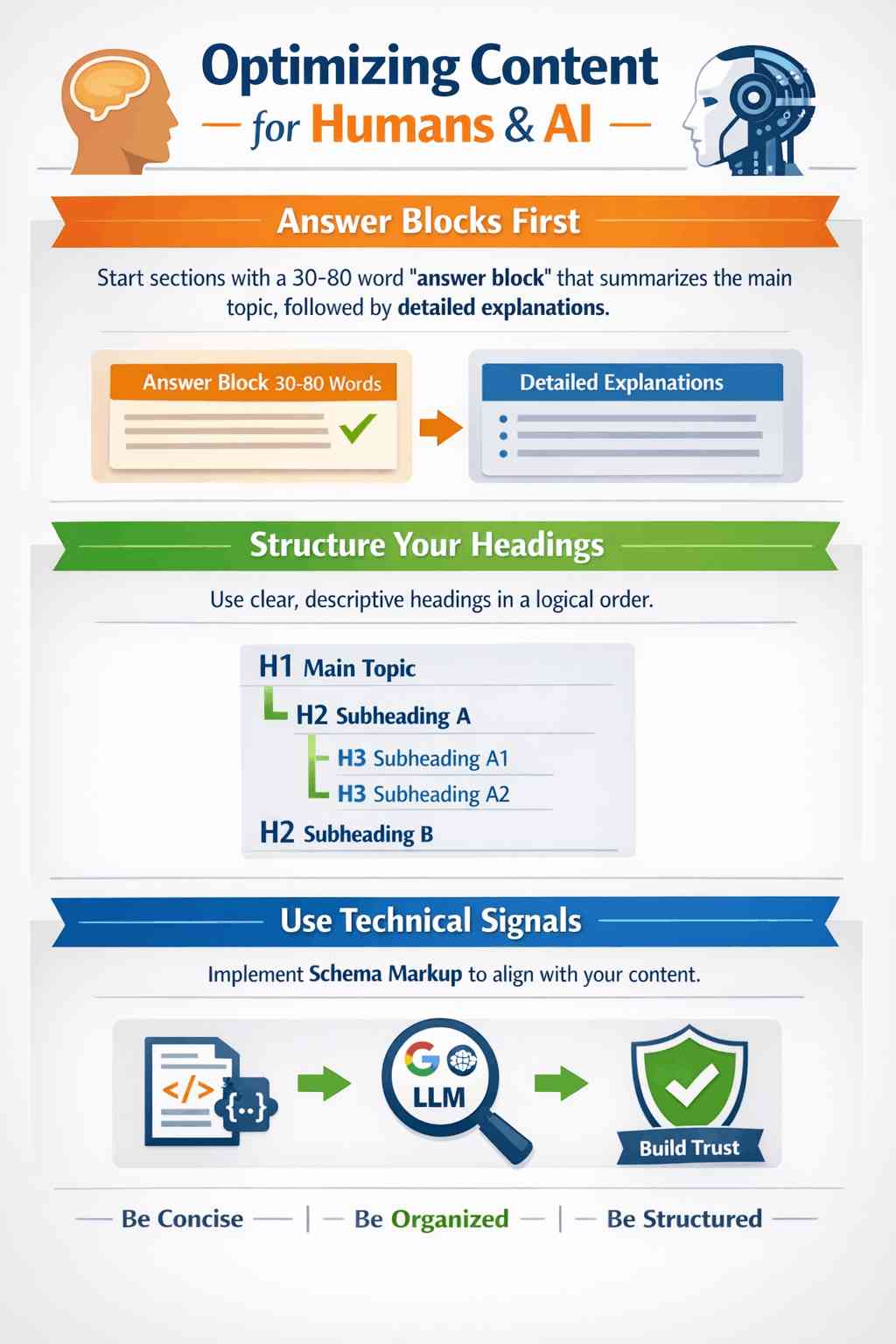
- Heading hierarchy
- lists
- tables
- structured data markup
- FAQs
Structured content improves readability for both users and AI systems.
AI Search Content Optimization Checklist
|
Optimization Factor |
Why It Matters |
|
Clear headings |
Helps AI understand content structure |
|
Entity-based SEO |
Improves topic understanding |
|
Structured data |
Helps search engines interpret content |
|
Direct answers |
Improves chances of AI citations |
|
Internal linking |
Builds topical authority |
|
Updated content |
Signals freshness and relevance |
Content Structure for AI Optimization
Organizing content in a structured format improves readability and helps AI systems understand key points.
A recommended structure includes:
- A clear headline
- A concise introduction
- Organized headings and sections
- Supporting examples or data
- Tables where relevant
- Frequently asked questions
- Reliable references
This structure increases the likelihood that content will be used in AI-generated answers.
Use Entity-Based SEO
AI search engines rely heavily on entities, which are clearly identifiable concepts such as people, organizations, places, or topics.
Entity optimization involves:
- Mentioning recognized entities
- Providing clear definitions
- Connecting related topics
- Using semantic relationships
Instead of focusing only on keywords, content should focus on topics and relationships between concepts.
Optimize for Conversational Queries
AI search systems frequently process natural language questions.
Users often search using complete questions like the following:
- How does AI search work?
- What is AI search optimization?
- How can I optimize content for generative search?
Content should include natural question formats and conversational explanations.
Create Answer-Focused Content
AI search systems prioritize content that provides clear and direct answers to user questions. Instead of long, unclear explanations, each section of your content should address a specific question and provide a concise answer.
When content is structured in a question-and-answer format, it becomes easier for AI systems to extract key information and include it in generated responses.
One effective approach is to include short answer blocks within your content.
Example:
Question: How does AI search work?
Answer: AI search works by analyzing user intent, retrieving relevant information from indexed sources, and generating responses using large language models and natural language processing technologies.
Using this structured approach improves clarity and increases the likelihood that AI systems will reference your content in summaries or answers.
Use Data, Statistics, and Examples
AI systems often prioritize content that includes:
- Statistics
- Case studies
- Research data
- Examples
Data improves credibility and helps AI models identify reliable information.
Implement Structured Data
Structured data helps search engines understand webpage content.
Common structured data formats include:
- FAQ schema
- Article schema
- Organization schema
- Product schema
- How-to schema
These signals help AI systems interpret content more accurately.
Optimize Existing Content for AI Search
Many websites already have valuable content that can be improved for AI search.
Updating existing content is often more efficient than creating new pages.
Key steps include:
- Identify high-performing content
- Improve clarity and depth
- Add structured headings
- Include FAQs
- Update outdated information
- Add authoritative references
Refreshing content improves both SEO and AI visibility.
Content Signals AI Systems Evaluate
AI systems evaluate several signals when selecting content.
|
Signal |
Importance |
|
Content clarity |
High |
|
Topic depth |
High |
|
Author authority |
High |
|
Structured information |
High |
|
Website reputation |
High |
|
Updated information |
Medium |
|
Internal linking |
Medium |
Providing strong signals increases the likelihood of AI referencing your content.
Technical SEO for AI Search
Technical optimization remains important for AI visibility.
Key technical factors include:
- Fast page speed
- Mobile optimization
- Secure HTTPS websites
- Clean site architecture
- Structured data implementation
- XML sitemaps
- Proper indexing
These elements ensure search engines can efficiently access and analyze content.
Optimize Content for AI Summaries
AI systems frequently summarize content from multiple sources.
Content that performs well in AI summaries typically:
- Uses concise explanations
- Includes structured lists
- Provides clear definitions
- Organizes information logically
Well-structured summaries increase the likelihood of AI citation.
Build Topical Authority
Topical authority refers to covering an entire subject comprehensively. AI systems prefer websites that demonstrate expertise across related topics.
For example, a site covering AI search optimization might include content about:
- AI search engines
- Semantic SEO
- Structured data
- Generative search
- Conversational search
- AI ranking signals
This interconnected content strengthens authority.
Optimize Internal Linking
Internal linking helps AI systems understand relationships between topics.
Effective strategies include:
- Linking related articles
- Creating topic clusters
- Using descriptive anchor text
- Connecting supporting content to pillar pages
These links help establish topical expertise
Improve Content Readability
Readable content benefits both users and AI systems.
Best practices include:
- Short paragraphs
- Clear headings
- Simple language
- Logical flow
- Bullet points when necessary
Readable content improves comprehension and engagement.
Monitor AI Search Performance
Tracking performance helps evaluate optimization efforts.
Important metrics include:
- Organic traffic
- AI answer citations
- featured snippets
- search impressions
- engagement metrics
Continuous monitoring helps refine strategies.
Future of AI Search Optimization
AI search will continue evolving as models become more advanced.
Future trends may include:
- deeper conversational search
- personalized AI search results
- multimodal search (text, voice, images)
- stronger emphasis on trusted sources
- greater integration with knowledge graphs
Content strategies must remain adaptable to these changes.
Key Takeaways
- AI search focuses on intent and context instead of keywords.
- Content must be structured, authoritative, and clear.
- Using entities, structured data, and answer-focused content improves visibility.
- Websites should build topical authority across related subjects.
- Regularly updating content helps maintain AI search visibility.
Conclusion
AI search is reshaping how information is discovered online. Instead of simply ranking webpages, modern AI systems analyze content, extract key insights, and generate direct answers for users.
To remain visible in this evolving search landscape, websites must focus on high-quality, structured, and authoritative content that clearly addresses user intent.
By prioritizing clarity, expertise, structured information, and topic depth, content creators can improve their chances of being included in AI-generated answers and maintain strong visibility in the future of search.
Frequently Asked Questions
1. What is AI search optimization?
AI search optimization is the process of creating structured, authoritative, and context-rich content so artificial intelligence search systems can easily understand and include it in generated answers.
2. How is AI search different from traditional SEO?
Traditional SEO focuses on keyword rankings and links, while AI search focuses on context, user intent, content authority, and structured information to generate direct answers.
3. Why is structured content important for AI search?
Structured content helps AI systems identify key information quickly. Headings, tables, FAQs, and clear sections make it easier for AI models to extract useful answers.
4. How can existing content be optimized for AI search?
Existing content can be optimized by improving clarity, adding structured headings, updating information, including FAQs, and strengthening topical authority with internal links.
5. What type of content performs best in AI search results?
Content that is clear, authoritative, well-structured, and directly answers user questions performs best because AI systems prefer reliable and easy-to-interpret information.
6. Can AI search replace traditional search engines?
AI search is changing how information is delivered, but traditional search engines still play an important role. Most modern search platforms now combine AI-generated answers with traditional search results.