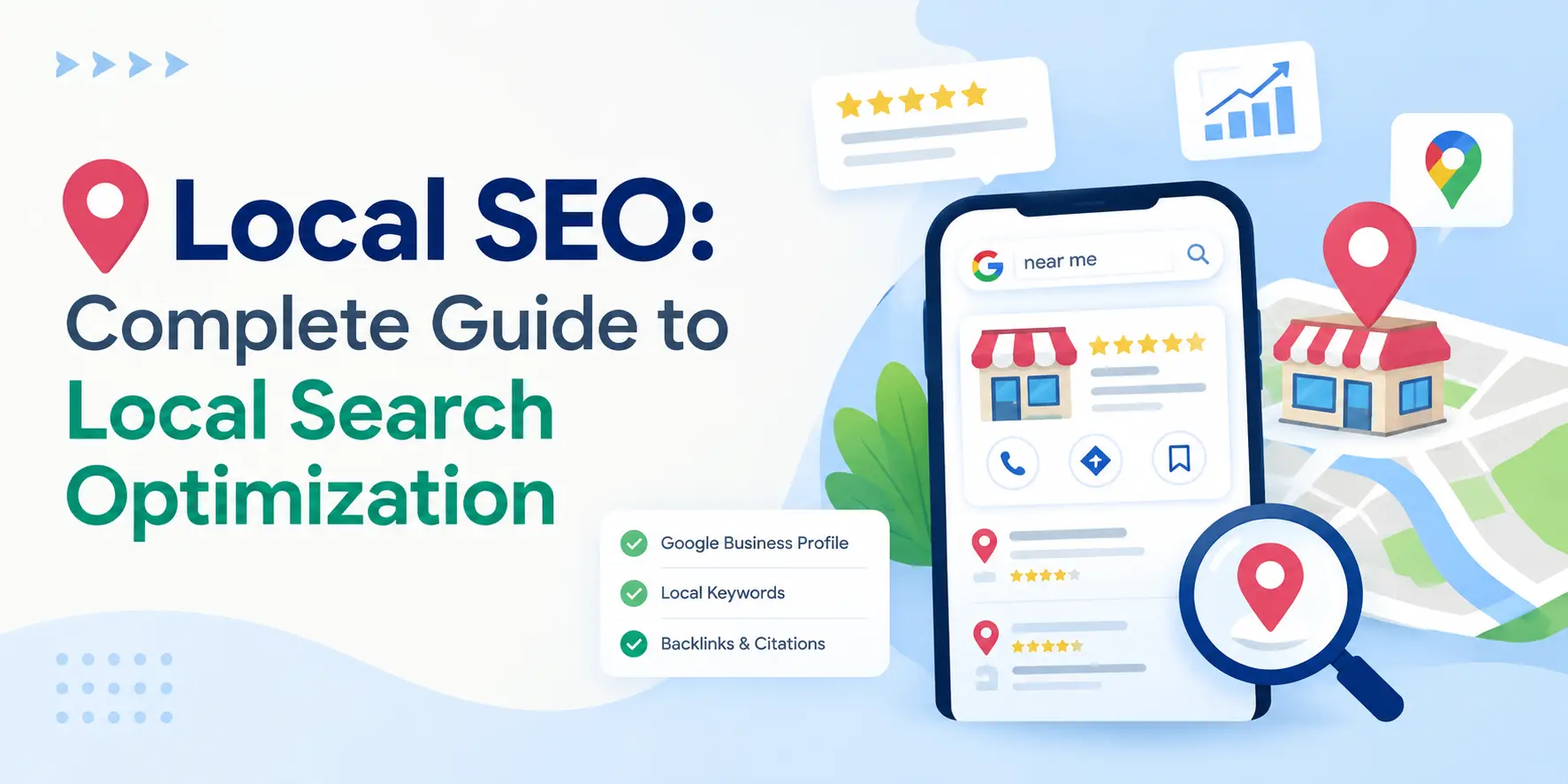

Local SEO is the practice of optimizing your online presence to attract customers who search for products or services in a specific location. It has become an important part of search visibility because 46% of Google searches have local intent, meaning a large share of searches are connected to a specific place or nearby business. Local searches can also lead to quick offline actions. One widely cited consumer study found that 76% of people who perform a local search on a smartphone visit a physical business within 24 hours, while 28% make a purchase. For businesses that depend on local customers, local SEO is not just about increasing website traffic. It helps people find your business, contact you, visit your location, or make a purchase when they are actively looking for what you offer.
What Is Local SEO?
Local SEO is a branch of search engine optimization focused on improving a business's visibility for searches connected to a particular geographic area. It is especially useful for businesses that serve customers in a specific city, neighborhood, region, or service area. Physical stores, restaurants, doctors, lawyers, contractors, agencies, and other local providers can use local SEO to reach people who are actively looking for their products or services.

Local search optimization includes improving your Google Business Profile, creating useful location-based website content, maintaining accurate business listings, using relevant local SEO keywords, earning links from relevant websites, and managing customer reviews. The goal is not simply to rank for a city name. It is to provide accurate and useful information that helps both search engines and customers understand what your business offers and where it operates.
Why Is Local SEO Important?
Local SEO is important because customers often use search engines when they are ready to find a nearby business. In one consumer benchmark, 84% of consumers said they had searched online for a local business in the previous three months, while 98% had used the internet to find information about a local business. This makes visibility across Google Search, Google Maps, and other local platforms particularly important.

Local SEO can help businesses:
- Increase visibility for relevant local searches.
- Attract nearby customers who are actively looking for a service or product.
- Generate phone calls, website visits, direction requests, and inquiries.
- Increase visits to physical locations.
- Build trust through accurate business information and genuine reviews.
Local search also has a strong connection with offline behavior. The previously mentioned 76% same-day visit statistic shows why local search can be valuable for businesses that depend on physical visits, while the 28% purchase figure indicates that some local searches can lead directly to commercial action. These figures come from specific consumer research rather than a universal rule, so actual results can vary by industry, location, and search intent.
Local SEO Ranking Factors
Google says local search results are mainly based on three factors: relevance, distance, and prominence. These factors work together to help Google determine which businesses are useful for a particular local search. No single factor guarantees a specific ranking because local results can vary depending on the search query, searcher's location, and other signals.
Relevance
Relevance refers to how closely a business matches what a person is searching for. For example, someone searching for "emergency plumber" is more likely to see businesses that clearly provide emergency plumbing services. Accurate business categories, services, website content, and complete business information help Google understand what your business does. Your information should describe your actual services rather than being filled with unrelated keywords.
Distance
Distance refers to how far a business is from the location associated with a search. If someone searches for a specific location, Google can use that location when determining which businesses are relevant. If the search does not include a location, Google may use information about where the search is coming from. This is why the same local search can produce different results for people searching from different areas.
Prominence
Prominence refers to how well-known a business is. Google can consider information from across the web when determining local prominence, and factors such as reviews and links can contribute to this signal. A business with a strong reputation, relevant website mentions, genuine customer reviews, and an established online presence may have more local authority than a business with very little information available online.
Google Business Profile Optimization
Your Google Business Profile is a central part of local SEO because it allows eligible businesses to manage important information that appears on Google Search and Maps. A complete and accurate profile gives potential customers information such as your business name, category, address or service area, phone number, website, hours, services, photos, and reviews. The goal is not to fill the profile with keywords, but to make the information complete, accurate, and useful.
1. Claim and Verify Your Google Business Profile
Search for your business on Google Search or Google Maps to check whether a profile already exists. If you find an existing profile, follow Google's process to claim it. If your business does not have a profile, you can create one through Google Business Profile. Google determines which verification methods are available for each business, so the options can vary. Complete the verification process provided by Google before making further changes to the profile.
2. Optimize Business Information
Fill out the important sections of your profile with accurate information about your business. Your business name should reflect the real-world name customers know you by, while your address, phone number, website, services, and business description should all be correct. Keep important business information consistent across your website and major directories, but do not add extra keywords to your official business name simply to improve rankings.
3. Manage Categories and Business Hours
Choose the most accurate primary category for your business because it helps Google understand what your business primarily does. Add secondary categories only when they accurately describe additional aspects of your business. Your opening hours should also be kept current, including special hours when your schedule changes for holidays or other events. Incorrect hours can frustrate customers and may cause them to visit when your business is closed.
4. Add Photos and Respond to Reviews
Use genuine, high-quality photos that show customers what they can expect from your business. Depending on the business, these can include your storefront, interior, products, team, facilities, or completed work. Reviews should also be treated as part of your customer service process. Encourage genuine feedback, thank customers who leave positive reviews, and respond professionally when someone raises a concern. Avoid arguing with customers or trying to manipulate reviews.
On-Page Local SEO
Your website needs to make your business, services, and service locations clear to both users and search engines. Local on-page SEO includes optimizing important page elements, creating useful location pages, and adding structured data where appropriate. The most important principle is to make the content useful first instead of repeatedly adding city names or local keywords simply for SEO.
1. Optimize Title Tags, Meta Descriptions, and Headings
Include the main service and relevant location in your title when it accurately describes the page. For example, a page targeting a specific service could use a title such as "Emergency Plumbing Services in Austin | ABC Plumbing." Keep titles natural rather than filling them with multiple variations of the same keyword. Your meta description should clearly explain what the page offers and can include a relevant location and call to action. Use one clear H1 for the main topic and organize supporting information with H2 and H3 headings. Local terms such as neighborhoods, cities, regions, or landmarks can be included naturally when they help explain the business or service area.
2. Create Location Pages
Location pages can help businesses that genuinely serve multiple cities, neighborhoods, or regions. Each page should provide useful information about that specific area rather than simply replacing the city name in an identical template. A good location page can include the services offered there, local contact information, customer reviews, relevant projects, directions, and information about the area served. If your business has multiple physical branches, each branch can have its own useful page. Avoid creating dozens of nearly identical location pages simply to target different cities because they provide little value to users.
3. Add Local Business Schema Markup
LocalBusiness structured data helps search engines understand important information about a local business, including its name, address, phone number, business type, and other supported details. You can implement this structured data using JSON-LD and select the most specific LocalBusiness type that accurately represents your business. The information in the markup should match the information presented on your website. Structured data can help search engines interpret your business information, but adding it does not guarantee that Google will show a particular rich result.
Local Citations and Directory Listings
Local citations are online mentions of your business information, often including your business name, address, and phone number. They can appear on business directories, map platforms, industry websites, local organizations, and other websites. Accurate citations help customers find the correct business and provide search engines with consistent information about the business.
1. Maintain Consistent Business Information
Your business name, address, and phone number should be accurate across important online platforms. If your business moves, changes its phone number, or changes other important details, update your major listings. Pay attention to duplicate profiles and outdated information because customers may otherwise find conflicting details. Exact formatting differences such as "Street" and "St." are less important than ensuring the information accurately represents the same real-world business.
2. Submit to Relevant Business Directories
Focus on directories that are relevant to your customers, industry, and location rather than submitting your information to every directory available. Depending on your market, these may include Yelp, Apple Maps, Bing Places, YellowPages, industry-specific directories, local business associations, and Chamber of Commerce websites. Established data providers such as Data Axle, Neustar Localeze, and Foursquare may also be relevant in markets where these services operate. Quality and relevance are more useful than simply increasing the number of citations.
3. Audit and Update Local Citations
Regular citation audits help you find outdated information, duplicate profiles, and missing listings. Search for your business name, phone number, and address on major directories and industry platforms. Correct inaccurate information, claim important profiles, and resolve duplicate listings where possible. Repeat the process after a business relocation, name change, phone number change, or other major update so customers and search engines continue to receive accurate information.
Local SEO Keywords
Local SEO keywords connect your services or products with the geographic areas you serve. Instead of choosing keywords simply because they contain a city name, focus on the terms your actual customers use when looking for your business. Keyword research should consider the service, location, search intent, and language customers naturally use.
1. Location-Based Keywords
Location-based keywords include geographic terms such as cities, neighborhoods, counties, and regions. Examples include "plumber in Austin," "Seattle accountant," "Brooklyn Heights coffee shop," and "Bay Area IT services." Use these terms naturally on relevant pages where they accurately describe your service area. There is no need to repeat the same location keyword throughout a page.
2. “Near Me” Keywords
Searches containing "near me" show strong local intent, such as "emergency dentist near me" or "best restaurant near me." You do not need to repeatedly place the phrase "near me" throughout your website. Search engines can use the searcher's location and other signals to understand local intent. Instead, make sure your Business Profile, website, contact information, service areas, and location details are accurate and complete.
3. Service and Location Keywords
Service and location keywords combine what you offer with where you offer it, such as "roof repair Denver" or "hail damage roof restoration Denver." These can be useful for high-intent searches because they describe both the customer's need and the relevant location. If your business offers several important services across different areas, dedicated service-location pages can be useful when each page contains genuinely unique and helpful information.
Local Link Building
Local link building is the process of earning links from relevant websites in your community, industry, or service area. A link from a local publication, community organization, business association, supplier, event website, or complementary business can provide useful context about your business and help people find your website.
Some practical opportunities include:
- Sponsoring relevant community events or local organizations.
- Contributing useful information or expert commentary to local publications.
- Building relationships with complementary, non-competing businesses.
- Participating in legitimate local business associations.
- Creating original local research, guides, or resources that other websites may reference.
The important point is that the link should make sense for both websites and provide value to the people who see it.
Reviews and Reputation Management
Reviews are important because they can influence customer decisions and contribute to local prominence. Google says review information is one of the signals that can contribute to local prominence, although reviews are only one part of local ranking. Consumer research also shows how commonly people use reviews when evaluating local businesses. One benchmark found that 81% of consumers used Google as their primary platform for reading and researching reviews, while 37% expected a business to have at least a four-star rating before considering it. These figures come from consumer research and should not be treated as a universal rule for every industry or market.
A practical review strategy includes:
- Asking genuine customers for honest feedback.
- Making it easy for customers to access your review page.
- Responding professionally to both positive and negative reviews.
- Addressing legitimate complaints rather than ignoring them.
- Monitoring important industry-specific review platforms.
- Never buying, creating, or manipulating reviews.
Depending on the industry, customers may use platforms such as Houzz, Avvo, TripAdvisor, OpenTable, or other specialist websites in addition to Google.
Local SEO for Different Types of Businesses
The right local SEO approach depends on how customers interact with your business. A physical store needs to make its location easy to find, while a service-area business needs to clearly communicate the areas it serves. Businesses with multiple branches need accurate information for each location without creating duplicate or low-value pages.
1. Local SEO for Physical Stores
Physical stores depend on customers being able to find and visit a specific location, so accurate address information, opening hours, phone numbers, directions, and store details are particularly important. Retail businesses that meet Google's eligibility requirements may also be able to show local product availability through Google's local inventory features.
Adding appropriate LocalBusiness structured data to your website can help search engines understand information about your store. Your contact or location page should also make practical information easy to find, including directions, parking details, and nearby landmarks when useful.
2. Local SEO for Service-Area Businesses
Service-area businesses such as plumbers, cleaners, electricians, and landscapers travel to customers rather than serving them at a public storefront. If customers do not visit your business address, Google allows eligible service-area businesses to hide their address and specify the areas they serve.
Your website can also include useful pages for major cities or regions you genuinely serve. These pages can include relevant projects, services, customer experiences, and information about the local service area. Do not create fake offices or use virtual locations simply to appear in additional areas.
3. Local SEO for Multiple Locations
Businesses with several branches should optimize each legitimate location individually. Instead of placing every address on one generic page, create useful location pages when appropriate, with each page containing the branch's address, phone number, hours, services, photos, reviews, and other relevant information.
Each eligible physical location can also have its own Google Business Profile. Avoid copying the same content across every location page with only the city name changed. Unique information about each branch makes the pages more useful and gives customers a clearer picture of the location they are considering.
How to Measure Local SEO Performance
Measuring local SEO involves more than checking where your business ranks for one keyword. A business can rank well but still receive few calls, visits, or leads. Track visibility, website activity, and customer actions together to understand whether your local SEO efforts are actually contributing to business growth.
Important metrics include:
- Google Business Profile actions: Track calls, website visits, direction requests, and other available interactions to see how people engage with your business listing.
- Local keyword rankings: Monitor important keywords from different locations because local rankings can vary depending on where the search is performed.
- Organic traffic: Check traffic to service pages, location pages, and other locally relevant pages to see whether more people are reaching your website through search.
- Search impressions and clicks: Use Google Search Console to see how often your pages appear in search results, which local queries generate impressions, and which searches bring visitors to your website.
- Calls and inquiries: Track phone calls, contact form submissions, quote requests, and other inquiries generated through local search.
- Bookings and purchases: For businesses that accept appointments, reservations, or online orders, measure how many customers complete these actions after finding the business through search.
- Leads and customers: Connect your SEO data with actual leads and customers whenever possible. This helps you understand whether increased visibility is bringing relevant prospects rather than just more website traffic.
The most useful local SEO measurement connects search visibility with real business results. A higher ranking is valuable when it brings relevant visitors, inquiries, bookings, store visits, or sales. Review these metrics regularly to identify which local SEO activities are generating results and where further improvements are needed.
Common Local SEO Mistakes
Several mistakes can weaken your local SEO performance even when your website and Google Business Profile are otherwise well optimized. Avoiding these issues helps keep your business information accurate, your pages useful, and your local presence trustworthy.
- Creating duplicate listings: Creating multiple Google Business Profiles for the same location can confuse customers and violate Google's guidelines. If a profile already exists, claim and verify it instead of creating another one. For businesses with multiple locations, create separate profiles only when each location is eligible.
- Using a P.O. Box or unsuitable virtual address: Do not use a P.O. Box, remote mailbox, or similar address as your Google Business Profile location. Your listed location should meet Google's eligibility requirements. If customers do not visit your business address, an eligible service-area business can hide its address and specify the areas it serves.
- Ignoring negative reviews: Leaving negative reviews unanswered can make potential customers question how your business handles complaints. Respond calmly, acknowledge the customer's concern, and provide a helpful way to resolve the issue when appropriate. Never use fake reviews or offer incentives in exchange for positive reviews.
- Adding keywords to the business name: Your Google Business Profile name should match your real-world business name. Adding keywords such as "Best Affordable Plumber Austin" to "Joe's Plumbing" just to improve rankings can violate Google's guidelines. Use relevant keywords in appropriate areas such as your website content, services, and business description instead.
- Creating thin location pages: Creating separate pages for every city and changing only the location name provides little value to users. A useful location page should contain information specific to that area, such as services available, local projects, customer reviews, directions, or details about the location. Only create location pages for areas your business genuinely serves.
- Overusing local keywords: Repeating city names, neighborhoods, or phrases such as "near me" throughout your content can make it difficult to read and may look like keyword stuffing. Mention locations naturally where they help explain your services, service area, or business location. Focus on answering the customer's question rather than repeating keywords.
Conclusion
Local SEO helps businesses connect with customers who are searching for products and services in specific areas. With 46% of Google searches reported to have local intent, businesses that serve a defined geographic market have a strong reason to pay attention to local search visibility. A strong local SEO strategy starts with accurate business information and a well-maintained Google Business Profile, then extends to useful website content, location pages, local keywords, citations, reviews, relevant links, and ongoing performance measurement. The goal is not to add a location keyword everywhere or create hundreds of directory listings. Instead, make your business information accurate, create genuinely useful local content, build a trustworthy reputation, and make it easy for customers to contact or visit your business.
Need Help With Local SEO?
If managing local SEO alongside your website and other marketing activities is becoming difficult, professional SEO support can help you build a more structured approach.
- Local SEO strategy: Develop a strategy around your services, locations, competitors, and target customers.
- On-page optimization: Improve service pages, location pages, titles, headings, internal links, and other important website elements.
- Local search optimization: Strengthen your presence across Google, relevant directories, local content, and other important search channels.
- Performance tracking: Monitor rankings, organic traffic, leads, and other meaningful SEO metrics.
For businesses looking for professional SEO support, TechAtom can help develop and implement practical SEO strategies focused on improving search visibility and attracting relevant customers.
Frequently Asked Questions
1. How Does Local SEO Work?
Local SEO helps your business appear in relevant searches based on your services and location. Google mainly considers relevance, distance, and prominence.
2. How Do I Rank My Business on Google Maps?
Claim and verify your Google Business Profile, keep your information accurate, choose the right category, add photos, and collect genuine reviews.
3. How Many Google Reviews Do I Need for Local SEO?
There is no fixed number. Focus on getting genuine reviews regularly and responding to customer feedback professionally.
4. Does Local SEO Work Without a Physical Location?
Yes. Eligible service-area businesses can use local SEO by listing the areas they serve without showing their business address.
5. How Much Does Local SEO Cost?
The cost depends on your business size, location, competition, website, and SEO requirements. There is no fixed price for local SEO.
People are also Reading