
Management is the foundation of every successful organization. Whether a company is small or large, proper management helps achieve goals, use resources wisely, and keep teams moving in the right direction. This is where the four functions of management become important.
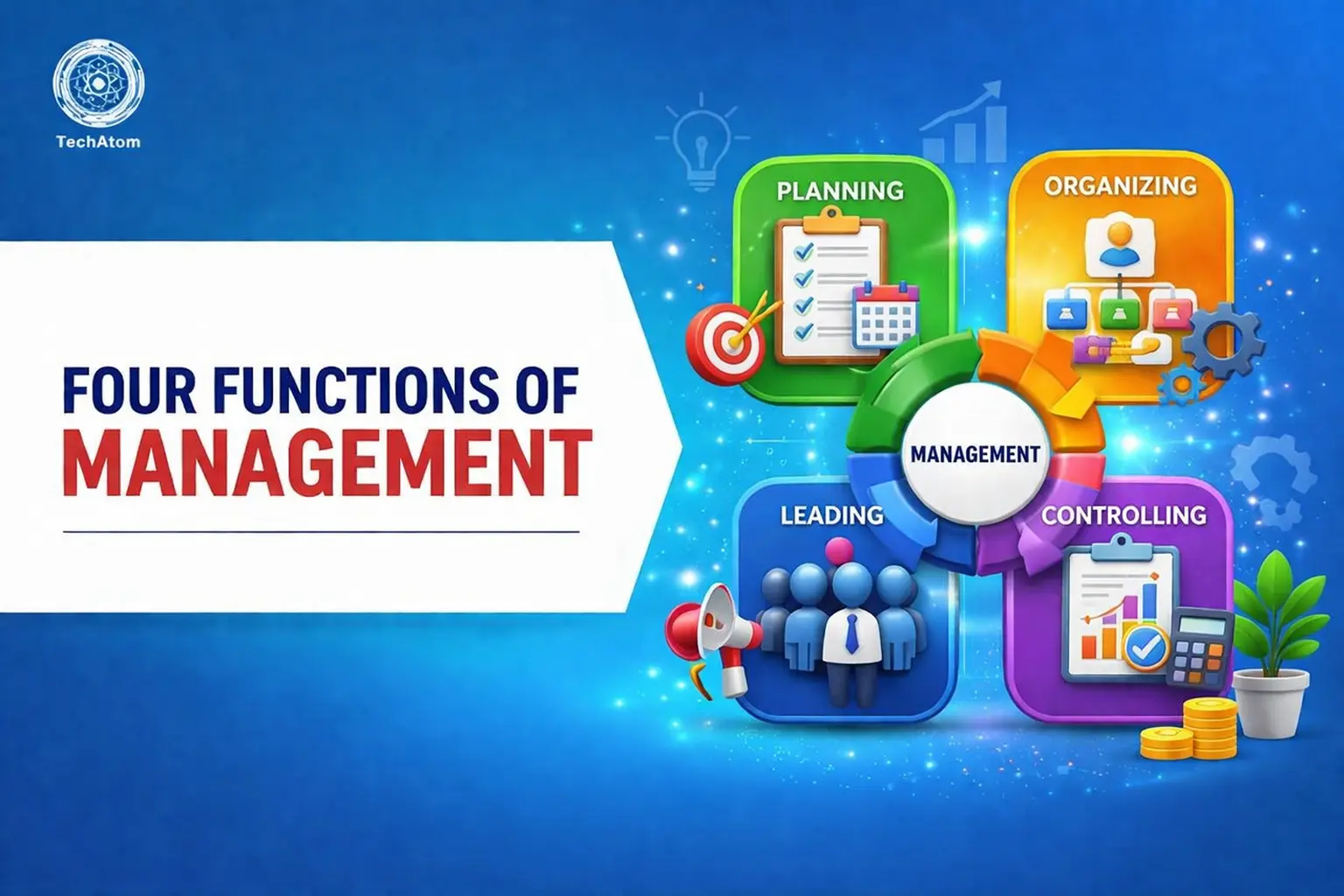
The four functions of management are planning, organizing, leading, and controlling. These are the core responsibilities of every manager. They help managers make decisions, assign work, guide employees, monitor performance, and improve results over time.
Together, these functions form a continuous management process. Managers first set goals, then arrange resources, guide people through execution, and finally measure results to make improvements where needed. Understanding this process is essential for students, business owners, team leaders, and professionals who want to improve organizational performance.
What Are the Four Functions of Management?
The four functions of management are the main activities managers perform to achieve organizational goals:
- Planning – deciding what needs to be done and how to do it
- Organizing – arranging people, resources, and tasks in a structured way
- Leading – motivating, guiding, and directing employees
- Controlling – tracking performance and taking corrective action when necessary
These functions are closely connected. Planning creates direction, organizing builds structure, leading drives action, and controlling checks whether goals are being achieved. Since organizations constantly adapt to changes, managers use these functions again and again as part of an ongoing cycle.
Quick Overview of the Four Functions of Management
|
Function |
Main Purpose |
Key Question |
|
Planning |
Set goals and decide actions |
What should be done? |
|
Organizing |
Arrange people and resources |
Who will do it and how? |
|
Leading |
Guide and motivate employees |
How do we get people to act? |
|
Controlling |
Measure results and correct issues |
Are we meeting the goals? |
How the Four Functions Differ Across Management Levels
The four functions of management are used at every level of an organization, but their scope is different.
Top-level managers focus more on long-term planning, strategic direction, and overall control. Middle-level managers coordinate departments and turn broader goals into practical action plans. First-line managers usually focus more on supervising daily work, guiding employees directly, and ensuring tasks are completed properly.
Why the Four Functions of Management Matter
The four functions of management matter because they provide a clear system for achieving objectives. Without them, businesses may struggle with confusion, poor communication, wasted resources, and weak results.
These functions help managers:
- set realistic goals
- improve decision-making
- allocate resources effectively
- create accountability
- motivate employees
- monitor progress
- solve problems early
- improve productivity
In simple terms, the four functions of management help organizations move from ideas to action.
1. Planning Function of Management
Planning is the first and most important function of management. It involves identifying goals and determining the best course of action to achieve them. Before any work begins, managers need to know what they want to accomplish, when they want to achieve it, and what resources will be required.
Planning gives direction to the organization. It reduces uncertainty and prepares the business for future opportunities and risks. It also helps managers align short-term actions with long-term goals.
Key Elements of Planning
A good planning process usually includes:
- setting organizational goals
- identifying tasks needed to reach those goals
- evaluating available resources
- forecasting future challenges and opportunities
- creating strategies and timelines
- developing backup or contingency plans
- balancing employee workload across projects
- estimating team capacity before assigning tasks
- matching the right people to the right responsibilities
Types of Planning
Managers use different types of planning depending on the situation:
Strategic Planning
This focuses on the long-term direction of the organization and is usually handled by top-level management.
Tactical Planning
This turns broader business goals into department-level action plans and is often handled by middle managers.
Operational Planning
This focuses on day-to-day activities and is usually carried out by supervisors or department managers.
Contingency Planning
This prepares the organization for risks, disruptions, or unexpected situations.
Common Tools Used in Planning
Managers often use practical tools to make planning more effective. These may include project schedules, Gantt charts, RACI charts, workflow maps, meeting calendars, and task timelines. These tools help define responsibilities, track deadlines, and improve coordination.
Example of Planning
Imagine a company wants to increase online sales by 20% in one year. The manager may create a plan that includes improving the website, increasing digital marketing, launching promotional campaigns, and training the sales team. This is planning because it defines a goal and outlines how to achieve it.
Importance of Planning
Planning is important because it:
- gives clear direction
- supports better decisions
- reduces uncertainty
- prepares teams for change
- improves coordination
- helps use time and money wisely
Without planning, employees may work hard but move in different directions.
2. Organizing Function of Management
Once a plan is created, the next step is organizing. Organizing means arranging resources and tasks so the plan can be carried out effectively. It involves deciding who will do what, what tools will be used, how teams will be structured, and how authority will flow within the organization.
Organizing turns plans into a workable structure. It helps managers assign responsibilities, establish reporting relationships, and make sure resources are available where needed. As organizations grow, organizing becomes even more important because teams, roles, and processes become more complex.
Key Elements of Organizing
Organizing usually includes:
- dividing work into tasks
- assigning responsibilities
- grouping activities into departments or teams
- delegating authority
- allocating resources
- establishing reporting relationships
- determining staffing needs
- adjusting team structures as the organization grows
- coordinating relationships between departments
Main Objectives of Organizing
The purpose of organizing is to make sure that:
- work is distributed properly
- employees understand their roles
- resources are available where needed
- communication flows smoothly
- duplication and confusion are reduced
It also helps define hierarchy, authority, and coordination across teams so work moves efficiently.
Example of Organizing
Suppose a manager has planned a product launch. To organize the work, the manager may assign the marketing team to promotions, the design team to packaging, the finance team to budgeting, and the sales team to customer outreach. The manager may also set deadlines and reporting structures. This is organizing.
Importance of Organizing
Organizing is important because it:
- creates structure
- improves efficiency
- prevents overlapping duties
- clarifies roles and authority
- helps teams collaborate better
- ensures proper use of resources
A plan may be excellent, but without organizing, it becomes difficult to execute.
3. Leading Function of Management
Leading is the function in which managers guide, motivate, influence, and supervise employees so that organizational goals can be achieved. Even the best plan and structure will not succeed if people are not properly directed or motivated.
Leading is often called the human side of management. It includes communication, motivation, teamwork, conflict resolution, leadership style, and decision-making. A good manager does not simply give instructions. They also build trust, encourage performance, and create a positive work environment.
Key Activities in Leading
Leading involves:
- communicating goals clearly
- motivating employees
- providing guidance and support
- resolving conflicts
- building teamwork
- making decisions
- encouraging accountability
- maintaining morale
Depending on the situation, leading may involve coaching, supporting, directing, or empowering employees.
Situational Approaches to Leading
Managers often adjust their leadership approach based on the team and the situation.
Directing
The manager gives clear instructions and closely supervises work. This approach is useful when employees are new or working on unfamiliar tasks.
Coaching
The manager provides guidance, feedback, and encouragement while staying involved in decision-making. This works well when employees are developing their skills.
Supporting
The manager encourages employees, helps solve problems, and gives them more confidence and independence.
Delegating
The manager gives employees greater responsibility and freedom to complete work with minimal supervision. This works best with experienced and reliable team members.
Example of Leading
A manager notices that employees are missing deadlines because they feel overwhelmed. Instead of only giving orders, the manager meets with the team, listens to their concerns, adjusts workloads, offers support, and motivates them with clearer goals. This is leading.
Importance of Leading
Leading is important because it:
- boosts employee motivation
- improves team performance
- strengthens communication
- builds trust and cooperation
- encourages innovation
- increases job satisfaction
A manager who leads well can turn average performance into strong results.
4. Controlling Function of Management
Controlling is the process of measuring actual performance, comparing it with planned goals, and correcting any differences. This function helps managers ensure that work is progressing as expected.
Controlling does not simply mean watching employees. It means checking whether strategies, processes, and outcomes are aligned with objectives. When results fall short, managers take corrective action to improve performance.
Steps in the Controlling Process
The controlling function generally includes four main steps:
1. Set performance standards
Managers decide what success should look like.
2. Measure actual performance
They collect data on results, productivity, quality, costs, or timelines.
3. Compare results with standards
They identify any gap between expected and actual performance.
4. Take corrective action
They fix problems, adjust plans, retrain staff, or improve processes.
Example of Controlling
A company sets a goal of delivering all customer orders within three days. After reviewing performance reports, the manager finds that many deliveries are taking five days. The manager investigates the problem, identifies delays in warehouse processing, and introduces a better workflow to solve the issue. This is controlling.
Importance of Controlling
Controlling is important because it:
- measures progress
- identifies problems early
- improves accountability
- maintains quality standards
- supports better decisions
- helps businesses stay on track
In real organizations, controlling may involve monitoring deadlines, reviewing budgets, tracking staffing levels, checking quality standards, evaluating employee performance, and providing corrective support when needed.
Relationship Between the Four Functions of Management
The four functions of management are closely linked. They are not separate activities that happen once. They form an ongoing cycle.
- Planning decides the goals
- Organizing arranges the work
- Leading moves people toward the goals
- Controlling checks results and improves future performance
Controlling also provides feedback that helps managers revise plans, improve resource allocation, and make better decisions in the next management cycle.
For example, if sales targets are not met, managers may return to planning, revise the strategy, reorganize resources, and guide employees differently. This shows that management is a continuous and dynamic process.
Real-Life Example of the Four Functions of Management
Consider a restaurant manager opening a new branch.
Planning: The manager sets a target opening date, budget, hiring plan, and marketing strategy.
Organizing: The manager hires chefs, servers, and support staff, buys equipment, and assigns job roles.
Leading: The manager trains employees, motivates the team, communicates expectations, and creates a positive work culture.
Controlling: The manager reviews customer feedback, checks daily sales, monitors service quality, and fixes issues quickly.
This example shows how the four functions work together in a real business setting.
Advantages of the Four Functions of Management
When managers apply these functions properly, organizations benefit in many ways:
- better goal achievement
- stronger teamwork
- improved efficiency
- effective resource use
- higher employee engagement
- faster problem-solving
- improved adaptability
- better performance measurement
- continuous improvement
These advantages make the four functions essential in every type of organization, from startups and schools to hospitals and multinational companies.
Challenges Managers Face While Applying These Functions
Although the four functions are simple in theory, applying them effectively can be challenging.
Common challenges include:
- unclear goals during planning
- poor delegation during organizing
- lack of motivation during leading
- weak monitoring systems during controlling
- resistance to change
- communication problems
- limited resources
- fast-changing market conditions
Good managers respond to these challenges by staying flexible, communicating clearly, and improving their approach over time.
Skills Needed to Perform the Four Functions of Management
To perform the four functions successfully, managers need a mix of technical, interpersonal, and decision-making skills.
Important management skills include:
- communication skills
- leadership skills
- problem-solving ability
- decision-making skills
- time management
- strategic thinkin
- delegation skills
- analytical ability
- adaptability
- emotional intelligence
These skills help managers apply each function more effectively in real workplace situations.
Four Functions of Management in Modern Business
In modern workplaces, the four functions of management are still highly relevant. However, the way managers apply them has changed with technology, remote work, automation, data analytics, and globalization.
For example:
- planning now often uses data, forecasting tools, and digital dashboards
- organizing may include remote teams and cross-functional collaboration
- leading requires stronger communication in virtual environments
- controlling often relies on real-time metrics and performance software
In project-based workplaces, managers often combine these functions with project management processes. They plan timelines, organize responsibilities, lead cross-functional teams, and control deadlines and deliverables at the same time.
Difference Between Management Functions and Management Skills
Many people confuse management functions with management skills, but they are not the same.
Management functions are the core responsibilities managers perform, such as planning, organizing, leading, and controlling.
Management skills are the abilities managers use to perform those functions effectively, such as communication, leadership, analysis, and decision-making.
In simple words, management functions are what managers do, while management skills are how they do it well.
Key Takeaways
- planning sets direction
- organizing builds structure
- leading drives action and motivation
- controlling measures results and improves performance
Together, these four functions help managers achieve goals and improve organizational effectiveness.
Conclusion
The four functions of management planning, organizing, leading, and controlling form the backbone of effective management. They help managers set goals, arrange resources, guide employees, and measure results.
These functions are interconnected and create a continuous cycle of improvement. Planning provides direction, organizing creates structure, leading inspires action, and controlling ensures accountability. Together, they help businesses achieve objectives, improve productivity, solve problems, and adapt to change.
Whether you are a student learning management concepts or a professional applying them in the workplace, understanding these four functions is essential. They are not just textbook ideas. They are practical tools that shape the success of real organizations every day.
Frequently Asked Questions
1. What are the four functions of management?
The four functions of management are planning, organizing, leading, and controlling.
2. Why is planning the first function of management?
Planning comes first because managers must decide goals and methods before organizing resources or directing employees.
3. Are the four functions of management still relevant today?
Yes, they are still relevant because all organizations need direction, structure, leadership, and performance monitoring.
4. What is the main purpose of controlling in management?
The main purpose of controlling is to compare actual performance with planned goals and take corrective action when needed.
5. Can one manager perform all four functions?
Yes, most managers perform all four functions, although the level and complexity may vary depending on their role and the size of the organization.
6. Which of the four functions of management is most important?
All four are important because they work together. However, planning is often seen as the starting point because it sets the direction for everything else.
People are also reading: